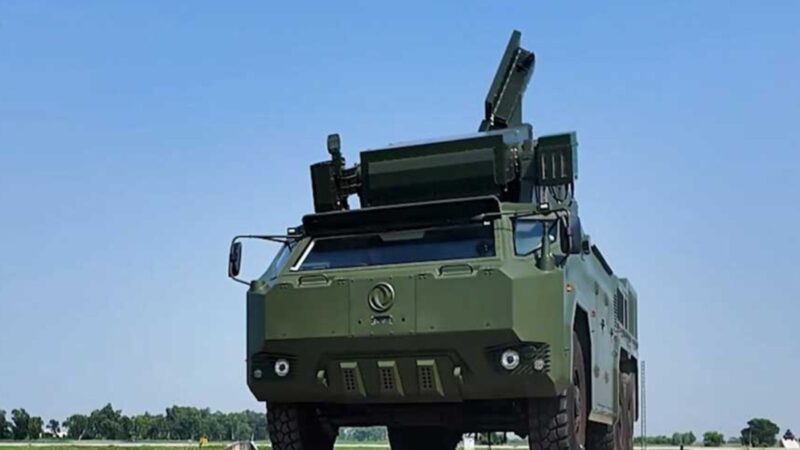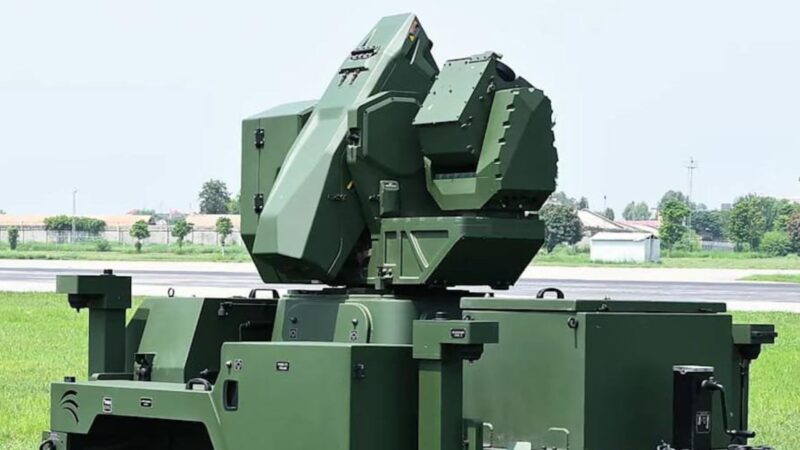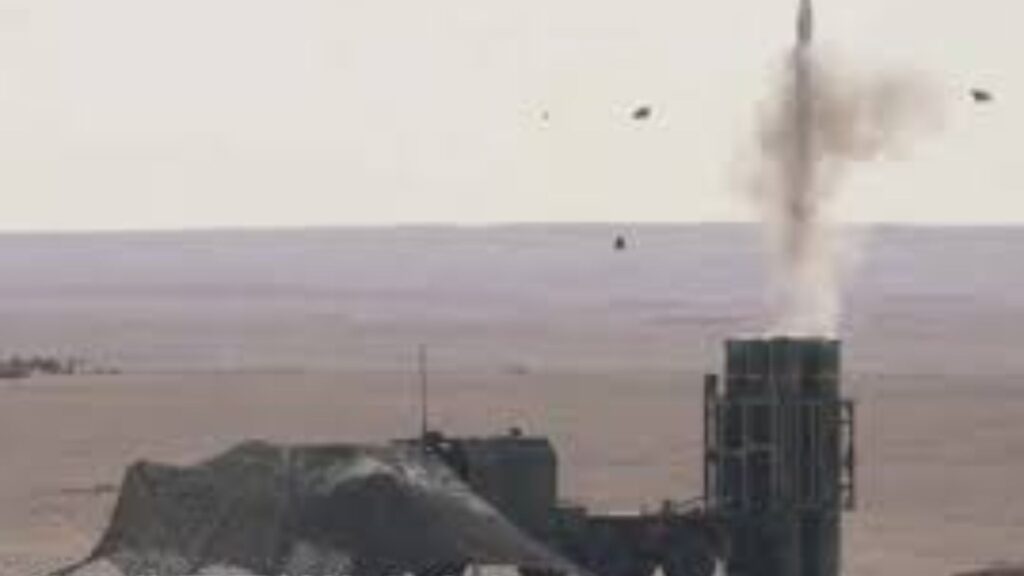
On 05 June 2026, the Chinese People’s Liberation Army (PLA) conducted the first publicly disclosed live-fire trial of the Hong Qi (HQ)-16F surface-to-air missile (SAM), with the state broadcaster CCTV airing footage of an unmanned brigade of the 73rd Group Army firing the system in the Gobi Desert in northwestern China.
The test was conducted over 1,000 km from the unit’s home garrison in Fujian to showcase the HQ-16F’s capacity to operate in demanding terrain and amid electromagnetic interference. The HQ-16F was shown intercepting an airborne target at a range of around 50 km.
While Chinese state media stopped short of naming the system and disclosing its specifications, a close-up of the nameplate during the broadcast read “HQ-16F.” In 2022, China Aerospace and Technology Corporation (CASC) showcased an apparently export-oriented model called the HQ-16FE, which provided a stated range of 160 km and an altitude envelope of 15 m to 27 km.
Interestingly, in 2024, the Pakistan Air Force (PAF) revealed that it would induct the HQ-16FE into its expanding integrated air defence system (IADS), joining the HQ-9BE and FD-2000 long-range SAMs.
Therefore, the recent test of the HQ-16F ties directly into the PAF’s – and potentially, the wider Pakistani military’s – long-term procurement planning of SAM solutions, especially from China.
HQ-16F / HQ-16FE vs Older HQ-16/LY-80 Variants
Compared to the current HQ-16 and LY-80 variants in service with the Pakistan Army (PA) and Pakistan Navy (PN), the standout feature of the HQ-16F/FE is its vastly extended range of 160 km (to the 40-70 km of older variants) and greater altitude scope of 15 m to 27 km. However, the HQ-16F/FE missile itself carries a wide assortment of design improvements compared to its predecessors that, as a whole, position it as a new sub-lineage or family, one geared for the future.
Quwa Pro
See Where Emerging Defence Markets are Moving
Quwa Pro goes beyond tracking programs and equipment by explaining the policies, incentives, industry dynamics, and competitive pressures shaping South Asia's defence markets.