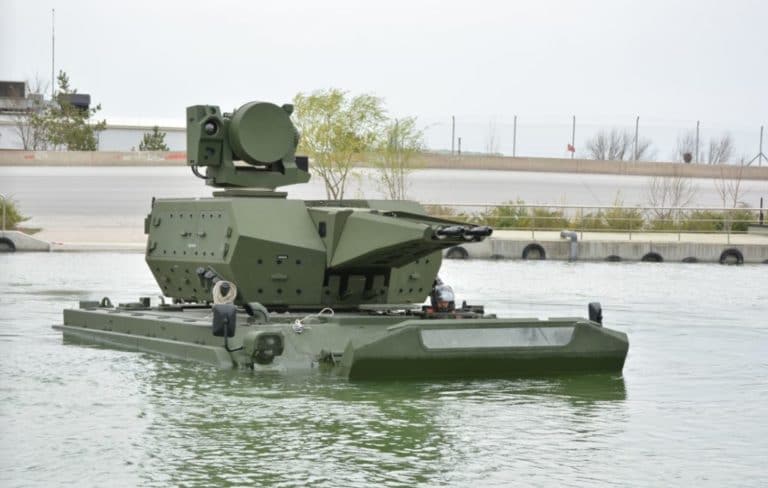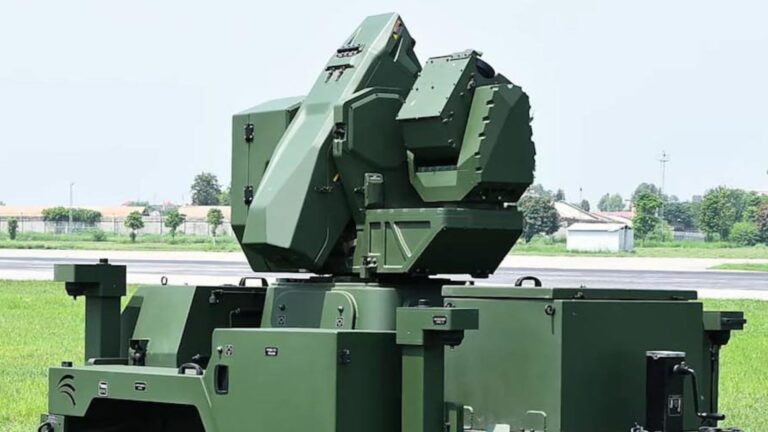

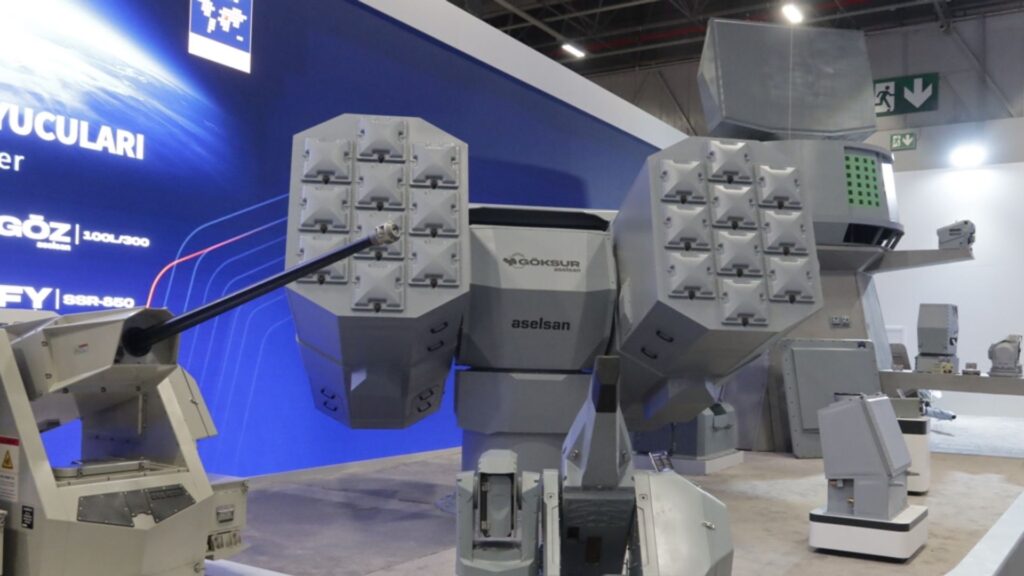
Aselsan chief executive Ahmet Akyol published images on 3 August 2026 showing a GÖKSUR 100-N point defence missile system turret on the production line, released during a visit to an Aselsan production facility by Turkish Coast Guard Commander Rear Admiral Ahmet Kendir. It is the first time the system has been seen as manufactured hardware rather than an exhibition mockup, and Turkish state broadcast coverage framed it as an indigenous replacement for an imported capability.
The configuration shown is the turreted variant without integrated sensors, matching the 20-missile capacity launcher Aselsan unveiled at Euronaval 2024, cueing off the ship’s combat management system rather than its own radar. No serial production contract, delivery schedule or customer was announced alongside the images.
GÖKSUR is a naval point defence missile system built by Aselsan as Türkiye’s equivalent to the American RIM-116 Rolling Airframe Missile and SeaRAM, with the interceptor supplied by TÜBİTAK SAGE. Aselsan states a range of 15 km for the system and cites high effectiveness against sea-skimming anti-ship and cruise missiles.
The round is frequently misidentified, and the distinction is worth stating plainly. GÖKSUR does not fire the Roketsan LEVENT missile. It fires the GÖKSUR IIR, which TÜBİTAK SAGE describes as carrying an infrared seeker head with a next-generation imager, intermediate-stage guidance by data link, and 360-degree threat destruction capability.
The turret derives from Türkiye’s BOZDOĞAN air-defence work, the within-visual-range air-to-air missile developed under the Göktuğ program.
LEVENT is a separate and competing Roketsan program, an IIR-guided missile on an 11-cell launcher unveiled alongside GÖKSUR at IDEF 2023, both presented as Turkish answers to the RAM class. The Turkish Navy has not publicly selected between them. The 11-cell and 21-cell figures that circulate in connection with GÖKSUR belong to LEVENT.
GÖKSUR is also distinct from GÖKDENİZ, which is a gun-based close-in weapon system rather than a missile system, pairing a 35 mm twin-barrel mount firing ATOM airburst ammunition at 1,100 rounds per minute against targets out to 4 km. GÖKDENİZ is in service aboard the Istanbul-class frigates and the Hisar-class offshore patrol vessels, one of which Türkiye delivered to Romania in June 2026 as its first warship export to a NATO and European Union member.
Three GÖKSUR configurations have been shown. Aselsan describes a standalone version fitted with its own radar and electro-optics, a second based on fixed inclined launchers, and a vertical launch version, with a scaled-down launcher option the company characterized as five plus five missiles.
Testing has run through the vertical launch configuration. Aselsan conducted the first launch from a surface platform in February 2025 from the trials corvette TCG Beykoz off Sinop, though no intercept was confirmed for that shot. It followed in early October 2025 with a direct hit on a high-speed sea-skimming target at more than 11 km, billed as a first for an indigenous Turkish missile against that target set, announced by Aselsan with Akyol quoted.
The intended platform set centres on the TF-2000 air defence destroyer, where GÖKSUR appears as a point defence option alongside LEVENT and GÖKDENİZ. Lead ship TCG Kocatepe, first of the Tepe class, began construction at Istanbul Naval Shipyard on 2 January 2025, with eight planned and a 96-cell MİDLAS vertical launching system arrangement. The Ada-class corvettes are the other candidate, since they currently carry the RIM-116 RAM.
That is the constraint driving the program. Türkiye’s layered naval air defence is now indigenous at every level except the point defence missile layer, with SİPER and HİSAR-D RF handling long and medium range through MİDLAS and GÖKDENİZ covering the terminal gun engagement, while the missile layer between them remains American and embargo-exposed. The United States approved 94 RIM-116 rounds worth $90 million for the Turkish Navy in August 2024, an interim purchase that itself indicated the domestic system was not yet ready.
Quwa’s Turkish Market Intelligence reporting has tracked this pattern across Aselsan’s portfolio, including a company effort described as building systems with no foreign off-switch. GÖKSUR applies the same logic to the last imported layer of the naval air defence stack.
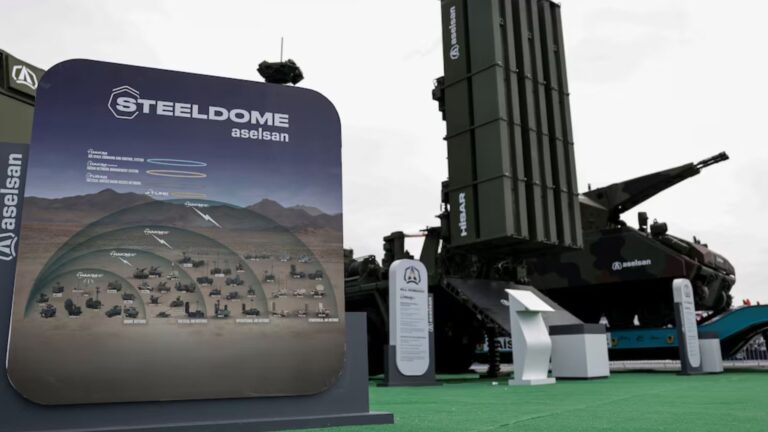
No GÖKSUR-specific serial production contract has been publicly announced, and the system does not appear in either of Aselsan’s two large 2026 air defence awards. The approximately €1.47 billion Steel Dome expansion contract signed in July 2026 covers Hisar-A, Hisar-O, Korkut, Gürz, Sungur, the Siper variants and the HAKİM command and control system, all land-based. Manufacturing has therefore begun without a disclosed series order behind it, which may reflect an undisclosed naval contract, a qualification batch under a development contract, or company-funded pre-production for export marketing.
No export customer has been named. Akyol discussed GÖKSUR within a Latin American marketing push in December 2025, describing the family as modular, scalable and fully indigenous, and Aselsan signed $52.7 million in naval export contracts with an unnamed Pacific-region customer in March 2025 without specifying the system.