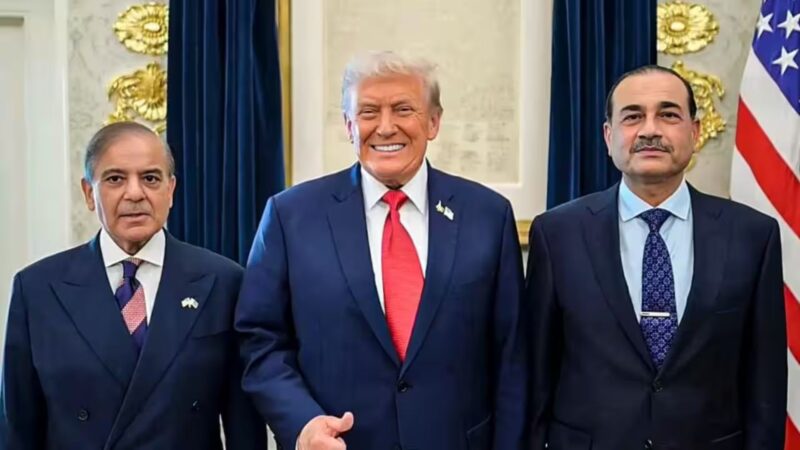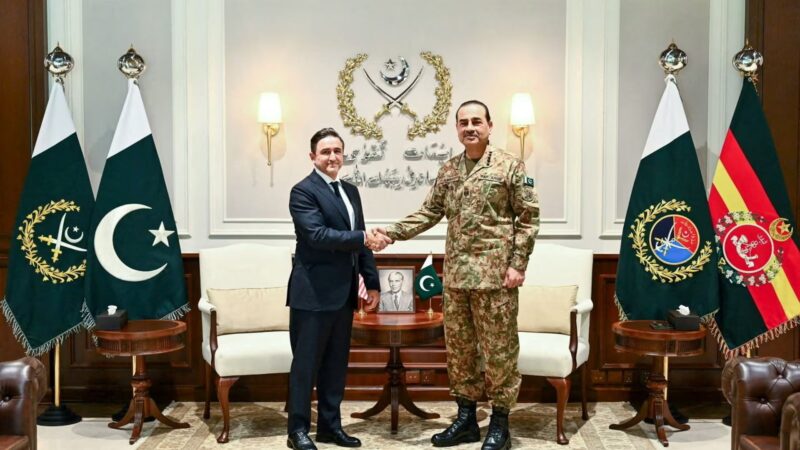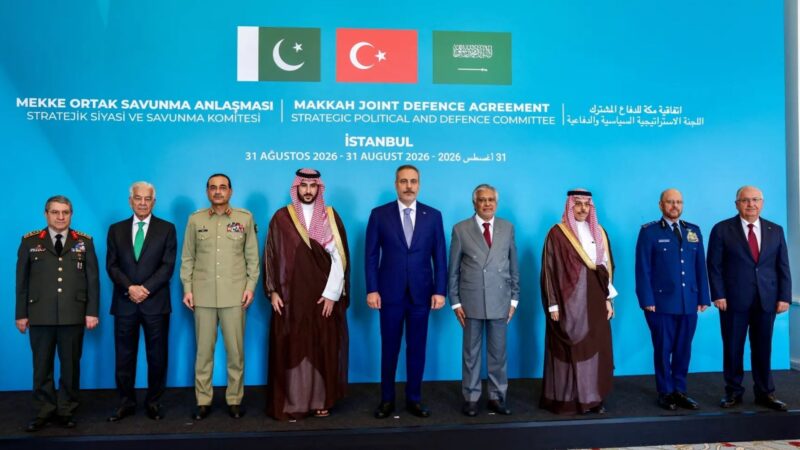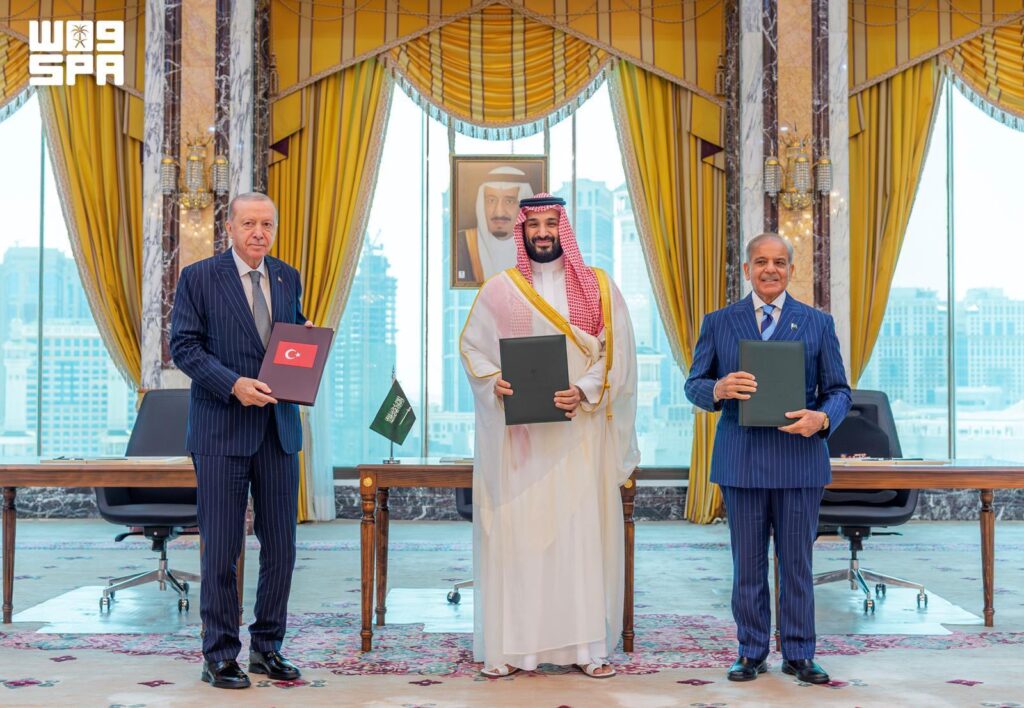
On 07 August 2026, Saudi Crown Prince and Prime Minister Mohammed bin Salman, Turkish President Recep Tayyip Erdoğan, and Pakistan’s Prime Minister Muhammad Shehbaz Sharif formally signed the Makkah Joint Defence Agreement (MJDA) at Al-Safa Palace in Makkah, Saudi Arabia.
In a press release issued after the Makkah Al-Mukarramah Summit for Joint Defence, Pakistan’s Ministry of Foreign Affairs (MoFA) stated:
“The Agreement is intended to strengthen collective deterrence against any act of aggression, and stipulates that any armed attack against one of the three States shall be regarded as an attack against them all. It further provides for the enhancement of all aspects of defence cooperation among the three states.”
The signing of the MJDA follows over six months of reported discussions between Islamabad, Riyadh, and Ankara on a potential trilateral security pact. The MJDA builds on the Strategic Mutual Defence Agreement (SMDA), the bilateral Saudi Arabia–Pakistan accord signed in Riyadh on 17 September 2025.
Observers were quick to note that the MJDA includes a provision mirroring NATO’s Article 5 – i.e., ‘an attack on one will be considered an attack on all.’ However, there is also skepticism regarding the viability or likelihood of a joint-allied response to an attack under the MJDA, much of it carried over from the SMDA’s own first wartime test.
Indeed, a commitment of that nature would pull Saudi Arabia, Türkiye, and Pakistan into security challenges that they may not be able to sustain in terms of resources or justify to their domestic stakeholders.
For example, Pakistan must balance its unique relationship with Iran (tying into a shared border and demographic linkage) while supporting Saudi security. Saudi Arabia would want to ensure its economic interests in India are maintained while supporting Pakistan. And finally, Türkiye would honour its founding principles of not embroiling itself in non-Turkish obligations.
That said, there are reasons to believe that the MJDA can be made into a substantive initiative – at least more so than the SMDA, in Quwa’s assessment, where the ambiguity has repeatedly returned – but one tuned for security through capacity building across each member rather than a joint, active warfighting umbrella (ala NATO).
Ultimately, none of the three states involved in the MJDA are requesting active military support from their partners in the form of troops or ships. Rather, each one wants a collaborative pathway through which they can build towards guaranteeing their own security.
Quwa Plus
Go Beyond the Headlines on Pakistan’s Defence and Security.
Quwa Plus gives you deeper reporting, briefings, and analysis on Pakistan’s defence programs, foreign policy, national security, and regional strategy. Follow the developments that matter to professionals, analysts, and serious readers tracking Pakistan’s security landscape.
Join ($29.99/Year) Already a subscriber?Sign in