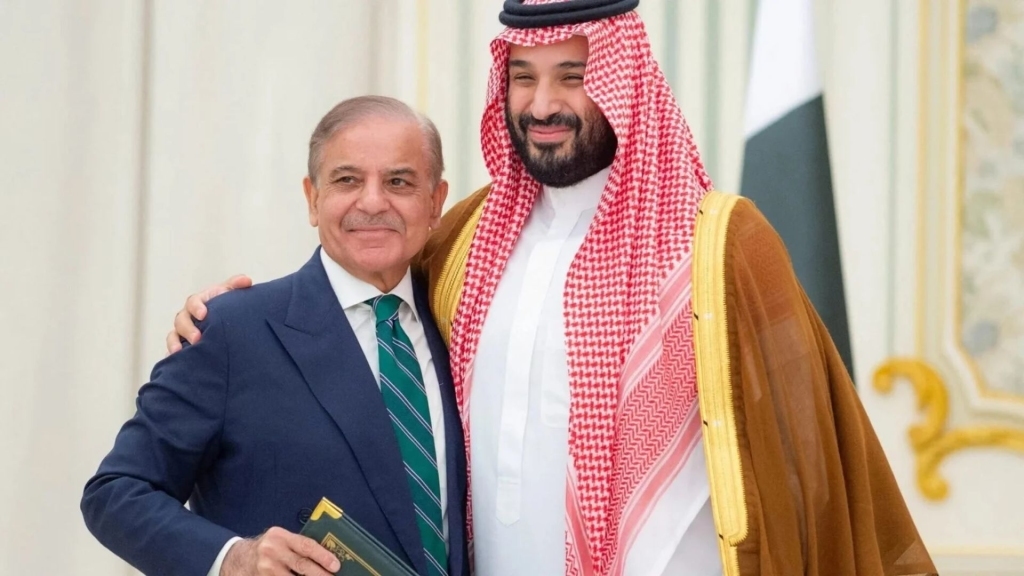
When Prime Minister Shahbaz Sharif signed the Saudi-Pakistan Strategic Mutual Defence Agreement (SMDA) in September 2025, the moment was framed as a watershed in Pakistan-Gulf relations.
The agreement formalized decades of de facto security cooperation between the two capitals that have long behaved more like brothers than ordinary bilateral partners. It also arrived at a politically charged moment — just days after Israel struck a Hamas leadership meeting in Doha and unsettled Gulf perceptions of American security guarantees.
Six months later, the agreement faces its first real stress test. Pakistan’s response so far suggests an old pattern at work, one where Islamabad consistently undersells the security premium it brings to the table.
The Iran Conflict and the Pakistani Position
Operation Epic Fury, which began on 28 February 2026, has reshaped the Gulf security landscape in ways that directly implicate the SMDA. Iranian Shahed-series drones and missiles have struck Saudi infrastructure, Riyadh’s airspace has been violated, and the Strait of Hormuz has been threatened with closure. These are precisely the contingencies the SMDA was meant to address.
Yet Pakistan’s public posture has remained studiously ambiguous. Islamabad has neither committed to operational support for Saudi Arabia nor articulated a clear framework for what the agreement means under live conditions.
That ambiguity has not gone unnoticed in Riyadh. Saudi policymakers are sophisticated readers of Pakistani signalling, and they understand the domestic constraints — the 15 to 20 percent Shia population, the unwillingness to open a third hostile front after India and Afghanistan, the proximity of a long Iranian border. Understanding the constraint, however, does not eliminate the discomfort of seeing it play out in real time.
A Historical Pattern of Hedging
This is not the first time Pakistan has hesitated when Saudi Arabia called. In 2015, when Riyadh launched its campaign in Yemen against the Houthis, Pakistan declined to commit forces despite expectations within the Gulf Cooperation Council (GCC) that it would. The decision left a sour taste with Saudi policymakers that took years to dissipate.
The Imran Khan government deepened the friction. Then-Foreign Minister Shah Mahmood Qureshi made public statements about Saudi Arabia that no senior diplomat should have voiced, and overtures toward Turkey and Malaysia — including talk of a new bloc that would rival the Organization of Islamic Cooperation (OIC) and the Arab League — compounded the damage. Bilateral relations only began to recover under the current civil-military setup that came to power afterward.
Each of these episodes reveals a structural weakness. Pakistan negotiates security commitments without clearly articulating, or pricing, the value of what it is offering. The result is a recurring pattern where Islamabad enters major agreements without leveraging them to extract durable economic, diplomatic, or strategic concessions.
The Underpriced Security Premium
What makes Pakistan’s hesitation particularly costly is that its security value is genuinely rare. Across the wider Middle East, few partners can credibly claim a track record of independently confronting state-level military threats — not the GCC monarchies, not Turkey, and not the broader regional security architecture.
Pakistan’s history of operating as a high-end gray zone actor, of confronting India directly when challenged, and of maintaining a credible nuclear deterrent gives it a distinct profile. That distinctiveness should translate into pricing power.
In the 1970s and 1980s, when Pakistani forces were stationed in Saudi Arabia, the kingdom paid Islamabad an estimated three to four billion dollars annually — equivalent to ten to fifteen billion in current terms. That arrangement worked because Pakistan understood the value of what it provided and structured the relationship accordingly. The current generation of Pakistani policymakers has lost that muscle memory.
The Look West Opportunity
The deeper argument is that Pakistan’s positioning on the Iran conflict is not just a diplomatic choice. It is a referendum on whether Islamabad is capable of executing a coherent Gulf strategy at all.
The Look West thesis, which frames Pakistan’s strategic future as deeply integrated with the Arab Gulf and Turkey, depends on Pakistan being able to deliver clear signals when its partners need them. Clarity does not require committing forces. It requires articulating a position, pricing the security partnership accurately, and ensuring that the SMDA is reinforced by economic and diplomatic structures that make ambiguity costly to all parties.
The risk of the current drift is not that the agreement collapses. It is that Pakistan, once again, locks itself into a long-term security commitment without locking in the long-term benefits.
Hear the Full Analysis on Pulse Check
In the latest episode of Pulse Check, Quwa’s subscriber-exclusive podcast, Lahore-based journalist Usman A. Khan joins host Bilal Khan to examine the structural dynamics behind Pakistan’s Gulf positioning. The conversation traces the trajectory of Pakistan-Saudi relations from the 1979 siege of Mecca through the Yemen war, the Imran Khan era’s diplomatic damage, and the current strategic moment created by the Iran conflict.
The free preview is available now. To access the full episode and Quwa’s complete archive of Pakistani defence procurement and strategic analysis, subscribe to Quwa Plus at quwa.org/plus.
Quwa Plus · In-Depth Pakistan Coverage
Understand Pakistan’s Defence and National Security in Unmatched Depth
Understand what Pakistan is acquiring, how its armed forces are evolving, and where national security policy is heading through dedicated defence news, force analysis, procurement tracking, Pulse Check briefings, and more than a decade of documented reporting.
Featured & Trusted By