When Pakistan stepped up to mediate between the United States and Iran in early 2026, the Islamabad talks were positioned as a serious diplomatic opening. They came on the heels of a fragile two-week ceasefire and gave Islamabad a rare seat at a table normally reserved for Oman, Qatar, or Switzerland.
They produced no agreement.
The standard explanation is that Iran was not ready to negotiate. The actual explanation is that the people who could have negotiated were no longer in the room — or in many cases, no longer alive. The Islamabad talks failed because the United States misread who in Iran actually held the authority to make a deal.
The Decapitation of Iran’s Pragmatist Class
Operation Epic Fury did more than degrade Iran’s military infrastructure. It systematically wiped out the senior leadership of the Islamic Revolutionary Guard Corps (IRGC) — the same officials who had served as the hidden backbone of every major US-Iran negotiation across the previous two decades, including the Joint Comprehensive Plan of Action (JCPOA) under the Obama administration.
That layer is now gone. What remains is a fragmented authority structure where pragmatist diplomats like Iraqchi and Gharibabadi retain visibility but no longer command the IRGC machinery beneath them. They are the faces Washington recognizes — but they are not the figures who currently make Iranian strategic decisions.
This is the gap that produced the Islamabad failure. The pragmatists showed up. The decision-makers did not.
The Rise of Iran’s Regionalized War Heroes
Before the conflict, the IRGC had quietly restructured around a doctrine of devolved authority. The objective was for Iran to continue functioning even if its senior leadership were destroyed. The doctrine worked, possibly too well.
Younger IRGC officers, many at the one- or two-star level, emerged from the conflict as regionalized war heroes within their respective jurisdictions. They derive their legitimacy from grassroots Iranian opinion, not from foreign endorsement. That is a fundamentally different political position than the one occupied by the JCPOA-era leadership, which depended on sanctions relief and economic normalization to deliver value to its constituency.
The new generation does not need Trump to lift sanctions. It needs to be perceived as having held the line, and that perception is incompatible with returning to the negotiating table on Washington’s terms.
Pakistan’s Squandered Mediation Opening
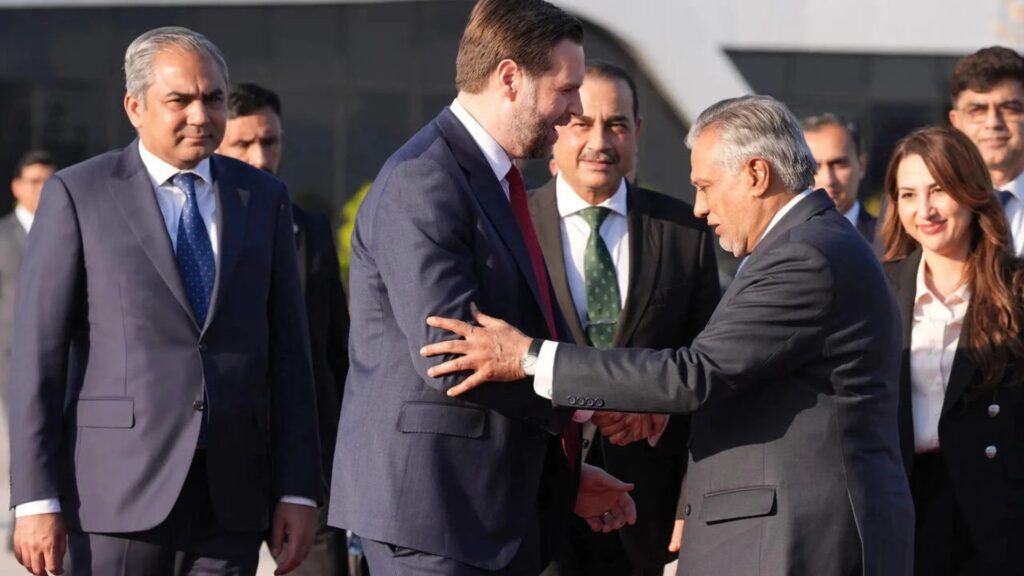
The deeper analytical question is what Pakistan was supposed to extract from this moment. General Asim Munir’s reception at the White House — and the broader push to revive the Look West engagement — signalled that Washington saw Pakistan as the only actor with the credibility, the IRGC backchannels, and the geographic positioning to bring the new Iranian leadership to the table. The JD Vance angle reinforced this: Washington wanted Islamabad to function as the introduction layer for an entirely new Iranian power structure.
That is significant leverage. Pakistan once knew how to convert this kind of moment into structural concessions, but the same hesitation that has shaped its response to the Saudi defence pact under live conditions is now shaping its mediation posture as well.
The Islamabad process can still deliver value — but only if Islamabad is willing to attach a price to its mediation rather than offer it for free.
Tying the Gulf to India Leverage
The most coherent argument for what Pakistan should be extracting is that its Iran-Gulf positioning is the only structural lever it has against India. The Indus Water Treaty, in any meaningful sense, has collapsed. India has positioned itself to weaponize water flows, and Pakistan currently has no instrument to credibly push back.
Energy transit changes that calculus. If the Iran-Pakistan pipeline were extended through Pakistani territory toward India — at a Pakistani-controlled surcharge — Islamabad would acquire a structural lever it could hold over New Delhi when water becomes contested. The same logic applies to maritime energy supply moving through the Arabian Sea: Pakistan’s geographic position can be converted into rent and deterrence simultaneously.
This is also where the tradeoff between Gulf integration and Indian deterrence becomes operationally real, rather than theoretical.
The Maritime Foundation
None of this works without a Navy capable of backing the posture. A maritime force structure built around peacetime grey zone enforcement, sustained presence, and credible interdiction is no longer a luxury — it is the foundation that makes the rest of the strategy executable.
Pakistan’s surface combatant trajectory over the past two decades reflects awareness of this requirement. The current question is whether the procurement curve can scale fast enough to make Arabian Sea presence a credible enforcement posture rather than a flag-showing exercise.
The Stress Test
The current moment is a stress test for the Look West thesis — the strategic frame that places Pakistan’s future in deeper integration with the Arab Gulf, Iran’s neighbourhood, and the wider Middle East. The thesis assumes Pakistan can deliver credibility under live conditions. The Islamabad talks were an early data point, and the data is mixed.
Pakistan got the seat. It did not get the deal. More importantly, it does not appear to have priced the seat itself into its broader regional negotiations.
The opening is not closed. But windows like this rarely stay open for long, and the next round of serious US-Iran engagement will not necessarily run through Islamabad.
Hear the Full Analysis on Pulse Check
In the latest episode of Pulse Check, returning guest Aseem joins host Bilal Khan to unpack the structural dynamics behind Iran’s leadership fragmentation, Pakistan’s mediation role, and the policy moves Islamabad should be making to convert this moment into durable leverage. The conversation traces the IRGC’s pre-war doctrine of devolved authority, the generational shift in Iranian decision-making, and the specific instruments — energy, maritime, diplomatic — that Pakistan could use to tie Gulf engagement directly to India deterrence.
The free preview is available now. To access the full episode and Quwa’s complete archive of Pakistani defence procurement and strategic analysis, subscribe to Quwa Plus at quwa.org/plus.
Quwa Plus · In-Depth Pakistan Coverage
Understand Pakistan’s Defence and National Security in Unmatched Depth
Understand what Pakistan is acquiring, how its armed forces are evolving, and where national security policy is heading through dedicated defence news, force analysis, procurement tracking, Pulse Check briefings, and more than a decade of documented reporting.
Featured & Trusted By