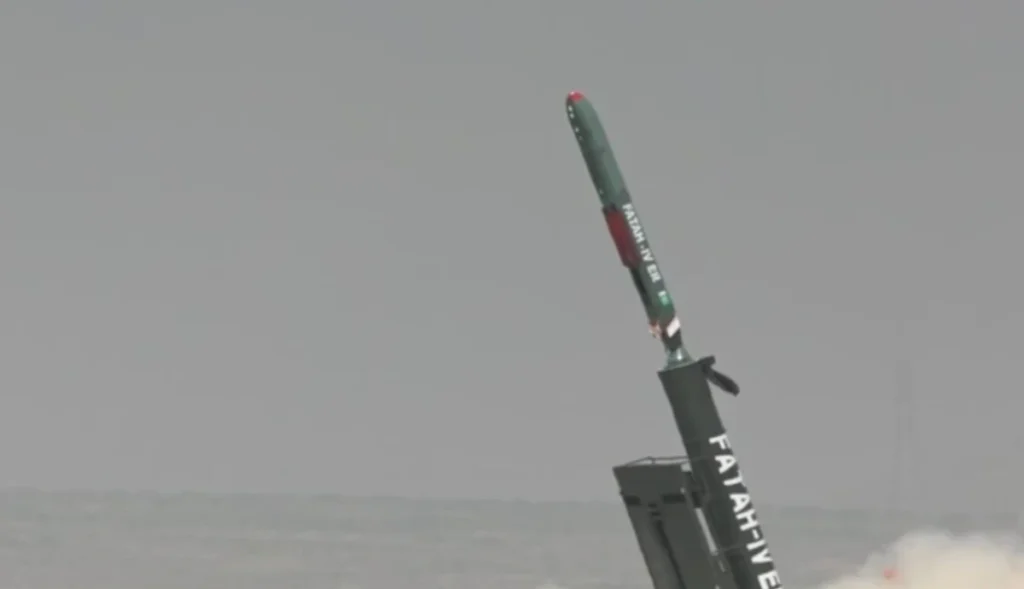
On 06 October, Pakistan test-fired an extended-range version of the Fatah-4 ground-launched cruise missile (GLCM) called the Fatah-4-ER. Inter Services Public Relations (ISPR), the armed forces’ press wing, stated that the GLCM “is capable of engaging targets at extended ranges with high precision and lethality,” adding that the missile test “validated additional technical parameters of various sub-systems incorporated for improved accuracy and enhanced survivability.”
ISPR did not disclose the range, dimensions, weight, or warhead mass of the Fatah-4-ER. That said, the launch footage shows a larger missile with folding wings mounted outside of the fuselage, which suggests a design meant for not only greater range, but also faster and cheaper production.
The Fatah-4-series (i.e., Fatah-4 and Fatah-4-ER) is a subsonic cruise missile platform derived from the Babur-series, which had originally been developed for strategic deterrence purposes. However, with the modern warfighting environment demanding scalable long-range munitions for conventional strike roles, Pakistan introduced the Fatah-4 as a non-strategic attack option.
Developed by the National Engineering and Scientific Commission (NESCOM), the Fatah-4 has a range of 750 km, a total weight of 1,530 kg, a length of 7.5 m, a diameter of 0.5 m, and a cruise speed of Mach 0.7. Like the Babur, the Fatah-4 offers ‘terrain-hugging’ flight, meaning it can fly at altitudes as low as 50 m above land as a way to evade detection on high-altitude, long-range air defence radars. According to the Pakistan Army’s Rocket Force Command (ARFC), the Fatah-4 carries a 330 kg blast fragmentation warhead, which it can deliver with an accuracy of within 5 m circular error probable (CEP).
Though ISPR did not disclose the range of the Fatah-4-ER, Quwa has inferred in past analysis that the ARFC will look to extend its cruise missile ranges to 1,000+ km and, potentially, aim for 1,500+ km relatively soon. For example, this author stated in August 2025:
“The Fatah-series adds to the Babur-line of land-attack cruise missiles (LACM), thereby providing the PA with a well-rounded stand-off strike capability that reaches up to 700 km. However, one should expect the PA to pursue even longer ranged designs, potentially in excess of 1,000 km, in the future.”
Then, in June 2026, reflecting on the introduction of the Fatah-4, this author had inferred that the Fatah-4 family could lead to longer-ranged variants, stating:
“In turn, the Babur lineage could continue evolving as a higher-end option, but with even greater range (1,000+ km).”
The goal with the Fatah-4 series is scalability. So, to achieve that goal, NESCOM started by first standardizing the platform across different roles. The Fatah-4 and the Harbah NG (which is the anti-ship cruise missile or ASCM counterpart) are both closely derived from the Babur. In effect, NESCOM has opted to leverage one core platform to support multiple roles, and that too across different service arms (i.e., the Army and Navy). This means that the required overhead spend or investment for increasing the missile’s production capacity will be scaled across many units such that the overhead cost can be amortized widely. Pakistan is also offering this missile for export, so there is also an added element of recouping costs through sales as well.
Quwa Plus
Go Beyond the Headlines on Pakistan’s Defence and Security.
Quwa Plus gives you deeper reporting, briefings, and analysis on Pakistan’s defence programs, foreign policy, national security, and regional strategy. Follow the developments that matter to professionals, analysts, and serious readers tracking Pakistan’s security landscape.
Join ($29.99/Year) Already a subscriber?Sign in