

The test marks the latest milestone in Islamabad’s push to field conventional cruise missiles alongside its nuclear-capable systems.
On 14 May, the Pakistan Army’s Rocket Force Command (ARFC) successfully test-fired the Fatah-4, an indigenously developed ground-launched cruise missile (GLCM), the military’s Inter-Services Public Relations (ISPR) directorate announced.
The ISPR said the weapon system is “equipped with advanced avionics and state-of-the-art navigational aids” and “capable of engaging long-range targets with high precision.” The test was categorized as a training fire, suggesting the system is approaching or has reached operational readiness within the ARFC.
The Fatah-4 is a subsonic land-attack cruise missile (LACM) with a reported range of 750 km, developed by the National Engineering and Scientific Commission (NESCOM) and marketed for export by Global Industrial Defence Solutions (GIDS). It is not, however, a new design in the strictest sense.
The Fatah-4 is a conventional-use variant of the Babur series — a family of land-attack cruise missiles that Pakistan has developed and refined for nuclear deterrence over the past two decades.
The Babur platform uses terrain contour matching (TERCOM) — which navigates by comparing the terrain below to a pre-loaded elevation map — and digital scene-matching area correlator (DSMAC) guidance, which uses onboard cameras to match visual landmarks against stored imagery for pinpoint terminal accuracy.
Together, this navigation architecture enables terrain-hugging flight profiles designed to evade air defences. The Fatah-4 inherits this architecture, effectively repurposing a proven strategic airframe for conventional precision-strike missions.
Get the Full Picture on Pakistan’s Defence and National Security
Get dedicated Pakistani defence news, force analysis, procurement tracking, and national security policy insight, backed by more than a decade of documented reporting and depth general news coverage cannot match.
When reviewing the footage released by the ISPR, one will notice that this particular Fatah-4 hit its target within a relatively tight circular error probable (CEP), indicating that a terminal-stage seeker of some type is at play.
The warhead also detonated in the air rather than on impact, suggesting the missile was armed with an airburst warhead — a configuration typically used to maximize the blast radius against soft or area targets.
The same platform lineage extends to the Pakistan Navy. The Harbah NG, a ship-launched anti-ship cruise missile (ASCM) and LACM first tested from an Azmat-class fast attack craft in 2021, shares the Babur-derived airframe, miniature turbojet propulsion, and navigation suite. The Fatah-4 is the ground-launched variant; the Harbah NG is its naval counterpart.
This pattern — fielding conventional derivatives of strategic weapons — has become a defining feature of Pakistan’s missile development strategy. Where the country’s cruise and ballistic missiles were once reserved exclusively for nuclear deterrence, Islamabad has in recent years spawned parallel conventional families across all three services.
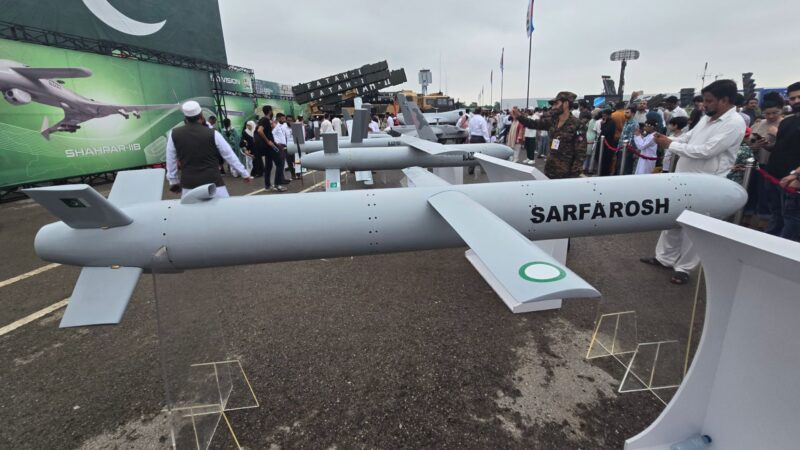
The Fatah-4 and Harbah NG now sit alongside the nuclear-capable Babur GLCM and Babur-3 submarine-launched cruise missile (SLCM). In the air domain, the Taimur air-launched cruise missile (ALCM) serves the conventional role alongside the nuclear-capable Ra’ad-2 ALCM, both operated by the Pakistan Air Force (PAF).
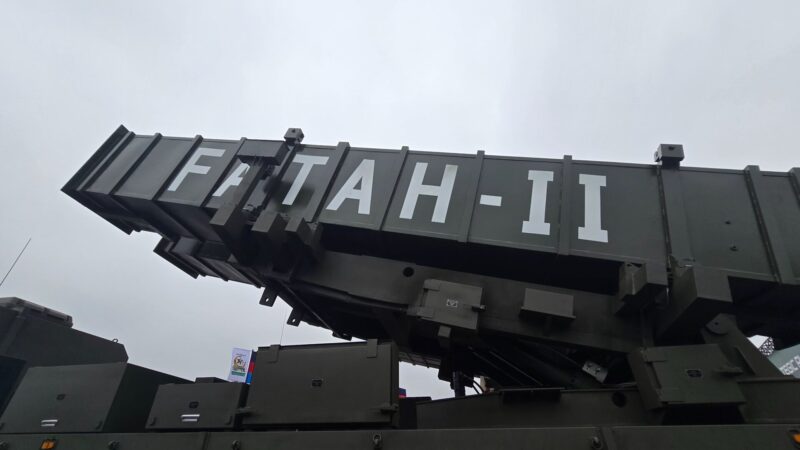
And on the ballistic side, the Fatah-2 — a 400 km-range supersonic surface-to-surface missile — occupies the conventional niche once held exclusively by the nuclear-tipped Abdali.
The establishment of the ARFC in August 2025, led by a three-star general, institutionalized this shift. By consolidating conventional rockets and missiles under a dedicated command separate from the Army Strategic Forces Command (ASFC), Pakistan formalized the doctrinal separation between its nuclear and conventional strike capabilities — and signalled that the latter is now a permanent feature of its force structure.
Quwa Plus · In-Depth Pakistan Coverage
Understand Pakistan’s Defence and National Security in Unmatched Depth
Understand what Pakistan is acquiring, how its armed forces are evolving, and where national security policy is heading through dedicated defence news, force analysis, procurement tracking, Pulse Check briefings, and more than a decade of documented reporting.
Featured & Trusted By