

Editor’s note (29 April 2026): This profile was updated with details on the PAF’s January 2026 test-firing, the Pakistan Navy’s April 2026 test-firing of the Taimoor ALCM, dual-service deployment implications, and the missile’s role in Pakistan’s precision-strike doctrine.
Global Industrial & Defence Solutions (GIDS) first revealed the Taimoor air-launched cruise missile (ALCM) at the 2022 International Defence Exhibition and Seminar (IDEAS 2022).
Like its sibling weapon, the GIDS Harbah NG anti-ship cruising missile (ASCM), the Taimoor is being promoted for export. The Taimoor is capable of both land-attack and anti-ship roles.
The Taimoor is the conventional-use counterpart of the strategic Ra’ad-2, the Pakistan Air Force’s (PAF) nuclear-capable long-range strike platform. In its domestic configuration, the Taimoor has a range of 600 km, while the export variant is capped to 290 km to comply with Missile Technology Control Regime (MTCR) guidelines.
In January 2026, the PAF test-fired the Taimoor ALCM, confirming the missile’s 600 km range and low-altitude flight capability. In April 2026, the Pakistan Navy (PN) also test-fired the Taimoor, signalling the missile’s emergence as a dual-service platform with both PAF and PN applications.
Track Pakistan’s Major Defence Programs
Get visibility on suppliers, technical requirements, and timelines.
Click Here
GIDS Taimoor Design Background
The GIDS Taimoor is an export variant of the Air Weapons Complex (AWC) Ra’ad-II, one of the PAF’s ALCMs.
The two missiles share several design features, notably, the “X”-type tail control surfaces, mid-body foldable wings, and underslung air-inlet for a miniature turbojet engine. Likewise, the Taimoor also uses some low-observability (LO) design attributes in its airframe, which are aimed at reducing its radar cross-section (RCS).
The Ra’ad-II has a range of 550-600 km. To comply with the MTCR’s guidelines, the Taimoor’s export range was capped to 290 km. Despite that, the Taimoor still leverages many of the key technologies of the Ra’ad-series, like terrain-hugging flight and guidance systems, which include TERCOM and DSMAC.
The GIDS Taimoor is a credible long-range strike solution, one that can still drive strategic impacts for its end-users, despite the export range limitation.
It is likely that AWC is reusing many of the same core inputs for its stand-off range weapons (SOW). For example, the GIDS Taimoor could be using the same turbojet engine and guidance stack of the Harbah NG. Likewise, the Taimoor’s imaging infrared (IIR) seeker may be finding its way to other applications, like the AZB-81LR.
GIDS Taimoor Specifications
Physical Dimensions
- Length: 4.38 meters
- Wingspan: 3.20 meters
- Weight: 1,100-1,200 kg
Performance Parameters
- Range: 600 km (domestic); 290 km (export)
- Cruise Speed: Mach 0.7-0.8 (450-500 knots)
- Terminal Speed: Mach 0.8 (500 knots)
- Launch Altitude: 610-7,620 meters (2,000-25,000 ft)
- Cruise Altitude: 152-6,096 meters (500-20,000 ft)
- Minimum Flight Altitude: Very low (terrain-hugging)
Key Technical Inputs
- Mid-course: INS aided with GNSS/GPS & DSMAC/TERCOM
- Warhead Types: Blast fragmentation, penetration & pre-fragmentation
- Terminal: Imaging Infrared (IIR) seeker
- Propulsion: Unknown miniature turbojet (possibly NESCOM NTJ-V1)
Key Capabilities of the GIDS Taimoor ALCM
Dual Land-Attack and Anti-Ship Targeting
The GIDS Taimoor ALCM was designed to engage both fixed and moving targets, including surface warships. For the latter, the Taimoor uses an IIR seeker in terminal-stage flight.
The satellite-aided inertial navigation system (INS) guides the missile’s flight until it reaches the terminal-stage. The TERCOM and DSMAC stack likely helps with providing the Taimoor more resilience in environments where GNSS/GPS links are not reliable, such as electronic warfare (EW)-dense scenarios where there is GNSS/GPS jamming.
Long-Range and Heavy Payload
GIDS did not disclose the Taimoor’s warhead weight. However, the overall weight of the Taimoor (and, by extension, the Ra’ad-II) is less than 1,200 kg, which is comparable to the mass of the MBDA SCALP and MBDA/Taurus KEPD-350, which weigh 1,300 kg and 1,400 kg, respectively. These ALCMs can deliver warheads weighing around 450-500 kg, so it is reasonable to assume that the Taimoor/Ra’ad-II could carry a comparable amount.
The ISPR confirmed in January 2026 that the Taimoor is capable of engaging targets with high precision at a range of 600 km carrying a conventional warhead, and can fly at very low altitudes to circumvent enemy air defence systems.
Low-Observability (LO) Design
The LO elements of the GIDS Taimoor manifest in two key ways. First, its airframe’s angular design helps with reducing its radar cross-section (RCS), making it more difficult to detect at long-range on radar. Second, the Taimoor has terrain-hugging flight capability (via TERCOM and DSMAC), allowing it to fly at low-altitudes and, in turn, exploit radar coverage gaps.
Flexible Launch Platform Integration
While Pakistan would love to see the GIDS Taimoor drive interest in the JF-17, GIDS will be happy with securing sales from a wider subset of customers. One advantage of focusing on becoming a munitions exporter is that Pakistan can approach countries that do not use any of its big-ticket platforms. Instead, the Pakistani industry can lean on its custom integration services to pair the Taimoor to a wider variety of fighter platforms.
Dual-Service Deployment: PAF and Pakistan Navy
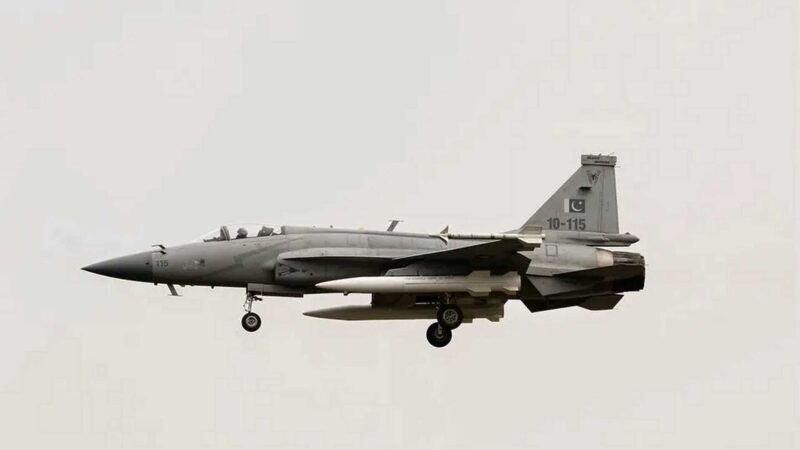
The Taimoor is now being adopted by both the PAF and the PN, making it a genuinely dual-service platform. The PAF test-fired the Taimoor in January 2026 from a Mirage 3 ROSE aircraft. ISPR footage confirmed the launch platform, though the JF-17 is expected to be the primary future carrier.
In April 2026, the PN also test-fired the Taimoor, marking a significant doctrinal shift for the PN, which has historically relied on subsurface and surface-to-surface capabilities for power projection. The PN is preparing to integrate the Taimoor with its forthcoming Sea Sultan long-range maritime patrol aircraft (LRMPA) as an anti-surface warfare (ASuW) capability.
While the PN’s primary use of the Taimoor would likely serve as an anti-access and area-denial (A2/AD) deterrent measure during peacetime or crisis scenarios, the availability of the Taimoor for PN use also implies that NESCOM’s Air Weapons Complex (AWC) is succeeding at scaling up the production rate – a major sign that long-range ALCMs are transitioning from the strategic/nuclear deterrence role to a scalable conventional capability.
The Taimoor in Pakistan’s Precision-Strike Architecture
The Taimoor sits alongside a growing family of conventional guided munitions in Pakistan’s emerging precision-fire and precision-strike strategy. While the Pakistan Army’s Army Rocket Force Command (ARFC) manages ground-launched systems like the Fatah-I, Fatah-II, and Fatah-IV, the PAF and PN are developing air-launched strike capabilities anchored to the Taimoor.
The doctrinal shift towards conventional guided munitions accelerated after the 2025 conflict with India and lessons drawn from the Russia-Ukraine war. High-quality satellite imaging – via Pakistan’s expanding constellation including PRSC-EO1/EO2 and the forthcoming PIESAT InSAR constellation – is critical for mission planning the Taimoor’s TERCOM/DSMAC-guided flight routes.
As Quwa has previously analyzed, the core Babur LACM platform now underpins multiple conventional weapons: the Fatah-IV GLCM for the Army, the Harbah-NG ASCM for the Navy, and the Taimoor/Ra’ad-II ALCM for the Air Force and Navy. This common-platform standardization supports NESCOM’s path toward scaling production across all three services.
Recent Developments
- November 2022: GIDS unveils the Taimoor ALCM at IDEAS 2022 as an export-oriented system.
- May 2025: 2025 India-Pakistan conflict accelerates urgency for scaling conventional guided munition stocks.
- August 2025: Army Rocket Force Command (ARFC) raised, formalizing the PA’s dedicated precision-strike arm with Fatah-series systems.
- January 2026: PAF test-fires the Taimoor ALCM, confirming 600 km range and low-altitude flight capability. Launch from Mirage 3 ROSE aircraft.
- April 2026: Pakistan Navy test-fires the Taimoor ALCM, marking the missile’s emergence as a dual-service platform for both air force and naval applications.
Learn More
600km & Low-Altitude Flight: Inside Pakistan’s Taimoor Air-Launched Cruise Missile
Pakistan Navy Test Fires Taimoor ALCM
Beyond Nuclear: Pakistan’s Quiet Shift to Mass-Produced Conventional Strikes
Lessons from Ukraine: Surging Value of Stealthy ALCMs
Analysis: Munitions Could Boost Pakistani Defence Exports
News Updates, Comments, and Analysis
Analysis: Munitions Could Boost Pakistani Defence Exports
Pakistani seems to be pivoting its defence industry to focus on advanced munitions, especially for the export market. The GIDS Taimoor ALCM could play a major role in generating sales. Read the full article here.
Analysis: Is Pakistan’s Next Strategic Focus on Boosting Munitions Output?
Finding lessons in the Russia-Ukraine War, the Pakistani military appears to be steering the domestic industry to learn how to scale and manufacture precision-guided munitions, such as the Taimoor ALCM, at scale. Read the full article here.
Analysis: Surging Value of Stealthy ALCMs
With Ukraine steadily demanding more stealthy ALCMs like the MBDA SCALP, the high value of these munitions is clearer than ever. This awareness might explain why Pakistan is investing in programs like the Taimoor ALCM. Read the full article here.
Upgrade to Quwa Plus
Get access to in-depth analysis, exclusive reports, and the latest developments in South Asian defence. Stay ahead with verified insights and objective forecasting from the Quwa team.