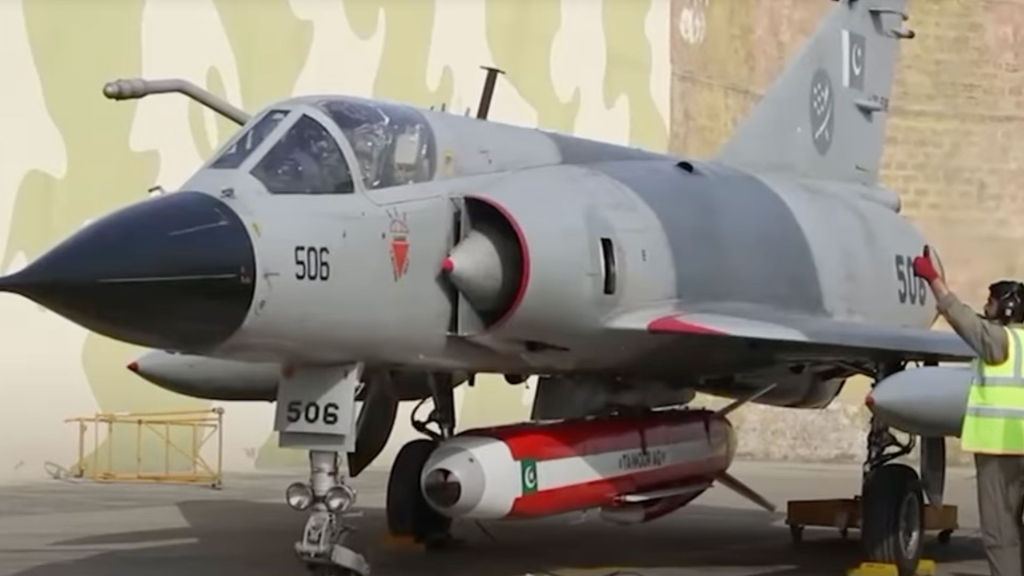
On 03 January, Pakistan’s Inter Services Public Relations (ISPR) announced that the Pakistan Air Force (PAF) test-fired the Taimoor air-launched cruise missile (ALCM).
According to the ISPR, the Taimoor ALCM “is capable of engaging enemy land and sea targets with high precision at a range of 600 kilometres, carrying a conventional warhead.” In addition, the ISPR highlighted the Taimoor ALCM’s ability to fly at “very low altitudes” to circumvent enemy air defence systems.
Video footage released by the ISPR showed that the Taimoor ALCM was launched from a PAF Mirage 3 ROSE (Retrofit of Strike Element) aircraft, which had been the primary carrier of the PAF’s ALCMs (i.e., the Ra’ad) and stand-off weapon (SOW) systems (i.e., H-2 and H-4) until the mid-to-late-2010s.
- Pakistan Air Force’s Shift to Satellites, Jamming, and Standoff Weapons
- How a US Mistake Handed Pakistan’s Arms Market to China.
- The Blueprint for Pakistan’s Future-Proof Air Defence System.
For a time, this model worked in that NESCOM only needed to focus on producing cruise missiles at low scale because the use-cases for these systems were limited in scope. Pakistan could largely lean on the strength of its nuclear weapons to drive deterrence (i.e., “minimum credible deterrence.”).
However, this framework started cracking under pressure from 2016, when India began taking control of the escalation ladder, first by claiming to initiate cross-border “surgical strikes.” While these strikes could not be verified, the episode gave New Delhi the sense it can dictate the pace of escalation. Then, in 2019, India carried out a cross-border air strike which the PAF had responded to one day after, demonstrating its capacity to strike key Indian military targets and downing a MiG-21 in the process.
In 2021, Pakistan began showing it was moving towards leveraging guided munitions in its conventional posture with the testing and induction of the Fatah-I. In 2022, Russia invaded Ukraine, kicking off a series of lessons on the importance of inducting guided munitions for conventional purposes, be it guided rockets analogous to the Fatah-I/II to cruise missiles like the Fatah-IV and Taimoor.
Pakistan’s recent conflict with India in May 2025 likely acclerated this goal, adding urgency towards the need for both healthy guided munition stocks, but the wider targeting and mission planning infrastructure necessary to achieving disproportionate effects via these munitions. The most notable shift to come out of the May 2025 conflict was the formation of Army Rocket Force Command (ARFC), a dedicated arm within the Pakistan Army to take the lead in managing precision strikes through guided rockets, cruise missiles, and certain types of loitering munitions (e.g., long-range one-way effectors or OWE).
However, Pakistan will never maintain large enough stocks of guided munitions to carry out Russian-style high-tempo, high-volume salvo attacks. The ARFC and the PAF will likely look to adopt more of Ukraine’s approach of pairing limited munitions stocks with ISR (intelligence, surveillance, and reconnaissance) via space-based assets, data fusion, and route planning to ensure the right targets are chosen with as high a probability of successful hits as possible. One key acquisition hinting at this strategy was the recent deal signed with China’s PIESAT for a constellation of interferometric synthetic aperture radar (InSAR)-based satellites. High-quality imaging is critical for building high-fidelity mapping data for the cruise missiles as well as route planning for their deployment.
Circling back to the Taimoor, the InSAR constellation would allow the PAF to fix two constraints that would make long-range conventional strikes ‘fragile’, so to speak: stale targeting and “blind” routing.
Quwa Plus
Go Beyond the Headlines on Pakistan’s Defence and Security.
Quwa Plus gives you deeper reporting, briefings, and analysis on Pakistan’s defence programs, foreign policy, national security, and regional strategy. Follow the developments that matter to professionals, analysts, and serious readers tracking Pakistan’s security landscape.
Join ($29.99/Year) Already a subscriber?Sign in