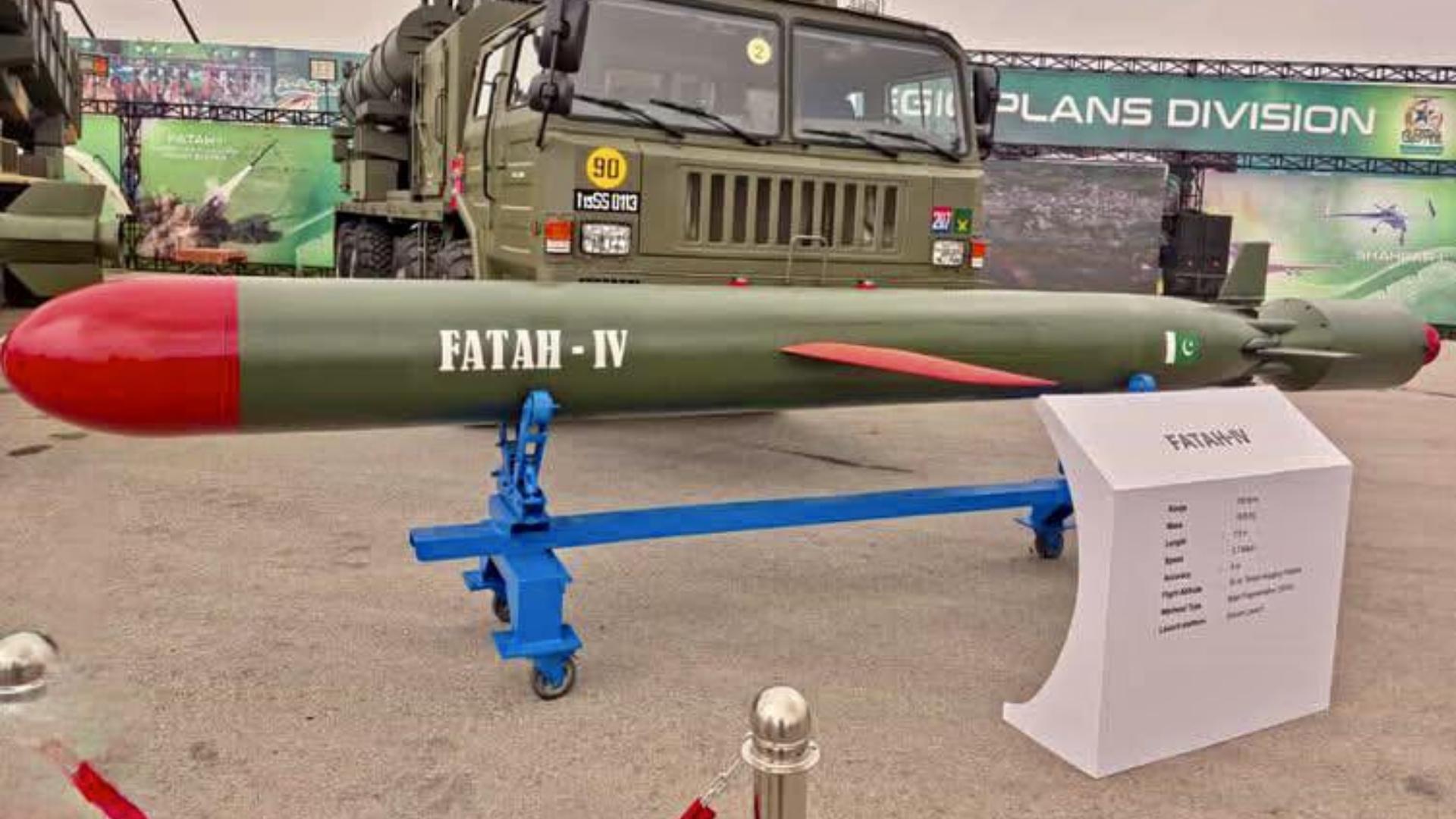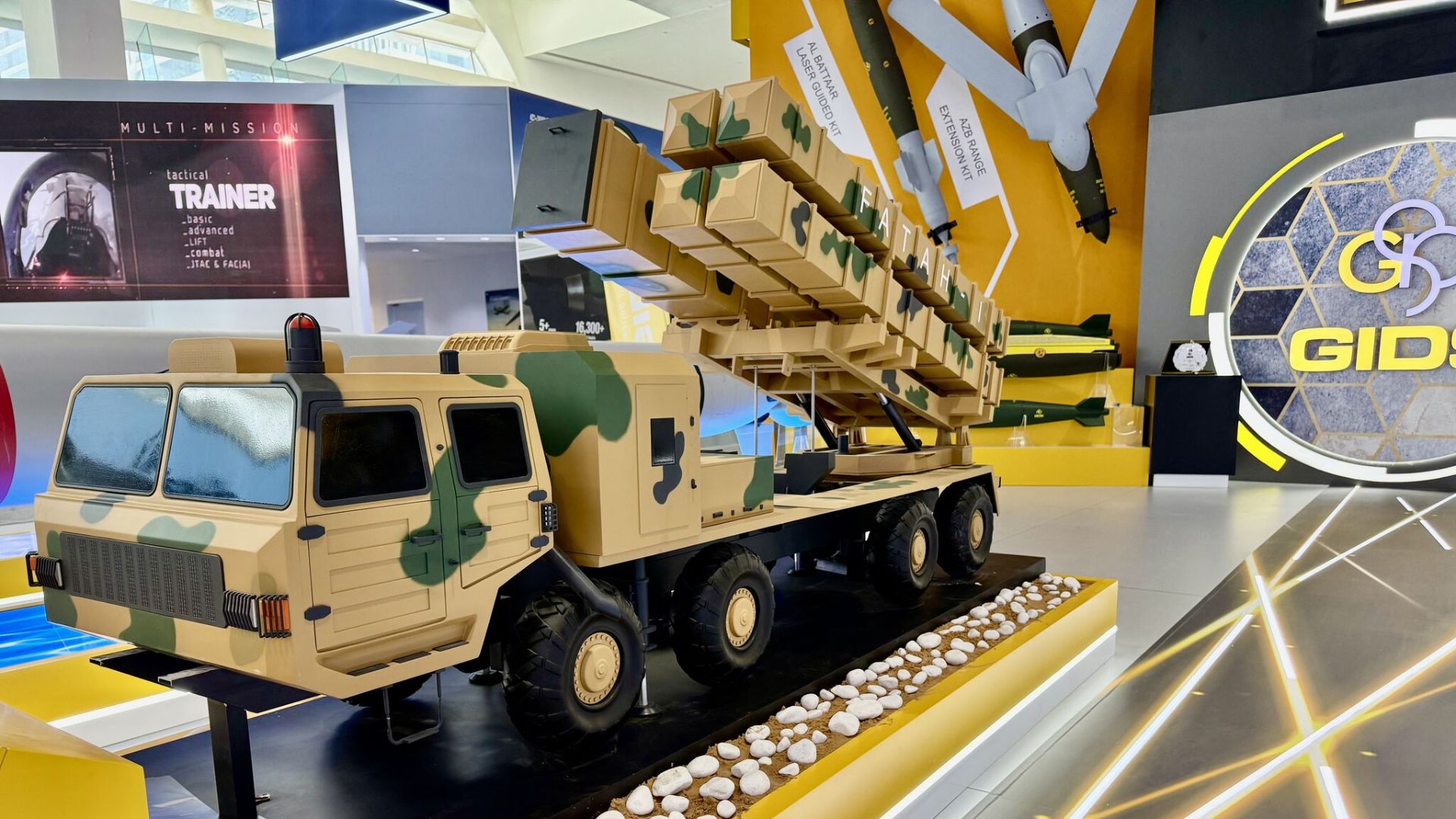
Editor’s note (May 2026): This profile has been restructured as a family overview. For detailed specifications, development history, and analysis of each variant, see the dedicated profiles: Fatah-1 GMLRS, Fatah-2 SSM, Fatah-3 SSCM, and Fatah-4 GLCM.
The Fatah missile family is Pakistan’s primary conventional guided surface-to-surface missile programme. Developed by Pakistan’s National Engineering and Scientific Commission (NESCOM) and marketed internationally by Global Industrial and Defence Solutions (GIDS), the Fatah series encompasses four distinct guided rocket and missile systems. Ranging from the 140 km-range Fatah-1 GMLRS to the 750 km-range Fatah-4 GLCM, the family provides the Pakistan Army (PA) with a layered conventional precision-strike capability spanning guided rockets, tactical ballistic missiles, supersonic cruise missiles, and subsonic land-attack cruise missiles.
These systems form the backbone of the Army Rocket Force Command (ARFC) – a dedicated arm raised in August 2025 to manage the PA’s growing arsenal of conventional guided rockets and missiles. The “Fatah” designation now broadly signifies conventional long-range surface-to-surface weapons, encompassing ballistic, supersonic cruising, and subsonic cruising variants.
Know What Defence Buyers in Will Need Next
See emerging requirements, likely suppliers, and routes to market across Pakistan, MENA, and fast-moving defence technologies, before demand becomes obvious.
Fatah Family at a Glance
| Variant | Type | Range | Speed | Status | Profile |
|---|---|---|---|---|---|
| Fatah-1 | Guided Multiple Launch Rocket System (GMLRS) | 70–140 km | Supersonic | Operational; combat-proven (May 2025) | Full Profile → |
| Fatah-2 | Surface-to-Surface Missile / Tactical Ballistic Missile | 100–400 km | > Mach 2 terminal | Operational; ARFC training launch April 2026 | Full Profile → |
| Fatah-3 | Supersonic Cruising Missile (SSCM) | ~290 km (MTCR export) | Mach 2.2–3.5 | In development; revealed May 2026 | Full Profile → |
| Fatah-4 | Ground-Launched Cruise Missile (GLCM) | 750 km | Mach 0.7 | Revealed August 2025 | Full Profile → |
History of the GIDS Fatah
The Fatah-series reflects Pakistan’s broader emphasis on indigenous defence production and self-reliance in guided munitions. NESCOM led the development effort, with GIDS handling the marketing and export promotion of the systems.
The transition from unguided platforms – such as the Yarmouk-series and the Chinese-origin A-100 MLRS produced under licence – to guided systems like the Fatah represents a doctrinal shift toward precision engagement and standoff capabilities. This shift accelerated after the May 2025 conflict with India, which validated the operational utility of precision-guided munitions at scale.
The Fatah-1 GMLRS was unveiled in January 2021. It was followed by the Fatah-2 in 2023 and the Fatah-4 GLCM in August 2025.
The Fatah-3 designation was initially assigned to a 450 km-range missile, but that design was subsequently re-designated as the Abdali Missile System. The Fatah-3 label was later reassigned to a ramjet-powered supersonic cruising missile revealed by ISPR in May 2026.
Army Rocket Force Command Integration
The PA formally raised the ARFC in August 2025 as a dedicated command to manage its conventional guided rocket and missile inventory. The ARFC was built to give the PA an independent long-range strike capability – one that does not depend on the Pakistan Air Force’s (PAF) aircraft availability, air base integrity, or air superiority.
The Fatah family constitutes the ARFC’s disclosed strike portfolio. Together, the four variants provide the PA with a layered conventional strike architecture covering targets from forward-deployed formations to deep-rear infrastructure.
The Fatah-1 was the first Fatah-series weapon to see combat, having been deployed during the 2025 India-Pakistan conflict. On 28 April 2026, the ARFC conducted a training launch of the Fatah-2 – confirming its transition from development to operational deployment within the command’s inventory.
Multi-Modal Strike Architecture
Each Fatah variant stresses a different layer of an adversary’s defensive posture. The Fatah-1 and Fatah-2 employ salvo saturation at supersonic terminal speeds. The Fatah-3 SSCM applies sustained supersonic cruise that compresses reaction windows. The Fatah-4 GLCM uses low-observable terrain-following penetration to exploit gaps in radar coverage.
This multi-modal architecture reflects what Quwa has described as a fundamental shift from denial-centric to deprecation-centric deterrence. Rather than seeking to deny an adversary access to a specific area, the ARFC aims to degrade and disrupt the adversary’s ability to sustain operations across multiple domains simultaneously.
In this vein, the Fatah family is supplemented by large quantities of piston- and jet-powered one-way attack (OWA) drones and loitering munitions. The operational concept involves launching expendable drones first to deplete enemy short-range air defences, followed by Fatah-series missiles against pre-mapped high-value targets.
Common-Platform Architecture and Production Scaling
The Fatah family’s significance extends beyond the PA. As Quwa has analysed in detail, the Fatah-2 and the Pakistan Navy’s (PN) SMASH anti-ship ballistic missile (ASBM) share a common 600 mm-diameter core platform. Similarly, the Fatah-4 GLCM and the PN’s Harbah NG anti-ship cruise missile (ASCM) are both derived from the strategic Babur LACM platform.
By standardising multiple missile families onto a common platform, NESCOM can consolidate its supply chain, amortise development costs across larger production runs, and streamline logistics. This platform standardisation is critical because the shift from producing small numbers of strategic weapons to sustaining large-scale conventional inventories – of the kind the ARFC and PN require – demands a fundamentally different industrial throughput.
The most feasible near-term pathway to scaling Fatah output likely involves tighter supply-chain integration with China, which holds a production capacity surplus in key missile component categories. NESCOM would retain control of the final design and integration, while sourcing critical inputs from Chinese suppliers at bulk pricing.
Precision-Fire Doctrine Context
The Fatah family sits within the PA’s broader shift towards an integrated precision-fire and precision-strike strategy. The Fatah-1 through Fatah-4 occupy the ‘precision-strike’ tier – designed for longer-range engagements intended to achieve broader tactical or strategic effects.
Meanwhile, the PA is also developing the Tipu 155 mm guided artillery shell and Nishana precision-guidance kits (PGK) for existing unguided munitions. These serve the shorter-range ‘precision-fire’ layer that complements the Fatah-series at greater depth.
The PA has also prototyped an Integrated Battlefield Management System (IBFMS) intended to unify the Army’s targeting and fire-direction systems – connecting PAKFIRE (artillery), PAK-IBMS “Rehbar” (armour), and tactical data links into a single operational picture. A detailed demand tracker analysis of the PA’s precision-fire networking needs is available for further reading.
Fatah Family: Timeline of Key Milestones
| Date | Milestone |
|---|---|
| 2015–16 | Ministry of Defence Production (MoDP) discloses programme to develop an “extended-range” MLRS. |
| January 2021 | Fatah-1 GMLRS unveiled by ISPR as Pakistan’s first indigenously developed guided MLRS. |
| December 2023 | Fatah-2 first tested, demonstrating 290+ km range with a supersonic glide vehicle. |
| Early 2024 | Fatah-2 officially inducted into the Pakistan Army’s inventory. |
| May 2025 | Fatah-1 deployed in combat during the India-Pakistan conflict. |
| August 2025 | ARFC formally raised to manage the PA’s guided missile arsenal. |
| August 2025 | Fatah-4 LACM/GLCM revealed with a range of 750 km. |
| November 2025 | Pakistan Navy test-fires SMASH ASBM (common Fatah-2 platform). |
| February 2026 | GIDS formally unveils SMASH for export at the 2026 World Defense Show. |
| April 2026 | Pakistan Navy tests extended-range SMASH from a Babur-class corvette. |
| 28 April 2026 | ARFC conducts training launch of the Fatah-2. |
| 8 May 2026 | ISPR reveals the Fatah-3 as a supersonic cruising missile. |
Quwa Pro – Defence Market Intelligence
See Where Defence Demand and Technology Are Moving Next
Track procurement priorities across Pakistan, the Gulf and wider MENA, and Central Europe. Follow emerging vendors, drones, AI, C-UAS, and affordable precision weapons, and see how lessons from today’s conflicts are reshaping military requirements and market opportunities.
Featured & Trusted By







Frequently Asked Questions About the Fatah Missiles
How many Fatah missile variants does Pakistan have?
Pakistan currently has four disclosed Fatah variants: the Fatah-1 GMLRS (140 km range), the Fatah-2 SSM (400 km), the Fatah-3 SSCM (range TBC, supersonic cruise), and the Fatah-4 GLCM (750 km). The Pakistan Navy also operates the SMASH ASBM, which is derived from the Fatah-2 platform.
Has the Fatah missile been used in combat?
The Fatah-1 GMLRS was deployed in combat during the May 2025 India-Pakistan conflict, marking the first operational use of any Fatah-series munition.
What is the Army Rocket Force Command?
The ARFC is a dedicated Pakistan Army command raised in August 2025 to manage the PA’s conventional guided rocket and missile inventory. It operates independently of the Pakistan Air Force.
Who manufactures the Fatah missiles?
The Fatah-series is developed by Pakistan’s NESCOM and marketed by GIDS, a state-owned defence conglomerate headquartered in Rawalpindi.
What is the Fatah-2 and SMASH common platform?
The Fatah-2 and SMASH ASBM share a common 600 mm-diameter core platform. Similarly, the Fatah-4 and the Harbah NG ASCM share the Babur cruise missile platform.
Explore the Fatah Family
For detailed specifications, development history, and strategic analysis of each variant, see the dedicated profiles:
- Fatah-1 GMLRS – Pakistan’s combat-proven guided rocket system with 140 km range and GPS/INS precision guidance.
- Fatah-2 Surface-to-Surface Missile – A 400 km-range tactical ballistic missile with supersonic glide vehicle and all-course manoeuvre capability.
- Fatah-3 Supersonic Cruise Missile – A ramjet-powered SSCM cruising at Mach 2.2–3.5, closing the ‘BrahMos gap’ from the emulation side.
- Fatah-4 Ground-Launched Cruise Missile – A 750 km-range GLCM derived from the Babur platform, designed for terrain-hugging deep-strike penetration.
- SMASH Anti-Ship Ballistic Missile – The Pakistan Navy’s ASBM derived from the Fatah-2 platform.
- Harbah NG Anti-Ship Cruise Missile – The Pakistan Navy’s subsonic ASCM sharing the Babur platform with the Fatah-4.