Between 2016 and 2026, the Pakistan Army (PA) has built a sizable capacity for precision firing across its armour and artillery, and, more recently, its aviation arm. In tandem, the PA has also initiated a series of domestic programs to source precision-fire-capable platforms (e.g., the AIMS automated mortar system and P251 wheeled howitzer) and precision-guided munitions (PGMs), ranging from dedicated shells and missiles to retrofit kits for existing legacy stocks. Recently, the PA also formed a dedicated arm – i.e., the Army Rocket Force Command (ARFC) – to manage its burgeoning stand-off range strike capacity via the Fatah-series of ballistic and cruise missiles.
Similar to the Pakistan Air Force’s (PAF) growing capacity for airborne precision strikes, the PA’s current trajectory is building technology and capability depth at two links in the broader precision-firing chain: the firing solutions (e.g., howitzers, munitions, etc.) and the intelligence, surveillance, target acquisition, and reconnaissance (ISTAR) infrastructure. In fact, the latter has seen significant growth in the previous year through the launch of the Space and Upper Atmosphere Commission’s (SUPARCO) HS-1 hyperspectral imaging satellite, the PRSC-EO2 electro-optical satellite, and possibly the PRSC-S1, a synthetic aperture radar (SAR) satellite. A deal was also signed last year for an interferometric SAR (InSAR) constellation.
If satellites are added to the PA’s ongoing investment in electronic support measures (ESM) and electronic warfare (EW), radars (via air defence programs), and unmanned aerial vehicles (UAVs), the ISTAR part of the firing chain/kill chain will likely become among the region’s most robust setups by 2030. However, like the PAF, the PA will now need to focus on the middle-layer links between ISTAR and precision-strike so as to drive the full wartime benefits of these investments, such as eliminating stale/out-of-date targeting data, rapid retargeting in fast-changing battlefields, and preserving high-cost munitions stocks by ensuring that the strikes succeed at relatively high rates thanks to better and more timely targeting.
The middle-layer links comprise many existing, in-development, and future systems – but the common underlying issue they are all working to solve is minimizing information-flow latency. In other words, the goal is to compress the time from when the ISTAR stack (e.g., sensors) “sees the target” to when a firing platform launches a munition at the target.
Last Mile Systems in the Platforms
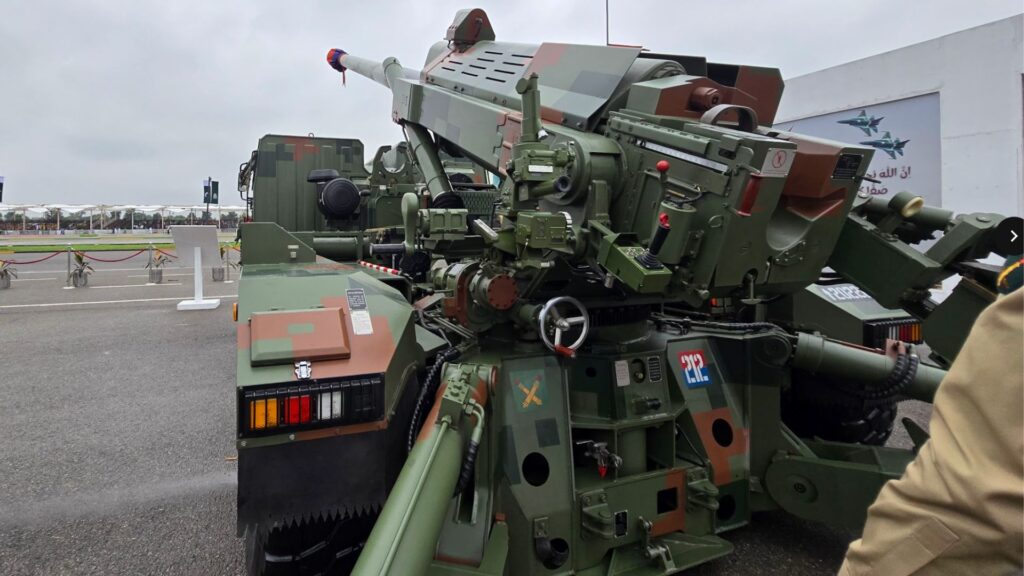
It is worth noting that the PA’s new platforms have largely solved the latency challenge at the launch step – i.e., the last link in the kill chain. This is because these systems are all integrated with a new digital fire control system (DFCS) that can directly draw on an external ISTAR source, notably GNSS/GPS. Thus, a measure of automated targeting-to-firing element is already present.
SH-15 Automatic Fire Control System (AFCS) and C4ISR Integration
The SH-15’s onboard systems reduce latency at two levels: the fire-control computation itself and the platform’s integration into the broader network.
Quwa Pro
See Where Emerging Defence Markets are Moving
Quwa Pro goes beyond tracking programs and equipment by explaining the policies, incentives, industry dynamics, and competitive pressures shaping South Asia's defence markets.