
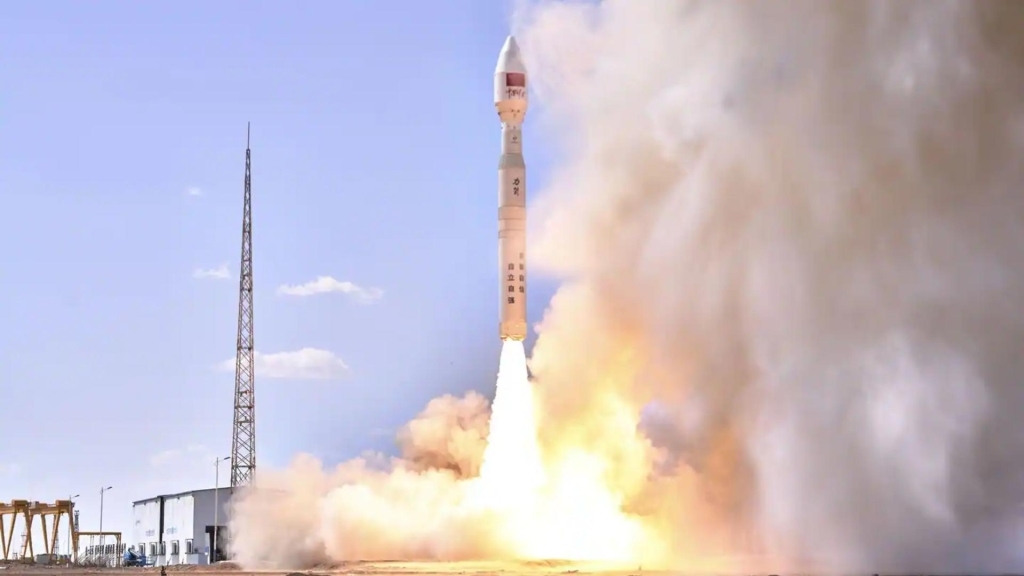
On 19 October 2025, China’s Jiaquan Satellite Launch Station sent into orbit Pakistan’s first hyperspectral imaging satellite, HS-1.
Pakistan’s Ministry of Foreign Affairs (MOFA) framed the launch of the HS-1, to be managed by the Space and Upper Atmosphere Research Commission (SUPARCO), as a significant step in Pakistan-China space cooperation. According to MOFA, the HS-1’s imaging data will be used to support “precision agriculture, environmental monitoring, urban planning, and disaster management.”
HS-1 now joins Pakistan’s growing constellation of Earth-observation satellites, which also includes the recently launched PRSC-EO1 and PRSC-S1, which provide electro-optical (EO) coverage.
This new launch adds to Pakistan’s imaging capability, providing now a multi-modal element whereby the EO1/S1 would report or provide context of an area, while the HS-1 will help with determining the actual nature (e.g., real or false positives) of any objects of interest in that area.
Overall, the new imaging constellation will contribute to the cadence, reliability, and sovereign control of Pakistan’s space-based intelligence, surveillance, and reconnaissance (ISR) capabilities.
Quwa Plus
Go Beyond the Headlines on Pakistan’s Defence and Security.
Quwa Plus gives you deeper reporting, briefings, and analysis on Pakistan’s defence programs, foreign policy, national security, and regional strategy. Follow the developments that matter to professionals, analysts, and serious readers tracking Pakistan’s security landscape.