
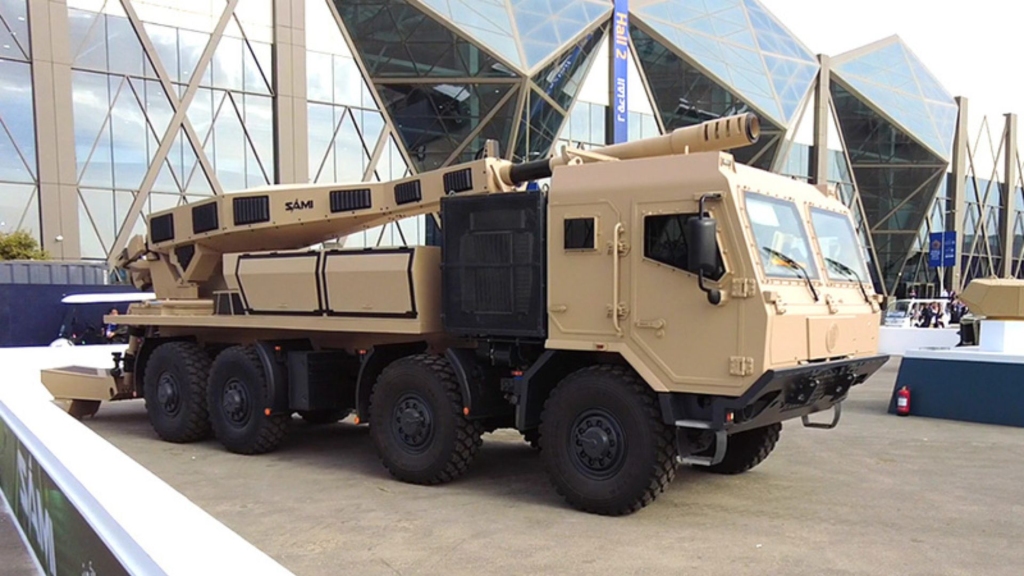
On 21 January 2026, Pakistan’s Heavy Industries Taxila (HIT) released a tender for the procurement of long-lead forgings for “Project P251” – i.e., a 155 mm/52-calibre Truck Mounted Artillery Gun System (TMAGS).
HIT is developing P251/TMAGS as an original wheeled self-propelled howitzer (SPH) for Saudi Arabian Military Industries (SAMI), which – as per the 2022-2024 Ministry of Defence Production (MoDP) Yearbook – selected HIT as the “prime contractor” for the SPH in 2022.
P251 is a continuation of an earlier project dating back to at least 2021, when HIT publicly announced it was working on an indigenous 155 mm artillery gun. However, it did not disclose the configuration, but the new MoDP report outlined that its tests were successful, thereby leading to a contract with SAMI to develop a full-fledged SPH.
This new tender calls for Long Lead High Value (LLHV) items, mostly high-quality alloys, for use in various parts of a new artillery gun system that HIT is developing in Pakistan, specifically the following grades:
- 40NiCrMoV15
- 35NiCrMoV12-5
- 35NiCrMoV12-5Mod
- 35NiCrMoV15Mod
The interesting aspect of these alloys is that they are all of high-quality European grades, with 35NiCrMoV15Mod in particular being positioned as an alloy for use in the next-generation 155 mm howitzer guns.
Thus, one can infer from the tender that SAMI had asked HIT to design and develop the gun system according to NATO – or at least near-NATO – standards, likely in line with the requirements of the Saudi military.
Currently, HIT requires seven items for use in the recoil system, three inputs for the breech components, and two items for the carriage. In effect, the tender covers all the components except the barrel, which Pakistan can manufacture indigenously.
Moreover, HIT requires the alloys to meet a tolerance requirement of -40°C, which indicates that SAMI’s requirements not only call for the need to operate in the hot environments of the Arabian Gulf but also in cold areas as well, potentially highlighting SAMI’s intent to market the system to other markets or, possibly, HIT looking ahead to a potential future Pakistan Army (PA) requirement as well.
Get the Full Picture on Pakistan’s Defence and National Security
Get dedicated Pakistani defence news, force analysis, procurement tracking, and national security policy insight, backed by more than a decade of documented reporting and depth general news coverage cannot match.
Overall, Project P251 or TMAGS carries several major implications that could reshape future Pakistani defence procurement trends.
First, the Pakistani defence industry is evidently marketing its in-house capacity for original design, development, and integration to others.
In fact, HIT is not unique in this regard, as the National Engineering and Scientific Commission (NESCOM) appears to be doing the same through its next-generation stand-off range weapons (SOW) projects, such as the AZB-81LR and Rasoob 250 smart munitions.
Original programs require overhead that the Pakistani military cannot always sustain as its limited funds compete with pressing operational needs. Thus, every development initiative requires a trade-off against procurement, hence why development is only taken seriously when off-the-shelf procurement is absolutely not an option.
The PA had tried to support an original next-generation tank program via the al-Khalid 2, but it likely could not shoulder the mounting development costs and urgently needed new tanks, so it opted for the VT4.
By marketing to other countries, especially those in the Gulf Cooperation Council (GCC) interested in building their defence industries, Pakistan’s state-owned enterprises (SOEs), e.g., HIT, NESCOM, and others, could offload R&D overhead to their foreign patrons.
In this case, the Saudis benefit from owning the IP for the new SPH and from HIT’s support in manufacturing it in Saudi Arabia, while HIT could design and offer a next-generation solution to the PA without charging the PA’s R&D overhead. Instead, the PA gets to see an operational SPH that it can opt to adopt and, in turn, spend only on direct manufacturing capacity overhead.
Besides funding, this approach could also be a way for Pakistan’s SOEs to gain overseas champions to facilitate their access to the latest CNCs, tooling, instrumentation, and other equipment for product development.
This freer access would elevate the quality and velocity of Pakistan’s own defence product development and, potentially (through a mix of foreign currency gains via exports, freed funding from product R&D, direct patronage funding, etc), help Pakistan invest in growing its own critical industries, such as steel and alloys, among others.
It is examples like P251 that should bring Pakistan’s shift to “Look West” into sharper focus, as more programs like this would be a major boon to Pakistan’s defence industry, from developing products to building critical industrial capacity. Thus, Riyadh and Islamabad could initiate additional projects of this nature on the back of their defence agreement.
In relation to P251 specifically, it seems that SAMI formally selected HIT as its prime contractor in September 2022, with the first contract signed in January 2023 to cover the detailed design and engineering costs. And a second contract was likely signed in December 2023, possibly allowing for prototype manufacturing.
Interestingly, in February 2024, SAMI unveiled an 8×8 wheeled 155 mm SPH at the World Defence Show in Riyadh. This system showcased an 155 mm gun mounted to a Czech TATRA 8×8 chassis, promising several key capabilities, such as semi-automatic loading, compatibility with GPS and GNSS-guided shells, and digital fire-control system. SAMI stated the system was undergoing trials with the Saudi Armed Forces. Although not confirmed, it would stand to reason that the howitzer shown by SAMI (as shown in the article image) was P251.
Second, the growth of original product design capacity in Pakistan could reopen the doors for Western Europe to factor deeply into Rawalpindi’s planning, except this time, it would be at the level of critical inputs (e.g., alloys, composites, etc) rather than complete systems or even, for that matter, subsystems. Pakistani SOEs such as HIT, NESCOM, National Radio and Telecommunications (NRTC), and the National Aerospace Science and Technology Park (NASTP) would take on a greater role in designing and integrating those subsystems.
Thus, at one level, defence-relevant transfers could potentially be much simpler for European regulators to pass as they would involve inherently dual-use inputs such as steel and alloys rather than complete solutions, such as engines or radars. However, at another level, Pakistan’s need or demand for manufacturing equipment, such as CNCs, would rise as well so as to support the domestic product design and production base. And this could lead to the risk of Western governments blocking the sale and transfer of certain systems to Pakistan. However, Saudi Arabia’s closer involvement could help Pakistan gain the leverage (using Riyadh’s far stronger fiscal position among European vendors) to overcome those hurdles. In any case, the availability of even some of the same types of manufacturing and instrumentation equipment accessible to India would greatly improve Pakistan’s capacity for defence product development.
Third, and returning to Project P251/TMAGS specifically, the PA could potentially be interested in leveraging a variant of this SPH in the future, especially as it may look to replace its older towed artillery guns.
While the PA has not yet voiced its interest in P251, it should be noted that Pakistan is investing in the wider artillery ecosystem. For example, two NESCOM entities are developing guided shell solutions; one is the Nishana Precision-Guided Kit (PGK), which configures unguided shells into guided ones via GNSS-based guidance modules and aerodynamic control surfaces, while the other is the Tipu, a laser-guided shell.
However, according to the 2022-2024 MoDP Yearbook, Pakistan’s main munitions producer, Pakistan Ordnance Factories (POF), is also working on 155 mm basebleed and basebleed rocket-assisted (BB/BBRA) shells, the latter could form the basis of guided long-range shells.
These guided shells would likely necessitate howitzer guns integrated with digital fire-control systems connected to satellite-based navigation and location systems and drones for targeting. In addition, the material improvements in newer guns could allow for greater accuracy as well as utilization/durability (e.g., higher firing rates for longer periods).
It would make sense for the PA to leverage these improvements through new-generation guns; however, inducting such guns at scale would pull domestic manufacturing, which adds to overall cost. Should the venture with SAMI enable HIT to lift the burden of the development and, possibly, production overhead costs, it could allow the PA to induct these guns at scale at a markedly lower cost than a standard purchase with technology transfer and licensed manufacturing rights.
While meant for Saudi Arabia, P251 would also stand to benefit through a PA acquisition, even in small numbers. The PA could play a critical role in field-testing the system to identify its technical issues, offer real-world operational feedback to HIT, and, ultimately, ensure SAMI receives both an advanced and mature system.
Quwa Plus · In-Depth Pakistan Coverage
Understand Pakistan’s Defence and National Security in Unmatched Depth
Understand what Pakistan is acquiring, how its armed forces are evolving, and where national security policy is heading through dedicated defence news, force analysis, procurement tracking, Pulse Check briefings, and more than a decade of documented reporting.
Featured & Trusted By