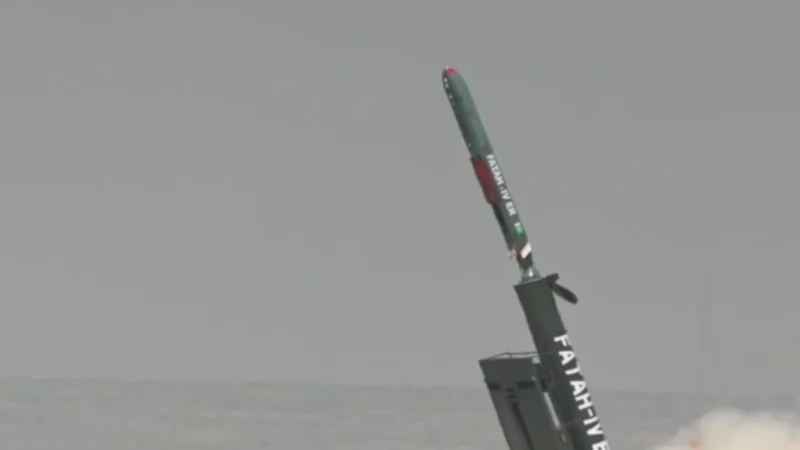

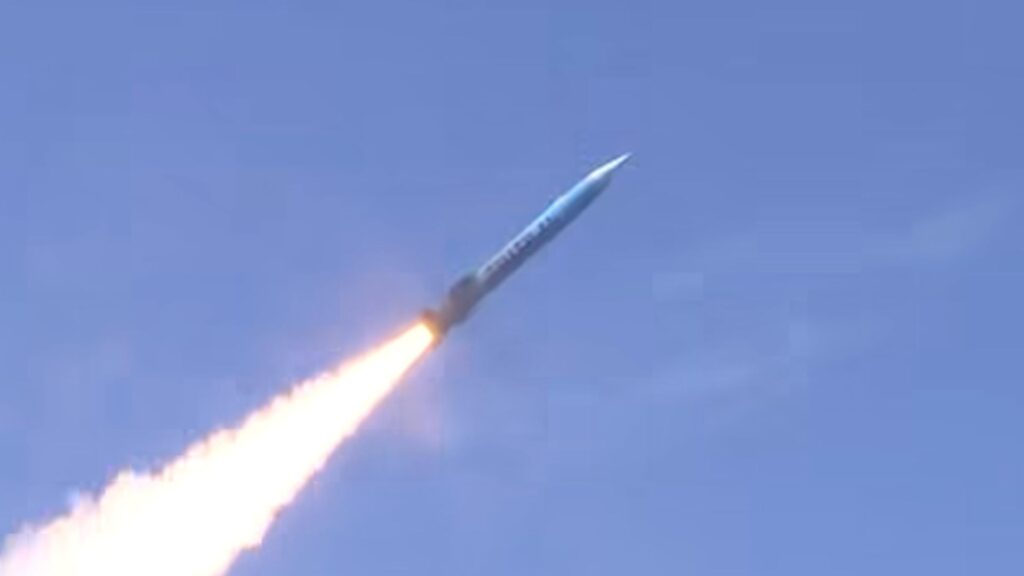
On April 15, 2026, the Pakistan Navy (PN) tested what it described as an indigenously developed ship-launched anti-ship ballistic missile (ASBM) that “accurately engaged its target with high speed at extended range.”[1] Chief of the Naval Staff (CNS) Admiral Naveed Ashraf witnessed the firing alongside senior scientists and engineers.[2]
This test points to the PN’s wider strike model. The service appears to be building a more scalable anti-ship missile mix centered on domestic development, common-platform production, and a wider range of launch options.
Turkish defence publication TurDef identified the launch platform as a Babur-class (MILGEM) corvette based on visual details in the released footage, including the IFF antenna, the SMASH 200/25 remote weapon station, and antenna placement near the exhaust.[3] If that identification is correct, then this was the first known ASBM firing from a corvette-class platform. The timing is also notable. The test came 11 days after the PN inducted PNS Khaibar (F-282), the second Babur-class corvette, on April 4.[4]
The missile itself appears to be a new sub-variant of the SMASH anti-ship ballistic missile, which GIDS is now openly identifying as the P282. During the previous known SMASH test, conducted from a Zulfiquar-class (F-22P) frigate in November 2025, the PN cited a domestic range of 350 km.[5] The use of the term “extended range” likely points to a longer-ranged configuration. However, the available information does not yet show how much range was added or whether the change came through a new motor configuration, revised propellant, lower payload weight, or a combination of these factors.
Background on the SMASH/P282
The P282 designation predates the SMASH branding. In October 2020, then-CNS Admiral Zafar Mahmood Abbasi described the program as a “hypersonic ship-launched anti-ship/land-attack ballistic missile” during his farewell address.[6][7] In practice, the “hypersonic” label was loose. It appears to have referred to terminal speed during descent rather than sustained hypersonic cruise in the contemporary sense of the term.
Quwa Plus
Go Beyond the Headlines on Pakistan’s Defence and Security.
Quwa Plus gives you deeper reporting, briefings, and analysis on Pakistan’s defence programs, foreign policy, national security, and regional strategy. Follow the developments that matter to professionals, analysts, and serious readers tracking Pakistan’s security landscape.
Join ($29.99/Year) Already a subscriber?Sign in