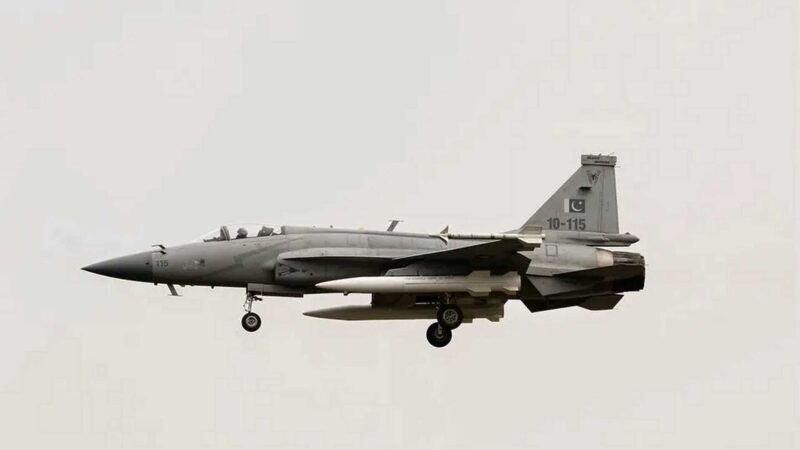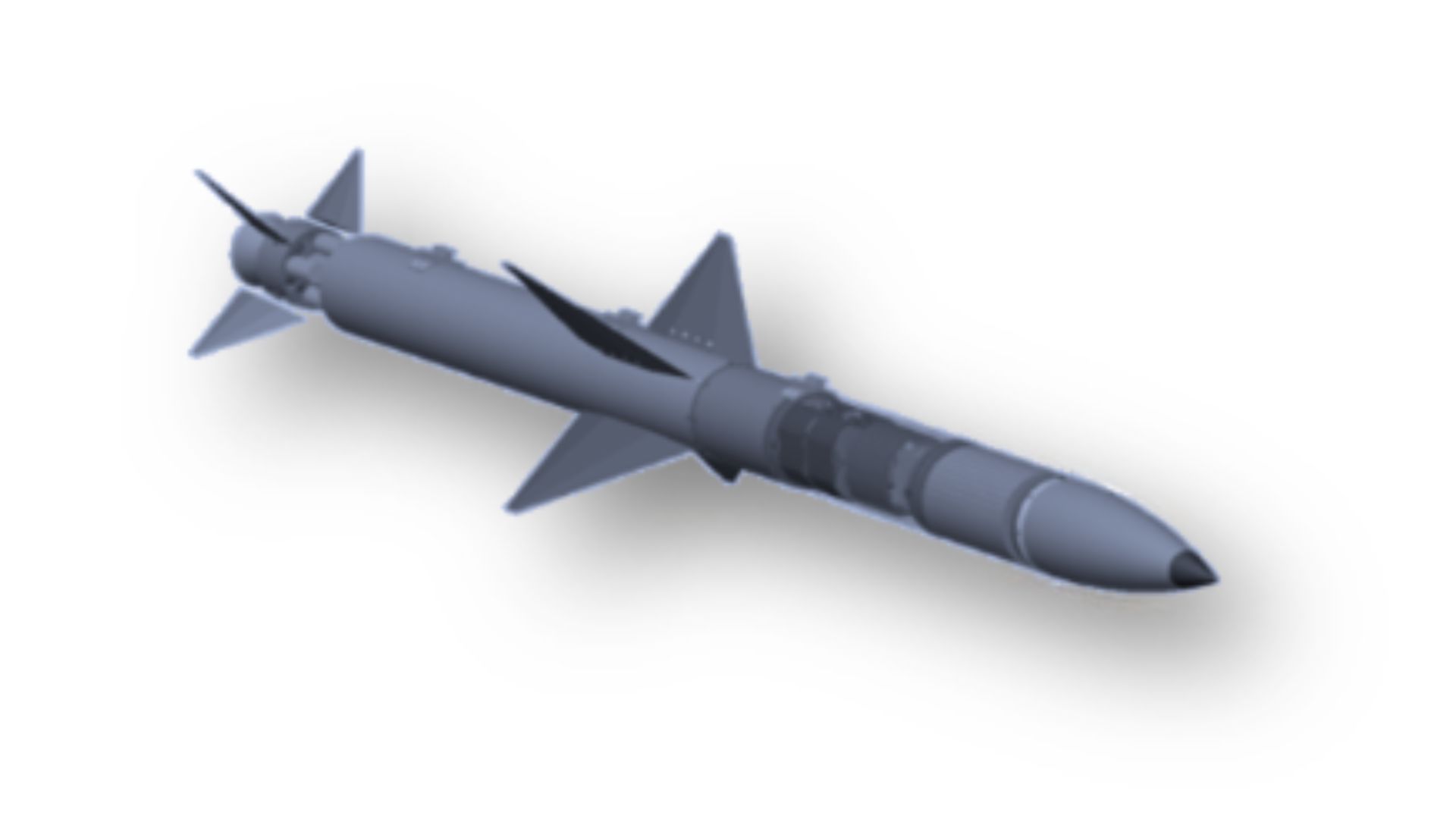

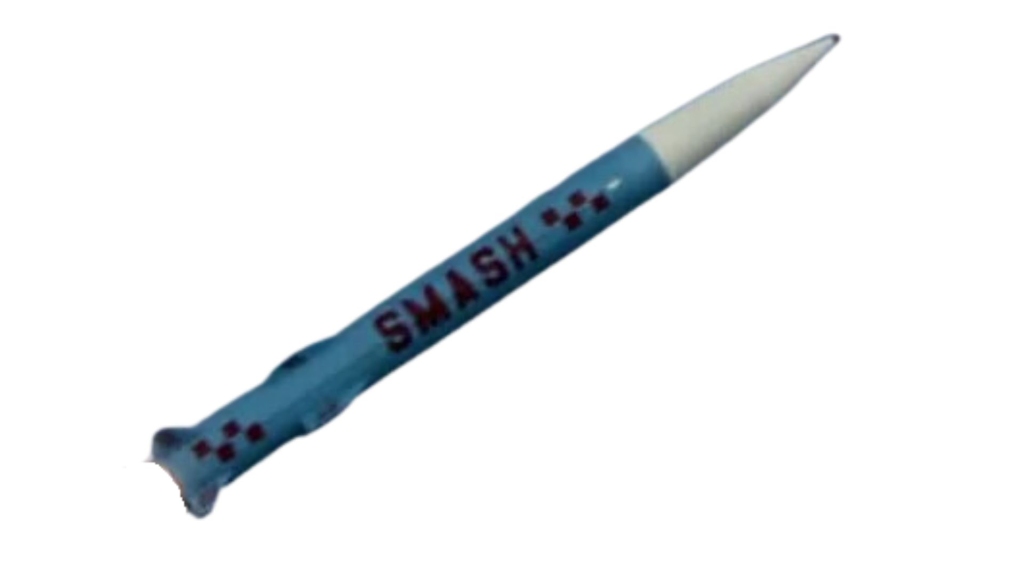
The SMASH anti-ship ballistic missile (ASBM) – an acronym for ‘Supersonic Missile Anti-SHip’ – is the Pakistan Navy’s indigenously developed ship-launched guided missile for anti-ship and land-attack missions. GIDS also designates it the P282. The Pakistan Navy (PN) operates the SMASH, a Fatah-2 derivative, at a domestic range of 350 km, an export range of 290 km, and a terminal speed exceeding Mach 2.
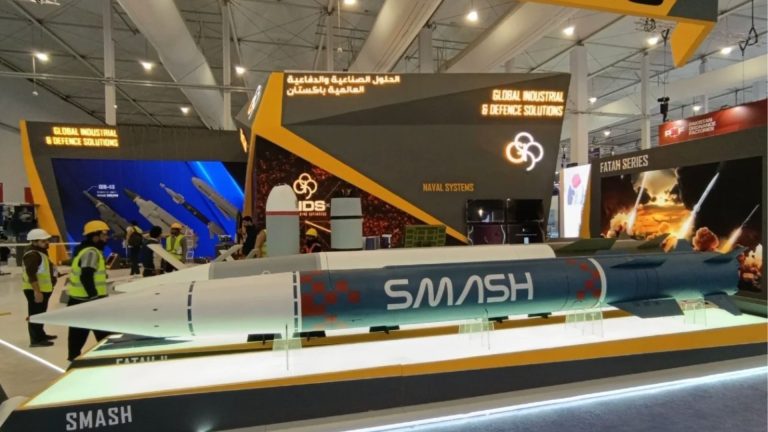
Global Industrial & Defence Solutions (GIDS) unveiled the SMASH for export at the 2026 World Defense Show (WDS) in Riyadh. In April 2026, the Pakistan Navy tested an extended-range variant from a Babur-class (MILGEM) corvette. GIDS describes the weapon as both ‘hypersonic’ and ‘super sonic’ across its own 2026 documentation – a discrepancy this profile examines in detail below.
SMASH Specifications
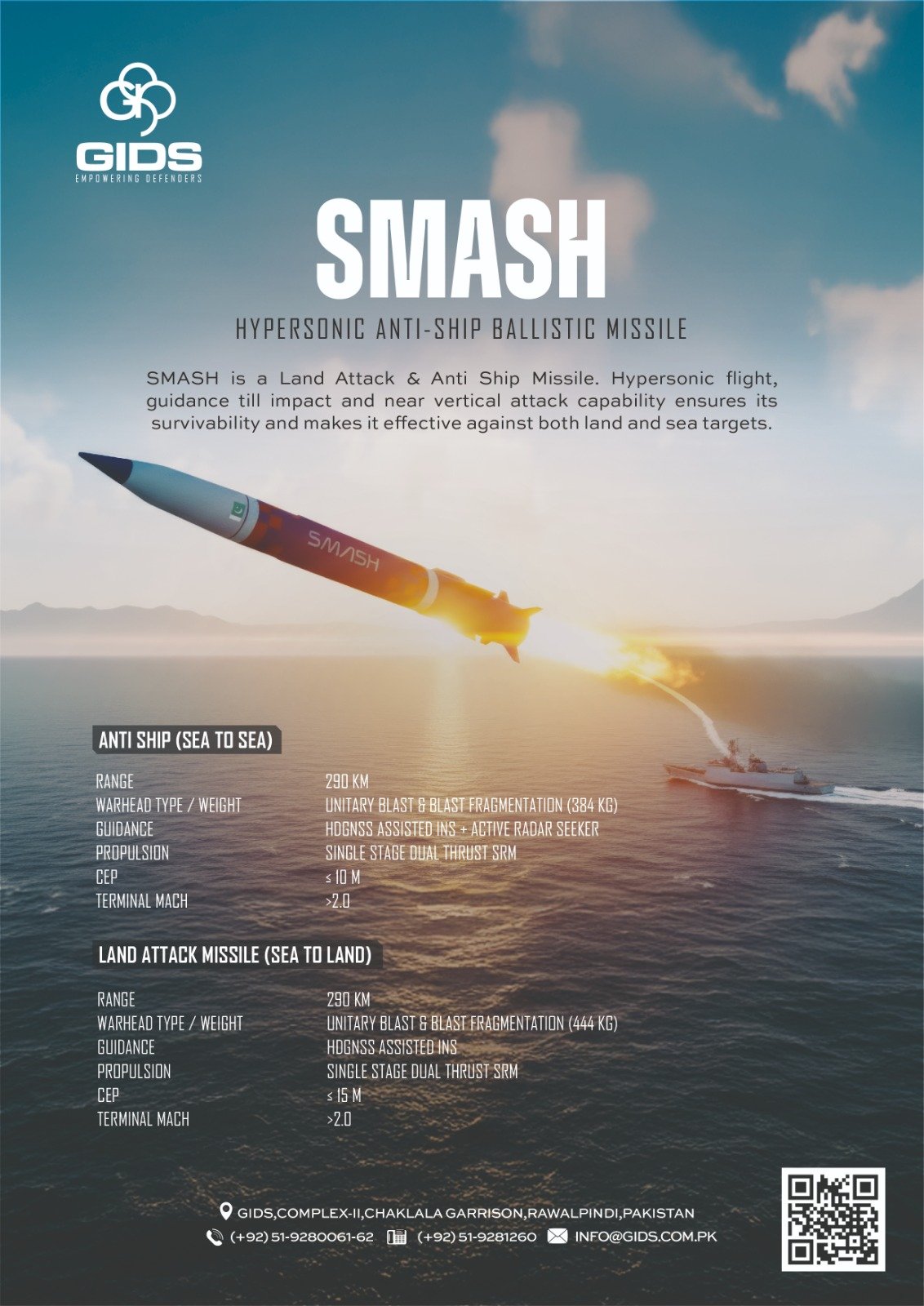
The figures below come from two GIDS primary sources: the standalone SMASH product datasheet GIDS issued around WDS 2026, and the GIDS Brochure 2026 corporate catalogue (p.40). Where the two documents differ, this profile shows both values.
Anti-Ship Configuration (Sea-to-Sea)
| Parameter | GIDS SMASH datasheet | GIDS Brochure 2026 (p.40) |
|---|---|---|
| Type | Anti-Ship Ballistic Missile (ASBM) | |
| Developer | NESCOM / GIDS | |
| Range | 290 km (export) | 290 km (export) |
| Warhead weight | 384 kg | 315 kg |
| Warhead type | Unitary blast and blast fragmentation | Semi-armour piercing |
| Guidance | HDGNSS-assisted INS + active radar-homing (ARH) terminal seeker | |
| Propulsion | Single-stage dual-thrust solid rocket motor (SRM) | |
| Accuracy (CEP) | ≤ 10 m | not stated |
| Terminal speed | > Mach 2.0 | ≥ Mach 2.0 |
Land-Attack Configuration (Sea-to-Land)
| Parameter | GIDS SMASH datasheet | GIDS Brochure 2026 (p.40) |
|---|---|---|
| Type | Land-Attack Missile (LAM) | |
| Range | 290 km (export) | 290 km (export) |
| Warhead weight | 444 kg | |
| Warhead type | Unitary blast and blast fragmentation | Blast fragmentation, for shore targets |
| Guidance | HDGNSS-assisted INS (no terminal seeker) | |
| Propulsion | Single-stage dual-thrust solid rocket motor | |
| Accuracy (CEP) | ≤ 15 m | ≤ 20 m |
| Terminal speed | > Mach 2.0 | ≥ Mach 2.0 |
Common Design Features
The GIDS Brochure 2026 lists a seven-item feature set for the SMASH that the WDS datasheet omits:
- Single-stage dual-thrust solid rocket motor
- Unique programmable trajectory
- In-flight manoeuvrability, with guidance until impact
- Specially designed indigenous thermal protection system
- Integrated navigation: HDGNSS-assisted INS with AJAS (anti-jam antenna system)
- Auto launch servo system and integrated positioning & orientation system
- Salvo and non-salvo firing modes
| Parameter | Specification |
|---|---|
| Diameter | 600 mm (common Fatah-2 airframe) |
| Common platform | Fatah-2 SSM |
| Status | Operational. The GIDS Brochure 2026 states the system is ‘installed on Pakistan’s Navy ships’ |
| Launch platforms | Zulfiquar-class (F-22P) frigate; Babur-class (MILGEM) corvette; Jinnah-class frigate (planned) |
Where the Two GIDS Documents Disagree
GIDS has published two primary-source specification sets for the SMASH, and they do not fully agree. The differences matter materially rather than cosmetically, and no other English-language source currently reconciles them.
- Anti-ship warhead type and mass. The datasheet gives a 384 kg unitary blast and blast-fragmentation warhead. The brochure gives a 315 kg semi-armour-piercing (SAP) warhead. This is not a rounding difference – a SAP warhead penetrates hull plating or superstructure before it detonates, while a blast-fragmentation warhead maximizes above-deck damage to sensors, launchers and weapon mounts. The two imply different targeting philosophies against the same class of warship.
- Land-attack accuracy. The datasheet gives a CEP of ≤15 m; the brochure gives ≤20 m. That ≤20 m figure matches the CEP the same brochure lists for the Fatah-II, which fits the two weapons sharing a guidance package in land-attack mode.
- Speed terminology. The datasheet titles the weapon a ‘Hypersonic Anti-Ship Ballistic Missile’ and describes ‘hypersonic flight’. The brochure titles the same weapon simply ‘Anti-Ship Ballistic Missile’ and describes ‘super sonic flight’. Both documents give the same terminal speed figure.
Two readings fit the evidence. GIDS may offer the 315 kg SAP and 384 kg blast-fragmentation warheads as alternative configurations to export customers, in which case both documents read correctly but incompletely. Alternatively, one document supersedes the other. Quwa could not establish the issue date of the brochure relative to the WDS datasheet, so this profile treats both as concurrent GIDS claims rather than as a revision.
Is the SMASH Hypersonic?
No. The SMASH is a supersonic weapon, not a hypersonic one. Both GIDS documents state a terminal speed of Mach 2.0 or greater. Hypersonic flight conventionally begins at Mach 5. A missile arriving at Mach 2+ is firmly supersonic – and the weapon’s own name says so: SMASH stands for Supersonic Missile Anti-SHip.
Where the ‘hypersonic’ claim originated
The label traces to October 2020, when then-Chief of Naval Staff Admiral Zafar Mahmood Abbasi publicly described the P282 program as a ‘hypersonic ship-launched anti-ship/land-attack ballistic missile’. That characterization then propagated through five years of secondary coverage, and GIDS itself carried ‘Hypersonic’ in the SMASH product title at WDS 2026.
The GIDS Brochure 2026 therefore stands out for what it does not say. In the corporate catalogue, GIDS describes the SMASH as having ‘super sonic flight’ and drops ‘hypersonic’ from the product title entirely, while leaving the stated performance unchanged. The manufacturer’s own documentation now supports the supersonic classification.
What about the Mach 8 figure?
Several outlets have reported the SMASH reaching Mach 8. No GIDS document supports that figure. Both the datasheet and the brochure state terminal Mach ≥2.0, and neither gives a mid-course or apogee velocity. A Mach 8 claim would sit awkwardly with a 290–350 km single-stage quasi-ballistic weapon on a 600 mm airframe; short-range ballistic missiles in this class typically peak around Mach 4–6 in mid-course, then decelerate through the denser lower atmosphere before impact. Treat Mach 8 as unsourced.
Why the distinction matters – and why it doesn’t
Terminology aside, a quasi-ballistic missile arriving at Mach 2+ on a near-vertical terminal trajectory poses a genuinely difficult intercept problem. Navies optimize ship-based air defences against sea-skimming cruise missiles on a horizontal approach; a steep top-down attack compresses reaction time and can fall outside the engagement envelope of point-defence systems that address low-altitude threats.
The distinction matters for benchmarking, not for capability. Analysts should measure the SMASH against other supersonic anti-ship weapons – the CM-302 in Pakistan Navy service, or India’s BrahMos, which cruises at roughly Mach 2.8–3.0 and likewise flies supersonic rather than hypersonic – and not against hypersonic glide vehicles.
SMASH Range, Speed and Weight
Range. GIDS markets the SMASH at 290 km in both anti-ship and land-attack configurations. That figure reflects the 300 km ceiling under Missile Technology Control Regime (MTCR) Category I guidelines for exported systems, not a physical limit. Reporting puts the domestic Pakistan Navy variant at 350 km, and the April 2026 corvette test involved an extended-range variant.
Speed. Both GIDS documents state a terminal speed of Mach 2.0 or greater. GIDS has not published a mid-course or peak velocity.
Weight. GIDS has not published a launch mass for the SMASH either. Published figures cover warhead mass only: 315–384 kg in anti-ship configuration and 444 kg in land-attack configuration, depending on the source document. The airframe shares the Fatah-2’s 600 mm diameter.
Common Platform With the Fatah-2
The SMASH and the Fatah-2 derive from the same core platform. Both use a single-stage dual-thrust solid rocket motor, share the same 600 mm-diameter airframe, and draw on the same guidance architecture.
The GIDS Brochure 2026 supports this directly. GIDS publishes an identical seven-item feature list for the SMASH (p.40) and the Fatah-II (p.31): the same programmable trajectory, the same indigenous thermal protection system, the same HDGNSS-assisted INS with AJAS, the same auto launch servo system, and the same salvo / non-salvo firing modes. Manufacturers do not usually reuse a feature list verbatim across two genuinely distinct products.
The substantive differences sit in three areas. First, the SMASH adds an active radar-homing terminal seeker for anti-ship use, which the Fatah-2 does not carry. Second, terminal accuracy in anti-ship mode improves to a stated 10 m CEP, against ≤20 m for the Fatah-II per the 2026 brochure. Third, GIDS structurally adapted the SMASH for shipboard launch. Notably, the brochure gives the SMASH the same ≤20 m CEP as the Fatah-II in land-attack mode – so the seeker delivers the accuracy gain, not the airframe.
At domestic range – 400 km for the Fatah-2, 350 km for the SMASH – the shorter reach of the anti-ship variant likely reflects the mass and volume penalty of the terminal radar seeker rather than a different motor.
HDGNSS Guidance and Anti-Jam Provision
Both GIDS documents list the SMASH’s mid-course guidance as ‘HDGNSS’-assisted INS. The designation likely refers to ‘high-definition’ global navigation satellite system, which could reflect China’s BeiDou constellation paired with a satellite-based augmentation system (SBAS).
The GIDS Brochure 2026 adds a detail the WDS datasheet omits: it specifies the integrated navigation suite as ‘HDGNSS assisted INS with AJAS‘ – an anti-jam antenna system. This matters. GNSS denial remains the central vulnerability of any INS/GNSS-guided weapon, and a controlled-reception-pattern antenna or equivalent null-steering array serves as the standard mitigation. Its inclusion suggests GIDS designed the SMASH for a contested electromagnetic environment rather than a permissive one.
In the anti-ship configuration, the HDGNSS/INS suite brings the missile within the acquisition cone of the ARH terminal seeker, which then handles the moving-target problem. In land-attack mode the HDGNSS/INS provides the sole guidance, yielding a CEP of 15–20 m depending on the source document.
Test History and Operational Status
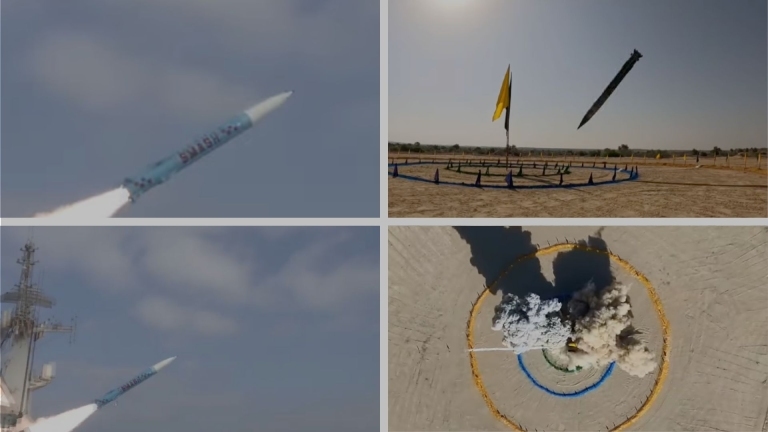
The first known test took place in November 2025 from a Zulfiquar-class (F-22P) frigate, confirming the SMASH as a shipboard-launched ASBM. Inter-Services Public Relations (ISPR) released footage of the launch.
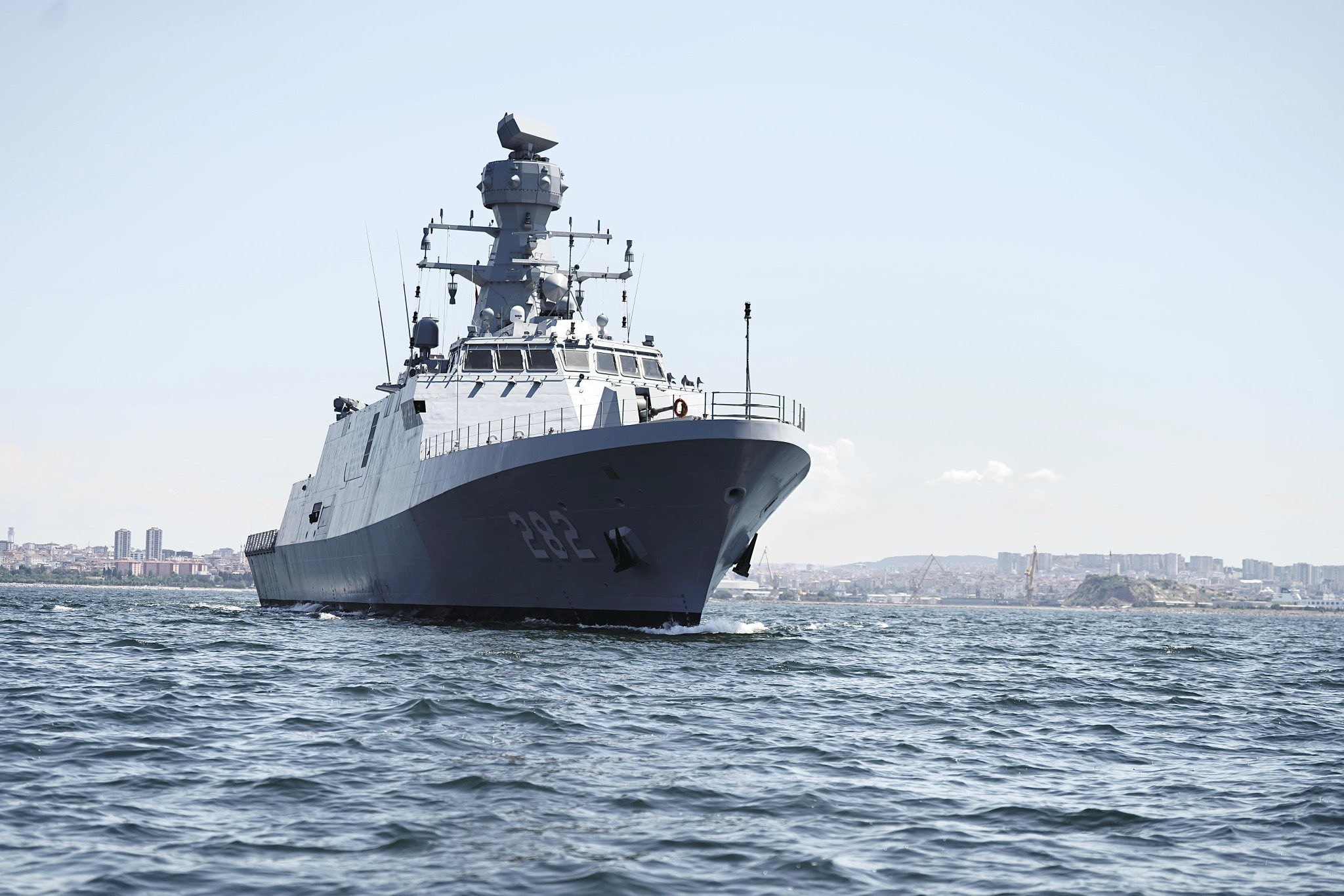
The second test occurred in April 2026, when the Pakistan Navy fired an extended-range variant from a Babur-class corvette – the first known ASBM firing from a corvette-class platform, and a meaningful signal of how far down the surface fleet the Pakistan Navy intends to push the capability.
GIDS formally promoted the SMASH at the 2026 World Defense Show in Riyadh, confirming the common Fatah-2 platform architecture. The GIDS Brochure 2026 describes the system as ‘installed on Pakistan’s Navy ships’ – the manufacturer’s own confirmation of operational rather than developmental status.
How the SMASH Compares to Other Anti-Ship Ballistic Missiles
An anti-ship ballistic missile is a ballistic or quasi-ballistic weapon that carries a terminal seeker so it can strike a moving vessel – a fundamentally harder problem than hitting fixed coordinates. Only a handful of states field one.
| System | Operator | Stated range | Class |
|---|---|---|---|
| SMASH / P282 | Pakistan Navy | 290 km export / 350 km domestic | Ship-launched, quasi-ballistic, ARH seeker |
| DF-21D | PLA Rocket Force | ~1,500 km | Land-based, medium-range |
| DF-26 | PLA Rocket Force | ~4,000 km | Land-based, intermediate-range |
| YJ-21 | PLA Navy | ~1,000 km (reported) | Ship- and air-launched |
| CM-401 | Export (CASIC) | ~290 km | Ship- and land-based, export-capped |
| Khalij Fars | Iran (IRGC Navy) | ~300 km | Land-based, EO seeker |
The closest analogue is China’s CM-401, another export-capped ASBM in the ~290 km class. Within this group the SMASH stands apart because it launches from a corvette-sized platform, whereas operators field the Chinese and Iranian systems predominantly from land or from larger combatants. That puts the capability on hulls Pakistan can build and operate in numbers.
A2/AD Role and the Pakistan Navy’s Strike Mix
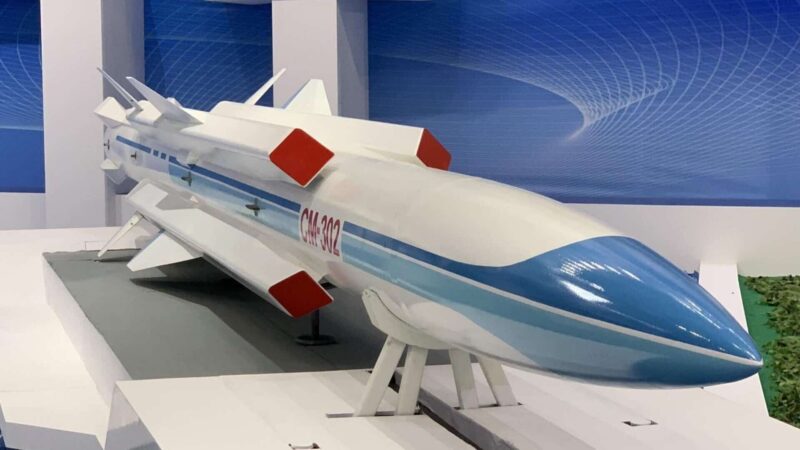
The SMASH introduces a third approach vector to the Pakistan Navy’s anti-ship portfolio, alongside subsonic anti-ship cruise missiles (the Harbah family) and the CM-302 supersonic-cruising missile that the Tughril-class (Type 054A/P) frigates carry.
Its quasi-ballistic trajectory and terminal speed above Mach 2.0 create a qualitatively different problem set for adversary air defences. A mixed salvo combining the SMASH’s high-altitude, steep-descent approach with low-altitude sea-skimming ASCMs would force a defending ship to engage threats across two flight profiles at once – a saturation problem rather than a speed problem. The brochure’s salvo firing mode matches exactly that concept of operations.
Platform Integration: Current and Planned
The Pakistan Navy has test-fired the SMASH from the Zulfiquar-class (F-22P) frigate and the Babur-class (MILGEM) corvette. Quwa expects integration aboard the Jinnah-class frigate to follow. Reporting has also raised the possibility of a land-based coastal battery variant, though GIDS has not published such a configuration.
Production and Export Potential
The SMASH’s common-platform relationship with the Fatah-2 lets NESCOM consolidate supply chains across the Pakistan Army and Pakistan Navy – one airframe, one motor line, one guidance package, two customers. GIDS markets the SMASH at its export-capped 290 km range alongside the Fatah-2 as part of a modular missile family.
The two warhead descriptions across GIDS’s own documents may themselves signal an export strategy. A 315 kg semi-armour-piercing option alongside a 384 kg blast-fragmentation option would let a customer choose between penetrating heavier combatants and maximizing above-deck effect against lighter ones – the kind of configurability that decides competitive export tenders.
The SMASH’s appearance at WDS 2026, alongside GIDS’s broader push into the Saudi defence market, suggests GIDS views the missile as a credible export product rather than a domestic-only system.
Frequently Asked Questions About the SMASH
What is the SMASH missile?
The SMASH – ‘Supersonic Missile Anti-SHip’, which GIDS also designates the P282 – is a Pakistani ship-launched anti-ship ballistic missile. NESCOM developed it and GIDS markets it. It engages both ships and land targets, and it derives from the Fatah-2 surface-to-surface missile.
Is the SMASH missile hypersonic?
No. Both GIDS documents give a terminal speed of Mach 2.0 or greater, which is supersonic. Hypersonic flight begins at Mach 5. GIDS’s WDS 2026 datasheet uses the word ‘hypersonic’, but the GIDS Brochure 2026 describes the same missile as ‘super sonic’. See the full discussion above.
Does Pakistan have a hypersonic missile?
Not by the Mach 5 definition, judging by published manufacturer specifications. GIDS states terminal Mach ≥2.0 for both the SMASH and the Fatah series. Pakistani officials have used ‘hypersonic’ to describe the P282 program since 2020, but no published figure supports it.
What is the range of the SMASH?
GIDS markets it at 290 km for export, in both anti-ship and land-attack configurations. Reporting puts the domestic Pakistan Navy variant at 350 km. The export figure reflects MTCR Category I guidelines rather than a physical limit.
What is the speed of the SMASH missile?
GIDS states a terminal speed of Mach 2.0 or greater. No GIDS document supports the Mach 8 figure that circulates in secondary coverage.
What warhead does the SMASH carry?
GIDS publishes two different anti-ship warheads across its own documents: a 384 kg unitary blast and blast-fragmentation warhead in the SMASH datasheet, and a 315 kg semi-armour-piercing warhead in the GIDS Brochure 2026. Both documents agree on a 444 kg warhead in land-attack configuration.
What is the difference between the SMASH and the Fatah-2?
They share a common 600 mm platform, motor and feature set. The SMASH adds an active radar-homing terminal seeker for anti-ship use, and GIDS adapted it for shipboard launch. The Fatah-2 uses INS and GNSS only, against land targets.
What ships carry the SMASH?
The Pakistan Navy has test-fired it from the Zulfiquar-class (F-22P) frigate and the Babur-class (MILGEM) corvette, and plans to field it on the Jinnah-class frigate. GIDS states that the system already equips Pakistan Navy ships.
How does the SMASH compare to BrahMos?
They belong to different weapon classes. BrahMos is a supersonic cruise missile that flies a low, air-breathing profile at roughly Mach 2.8–3.0. The SMASH is a quasi-ballistic missile that climbs, then attacks near-vertically at Mach 2+. Neither flies hypersonic. The SMASH gains its edge from trajectory geometry rather than speed.
What is an anti-ship ballistic missile?
A ballistic or quasi-ballistic missile that carries a terminal seeker so it can locate and strike a moving ship. Unlike a cruise missile, it spends most of its flight on a high-arcing trajectory and attacks steeply from above. Fielded examples include China’s DF-21D, DF-26 and YJ-21, Iran’s Khalij Fars, and Pakistan’s SMASH.
Sources and Documentation
This profile draws on manufacturer primary sources and official Pakistani statements. Where GIDS documents conflict, Quwa reports both figures rather than reconciling them by assumption.
- GIDS SMASH product datasheet – which GIDS issued in connection with the 2026 World Defense Show, Riyadh. It supplies the 384 kg anti-ship warhead, ≤10 m anti-ship CEP and ≤15 m land-attack CEP figures. This page reproduces it above.
- GIDS Brochure 2026, p.40 (SMASH) and p.31 (Fatah-II) – the corporate product catalogue. It supplies the 315 kg semi-armour-piercing warhead, ≤20 m land-attack CEP, the AJAS anti-jam reference, the salvo / non-salvo firing modes and the ‘installed on Pakistan’s Navy ships’ statement.
- Inter-Services Public Relations (ISPR) – which announced the November 2025 launch and released imagery from the Zulfiquar-class test.
- Admiral Zafar Mahmood Abbasi, then Chief of Naval Staff – who in October 2020 publicly described the P282 as a ‘hypersonic ship-launched anti-ship/land-attack ballistic missile’, originating the hypersonic designation.
- Missile Technology Control Regime – Category I guidelines, which set the context for the 290 km export ceiling.
Quwa has covered the Pakistan Navy’s anti-ship missile programs since 2015. Quwa reviews this profile after each publicly confirmed test or manufacturer disclosure.
Related Profiles
- GIDS Fatah Missile Family – Overview of the full Fatah series and common-platform architecture.
- Fatah-2 Surface-to-Surface Missile (SSM) – The SMASH’s parent platform.
- Fatah-1 Guided MLRS – The combat-proven 140 km-range guided rocket system.
- GIDS Harbah-NG Anti-Ship Cruise Missile – The Pakistan Navy’s subsonic ASCM.
- CM-302 Supersonic Anti-Ship Cruise Missile – The Tughril-class supersonic ASCM.
- YJ-21 Anti-Ship Ballistic Missile – China’s ship-launched ASBM, for comparison.
- PN Tests Extended-Range ASBM from Corvette – April 2026 Babur-class test analysis.
- GIDS Begins Promoting SMASH for Export – WDS 2026 coverage.