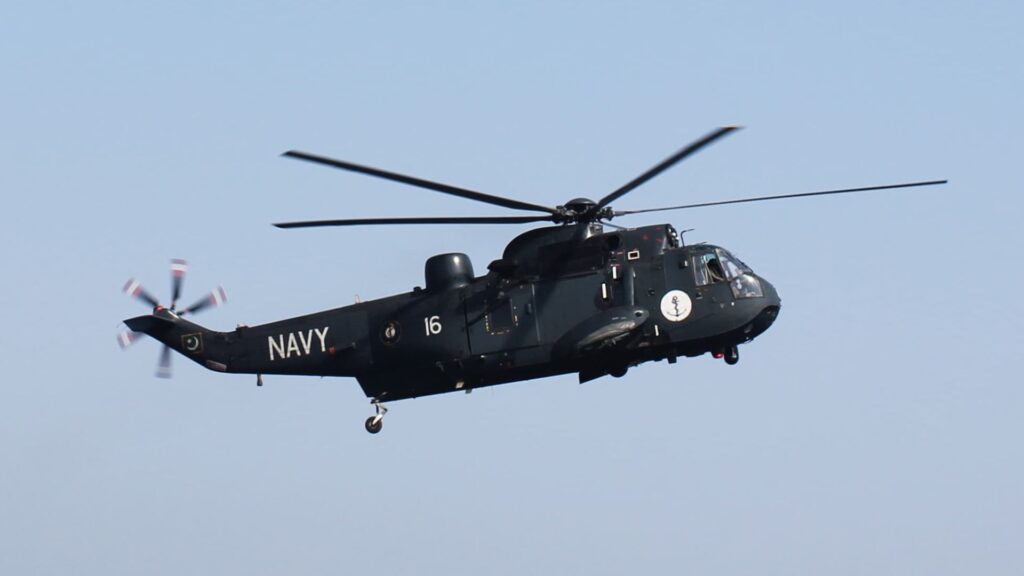
The Pakistan Navy (PN) currently operates roughly 20 Westland WS-61 Sea King helicopters alongside six Harbin Z-9EC anti-submarine warfare (ASW) helicopters and approximately seven Aérospatiale SA316/319 Alouette III light utility helicopters. The Sea King constitutes the PN’s most numerous and versatile rotary platform, filling roles spanning anti-surface warfare (ASuW), ASW, combat search and rescue (CSAR), and troop transport for the SSG-N and Marines. The fleet was built opportunistically over nearly five decades, drawing on three separate acquisition batches from the United Kingdom and Qatar, and is now facing questions over long-term supportability as global Sea King operators retire their fleets.
This report examines the PN’s current helicopter fleet, the fiscal and supplier-side constraints that have deferred a next-generation procurement, the candidate platforms available, and the engagement pathways for prospective vendors.
Executive Summary
The PN’s rotary-wing fleet is anchored to the Sea King – a platform it has operated since 1974 across ASuW, ASW, CSAR, and troop transport roles. However, the fleet comprises airframes from three separate acquisition batches (1974, 2017, and 2021) with wide variation in age and configuration, and the global support base for the type is shrinking as operators in Germany, the U.K., and Canada retire their fleets. The six Z-9EC shipborne helicopters have not been expanded despite eight new surface combatants entering service, and the Alouette III utility fleet is nearing the end of its useful life.
The helicopter requirement has been deferred by a dense procurement pipeline – i.e. the Hangor-class submarine program, the Jinnah-class frigate, the SWATS program, and the Sea Sultan LRMPA – which collectively consume the PN’s available budget. On the supplier side, the PN appears to prefer a single medium-weight platform (9–12 tonnes) configurable across all key roles, but the S-70i Black Hawk is blocked by ITAR, the AW101 and AW159 are cost-prohibitive at fleet scale, and the Chinese Z-20’s export status is unclear.
The most promising candidate is the Turkish Aerospace T925 – a 12-tonne heavy utility helicopter with a navalized variant planned, free of ITAR constraints, and backed by the NRDI-TUSAS MoU signed in February 2025 and a reported joint helicopter discussion at the 8th Pak-Turk Joint Working Group in January 2025. The T925 has not flown yet (maiden flight targeted for 2026), but the PN’s own requirement is not immediate, and the timelines could align if both sides engage early. Vendors should expect a two-to-five-year lead time before procurement initiation, and should come prepared with financing, regulatory pre-clearance, and a willingness to engage in an original collaborative program involving NRDI and NESCOM.
The Sea King Fleet: Three Batches, One Backbone
The PN’s Sea King fleet was not procured through a single contract. It was assembled across three separate acquisitions spanning 1974 to 2021, resulting in a fleet of at least four different marks with wide variation in age, configuration, and remaining airframe life.
The first batch arrived in 1974–1975 – i.e. six Sea King Mk.45 helicopters from the United Kingdom, forming No. 111 ASW Squadron at PNS Mehran.1 These were based on the Royal Navy’s HAS.1 and were capable of both ASW and ASuW, carrying AM39 Exocet anti-ship cruise missiles (ASCM) or Mk.44/Mk.46 lightweight torpedoes (LWT). One was lost in an accident in 1986 and replaced by an ex-Royal Navy HAS.5 (redesignated Mk.45C).
The second batch came in 2017, when the PN bought seven ex-Royal Navy and ex-Royal Air Force Sea Kings – i.e. two HC.4 Commando troop transport variants, one HAR.3A search-and-rescue (SAR) variant, and additional airframes for spare parts. Vector Aerospace refurbished three to flyable condition at its Gosport facility and shipped them to Karachi in December 2017.2 The HC.4s can each deploy up to 27 fully equipped troops or 2,700 kg in internal payload, providing a capability increase to the PN Marines and SSG-N. However, according to Asian Military Review, one of the former HC.4s was lost in August 2018 during a close-proximity manoeuvre with a PN frigate, reducing the operational count from the second batch almost immediately after delivery.3
The third and largest batch arrived in 2021. The PN received 10 ex-Qatari Sea Kings, comprising five Commando Mk.3A (ASW/ASuW-capable, fitted to carry two Exocet ASCMs) and five Commando Mk.2 (troop carrier and utility). These were inducted into No. 111 Squadron, bringing the PN’s total Sea King fleet to approximately 20 airframes.45 The induction ceremony was attended by officials from both Qatar and China.
Quwa Pro
See Where Emerging Defence Markets are Moving
Quwa Pro goes beyond tracking programs and equipment by explaining the policies, incentives, industry dynamics, and competitive pressures shaping South Asia's defence markets.
Subscribe Already a subscriber?Sign in