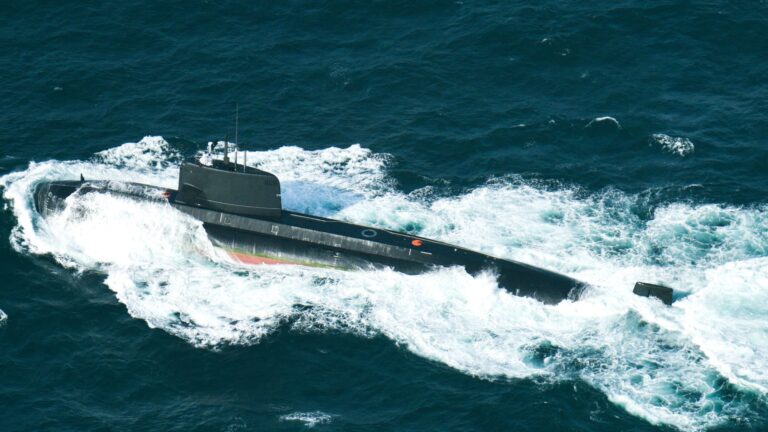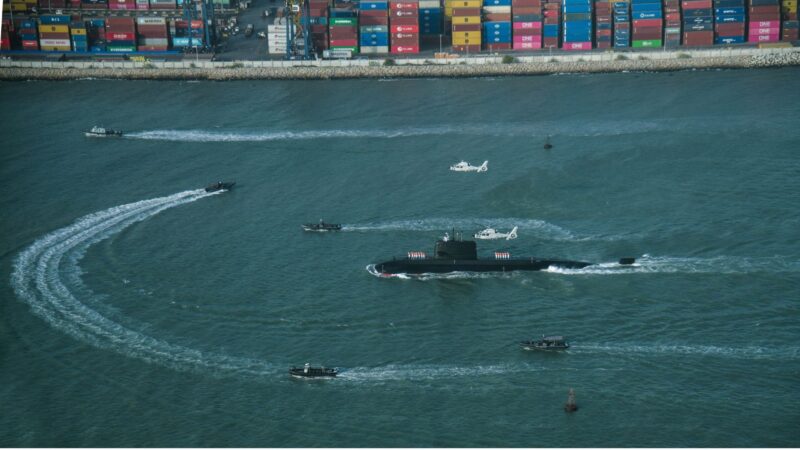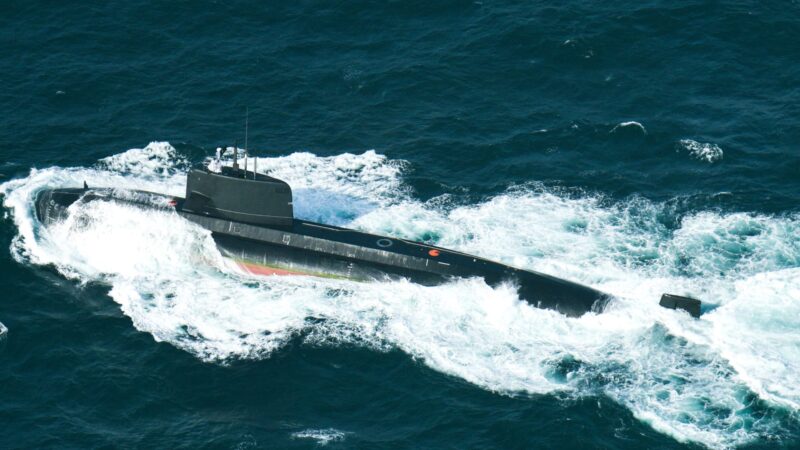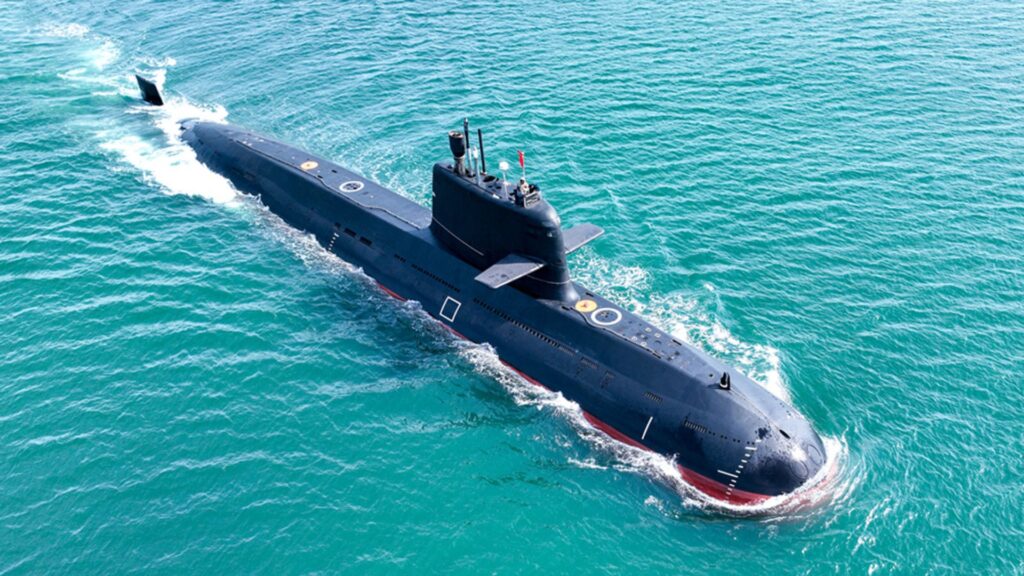
The Pakistan Navy (PN) commissioned the lead Hangor-class air-independent propulsion (AIP)-equipped submarine, PNS/M Hangor, at a ceremony in Sanya, China. President Asif Ali Zardari attended the event as chief guest, alongside Chief of the Naval Staff (CNS) Admiral Naveed Ashraf.
The commissioning caps a program that has been over a decade in the making – one that survived supplier disruptions, pandemic-driven delays, and a forced engine switch – to deliver what the PN regards as the centrepiece of its subsurface modernization. With seven more boats to follow, the Hangor-class will nearly quadruple the PN’s AIP-equipped submarine fleet from three to 11 boats, potentially giving it one of the largest sub-surface fleets in Asia.
Admiral Ashraf, speaking at the ceremony, framed the induction around the security of sea lines of communication (SLOC) across the Arabian Sea and the wider Indian Ocean. He stated that the Hangor-class – armed with advanced weapons, sensors, and AIP – will play a key role in deterring aggression and maintaining maritime order.
Get the Full Picture on Pakistan’s Defence and National Security
Get dedicated Pakistani defence news, force analysis, procurement tracking, and national security policy insight, backed by more than a decade of documented reporting and depth general news coverage cannot match.
A Program Shaped by Setbacks
The Hangor-class program traces its origins to the collapse of a separate deal. In the late 2000s, the PN had been negotiating with Germany’s Howaldtswerke-Deutsche Werft (HDW) for three Type 214 submarines. That effort fell through around 2011, prompting the PN to open talks with China Shipbuilding & Offshore International Co. Ltd (CSOC) for a new fleet of AIP-equipped boats.
In April 2015, the Pakistani government approved the purchase – not of the originally discussed six submarines, but of eight. The Ministry of Defence Production (MoDP) initially designated the program as the ‘S20,’ though the boats would later be identified as derivatives of CSOC’s S26 export design.
Reports pegged the overall deal at $4–5 billion, though it was unclear whether that figure included only the submarines or also the four Type 054A/P frigates the PN subsequently ordered from China. In January 2017, then-CNS Admiral Muhammad Zakaullah announced the new submarines would be christened the Hangor-class – honouring the original French-built Daphne-class boat that, in 1971, became the first submarine since World War II to sink a warship.
However, the program hit a major disruption when Germany refused to issue export licences for the MTU diesel engines originally specified for the submarines. The decision forced Pakistan and CSOC to switch to Chinese-made CHD-620 diesel engines – a change that, while ensuring the program’s continuity, introduced delays as the propulsion package was re-engineered.
The COVID-19 pandemic compounded those setbacks further.
Despite these difficulties, production at Wuchang Shipbuilding’s Shuangliu Base in Wuhan moved forward at a steady clip from 2024 onwards. The lead boat was launched for sea trials in April 2024, with the second (PNS/M Shushuk), third (PNS/M Mangro), and fourth (PNS/M Ghazi) following in March, August, and December 2025, respectively.
According to the PN’s Director General of Public Relations (DGPR), all four Chinese-built boats had been in the final stages of handover prior to PNS/M Hangor’s commissioning.
The four remaining boats are being assembled at Karachi Shipyard & Engineering Works (KSEW) under a technology transfer arrangement. The steel cutting ceremony for the fifth boat (first KSEW-built) took place in December 2021, and the keel laying for the sixth was held in February 2025.
However, the KSEW-built units are tracking behind the original schedule – which had envisioned all eight boats delivered by 2028 – and are now likely to be completed in the early 2030s.
To support the program, KSEW has invested in dedicated infrastructure. According to the MoDP’s 2022–2024 Yearbook, the shipyard installed a Ship Lift & Transfer System (SLTS) with two parking stations specifically allocated for submarine construction.
Design and Capabilities
The Hangor-class is broadly derived from the Yuan-class (Type 039B) family that forms the backbone of the People’s Liberation Army Navy’s (PLAN) conventional submarine fleet, though the Pakistani variant carries distinct specifications.
At 2,800 tons displacement and 76 m in length, the Hangor is heavier than the 2,550-ton S26 export baseline but slightly shorter than its 77.7 m reference design. The submarine features six torpedo tubes configured to fire heavyweight torpedoes, anti-ship cruise missiles (ASCM), and – in all likelihood – the Babur 3 submarine-launched cruise missile (SLCM), which Pakistan has tested with a stated range of 450 km.
The Hangor uses a Stirling-cycle AIP system, which uses a carbon fuel source to generate electricity to power the boat’s motors. In general, an AIP system enables a submarine to operate underwater without the need to snorkel for oxygen over a long time period – potentially several weeks.
This is a critical capability. A conventional diesel-electric submarine must periodically rise to snorkelling depth to run its diesel engines and recharge its batteries. During those windows, the submarine is exposed to detection by maritime patrol aircraft (MPA), surface ships, and their associated sensors. AIP removes much of that exposure, enabling the boat to stay submerged and on station for far longer.
The PN is not new to AIP. Its three upgraded Khalid-class (Agosta 90B) submarines use the French MESMA system, which operates on a similar principle but uses ethanol and oxygen combustion rather than a Stirling engine. However, the Agosta 90B displaces 2,083 tons when submerged – significantly smaller than the Hangor’s 2,800 tons. As Quwa has previously noted, the Hangor’s larger displacement and Yuan-class lineage point to a submarine designed for open-ocean, long-endurance operations rather than primarily coastal or shallow-water work.
In this sense, the AIP system is not just about underwater endurance in isolation. It is about giving the PN a submarine that can patrol the sea lines of communication (SLOC) running through the Arabian Sea and into the wider Indian Ocean – and do so for extended periods without surfacing. The PN could use the Hangor to deter adversaries from contesting those SLOCs, or to take a more forward approach aimed at interdicting an adversary’s own western supply lines.
Extending Pakistan’s Anti-Access Lines
The strategic rationale for the Hangor-class is rooted in the PN’s evolving anti-access/area-denial (A2/AD) posture.
As Quwa has previously analyzed, the design of the Hangor positions the PN to push its contested maritime space farther from the Pakistani coastline and deeper into the Indian Ocean – shifting the A2/AD line from a purely defensive cordon around Pakistani ports towards a forward-deployed presence that could complicate adversary operations in their own areas of interest.
This represents a layered approach to subsurface warfare. The PN’s existing Agosta 90B submarines – equipped with French MESMA AIP – and the older Agosta 70 boats would continue to operate closer to Pakistani waters, defending the littoral zone and exclusive economic zone (EEZ). The Hangor-class, with its larger displacement, greater endurance, and open-water design, would be the primary asset for operations farther afield.
The planned shallow-water attack submarine (SWATS) program, though its current status remains opaque, would add another layer. If the SWATS boats materialize as small AIP-equipped submarines, they would free the Hangor fleet from littoral duties entirely, enabling the PN to dedicate most – if not all – of its Hangor-class boats to deeper operations.
Once all eight Hangor-class boats are inducted, the PN will operate a combined fleet of at least 11 AIP-equipped submarines. That fleet size would give it the capacity to maintain a meaningful number of boats on patrol at any given time while cycling others through maintenance and crew rest – a basic but critical arithmetic that the PN’s current fleet of five submarines (three Agosta 90B and two Agosta 70) cannot support.
Get the Full Picture on Pakistan’s Defence and National Security
Get dedicated Pakistani defence news, force analysis, procurement tracking, and national security policy insight, backed by more than a decade of documented reporting and depth general news coverage cannot match.
Submarines as the PN’s Funding Priority
The Hangor-class commissioning also brings into focus a longstanding question in Pakistani defence planning: how does the PN allocate its limited budget across competing requirements?
Over the past two decades, the PN has simultaneously pursued surface combatants – the Zulfiquar-class (F-22P) frigate, Tughril-class (Type 054A/P) frigate, Babur-class (MILGEM) corvette, and now the Jinnah-class frigate – as well as offshore patrol vessels, maritime patrol aircraft, and naval aviation assets. However, when one examines the PN’s core deterrence requirements, it is the submarine arm that carries the heaviest operational weight.
Submarines are the PN’s primary anti-ship warfare (AShW) and ASW platforms – the assets most capable of threatening adversary surface combatants and of hunting opposing submarines. In a contested maritime environment, surface ships – regardless of their missile armament – are increasingly vulnerable to detection and targeting by satellites, maritime patrol aircraft, and long-range anti-ship missiles.
Submarines, by contrast, operate below the surface detection threshold and can position themselves across chokepoints and SLOCs in ways that surface ships cannot replicate.
In this vein, one can see the PN treating the Hangor-class – and by extension the KSEW-built follow-on boats and the eventual SWATS program – as the highest-priority conventional capability investment. The surface fleet is essential for presence, escort, and peacetime maritime security operations, but it is the submarine fleet that underpins the PN’s warfighting credibility – a dynamic Quwa explored in its analysis of the PN’s ‘silent service’ as the true core of the navy’s future.
This dynamic will likely shape PN budget debates for the remainder of this decade. With four KSEW-built Hangor submarines still in production, the SWATS program in development, and the Sea Sultan long-range maritime patrol aircraft (LRMPA) yet to be contracted, the PN faces competing demands on a defence budget that, even after a 20% increase in 2025–2026, remains stretched across all three services.
Thus, the commissioning of PNS/M Hangor is not simply a fleet addition. It is the beginning of a structural reorientation in how the PN prioritizes its procurement spending.
The submarines will demand continued funding to complete the KSEW boats, to build the shore-based maintenance infrastructure for a larger fleet, and to train crews for what will be a significantly expanded submarine arm.
What Comes Next
The immediate outlook is the induction of the remaining three Chinese-built boats. Given that all four were in the final stages of sea trials by late 2025, one can expect PNS/M Shushuk, PNS/M Mangro, and PNS/M Ghazi to follow in relatively quick succession – potentially within 2026 itself.
That would double the PN’s AIP-equipped fleet from three Agosta 90B boats to seven within a single year, a pace of fleet expansion the PN has not experienced in its modern history.
The KSEW-built boats will take longer. Given the delays that have accumulated – from the engine switch to pandemic disruptions to the inherent learning curve of a shipyard building this class for the first time – a realistic timeline for the fifth and sixth boats is the late 2020s to early 2030s, with the seventh and eighth following thereafter.
Beyond the Hangor program itself, the PN’s longer-term submarine ambitions are extensive. The SWATS program, the question of a dedicated nuclear-capable platform, and the broader goal of becoming a submarine-designing and building navy all sit on the horizon.
However, those aspirations will hinge on whether Islamabad can sustain the multi-year defence spending necessary to bring them to fruition. The Hangor-class consumed a decade of institutional effort and billions in investment to reach this commissioning day.
Replicating that commitment for the next generation of submarines – while simultaneously maintaining and upgrading a growing surface fleet – will test the PN’s share of the national defence budget in ways it has not faced before.
Quwa Plus · In-Depth Pakistan Coverage
Understand Pakistan’s Defence and National Security in Unmatched Depth
Understand what Pakistan is acquiring, how its armed forces are evolving, and where national security policy is heading through dedicated defence news, force analysis, procurement tracking, Pulse Check briefings, and more than a decade of documented reporting.
Featured & Trusted By