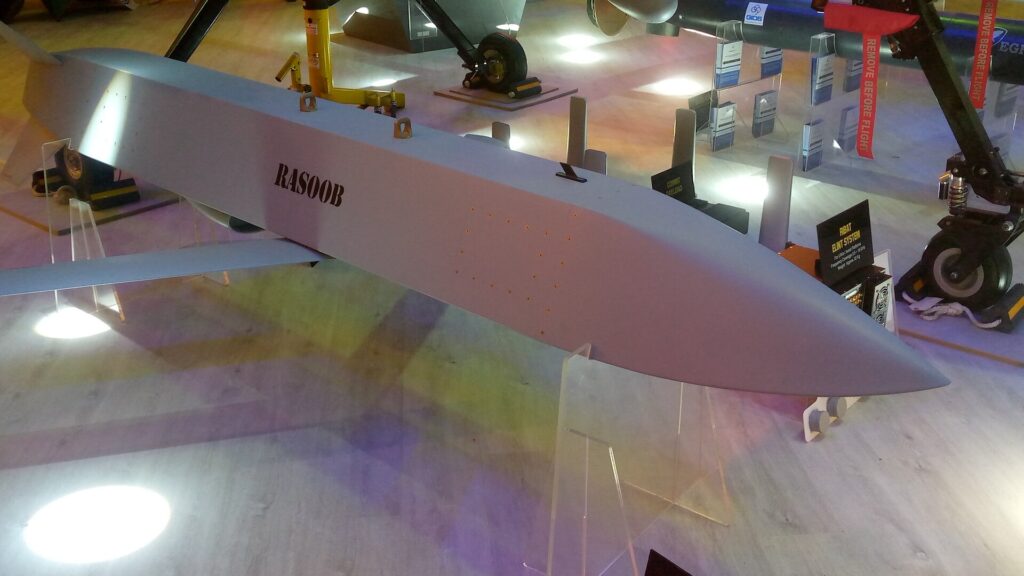
One of Pakistan’s currently in development air-launched cruise missiles (ALCMs), the Rasoob 250, could open the way for changes in how the Pakistan Navy (PN), to an extent, the Pakistan Air Force (PAF), and the Pakistan Army (PA) arm their platforms.
The basic point is that munitions like the Rasoob 250 – and its sibling munition AZB-81LR – trade warhead mass for a more compact size. This allows the end-user to either deploy long-range strike capabilities from lightweight platforms or deploy more munitions from larger ones. To offset the reduced warhead mass, these new designs leverage more precise targeting – the idea being that a tighter CEP would mean the munition does not need to rely as heavily on warhead effect, hence the smaller warhead.
Up to this point, the PN has relied on larger ASCMs – the C-802A, Exocet, Harpoon, and, most recently, the Harbah – none of which were manufactured by Pakistan. They were imported alongside their respective platforms – the C-802A with the F-22P/Zulfiquar-class frigates from China, the Exocet AM39 with the Agosta 90B submarines and PAF Mirage 5 fighters from France, and the Harpoon with the P-3C Orion maritime patrol aircraft from the United States – meaning each major platform acquisition brought its own parallel munitions inventory.
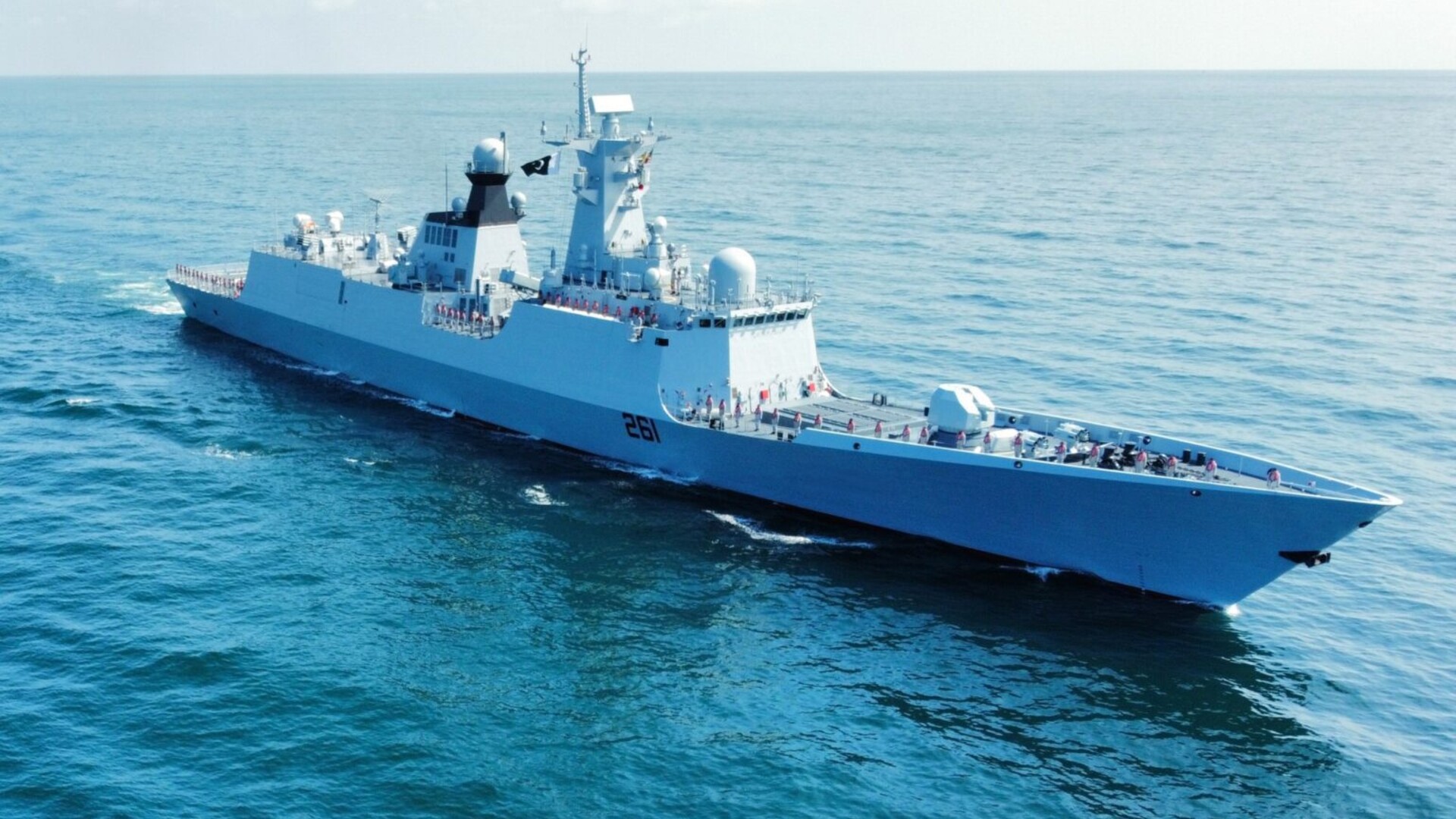
The Harbah changed this – as an indigenously developed dual anti-ship and land-attack cruise missile (LACM), it gave the PN, for the first time, the ability to deploy a domestically produced ASCM from both land and sea. However, the Harbah is a full-sized cruise missile and cannot be deployed from lighter platforms such as helicopters, drones, or small sub-250-ton fast attack craft (FACs).
In 2024, GIDS stated that the Rasoob 250 is being positioned as a solution for use from drones and slower-moving aircraft, such as helicopters and patrol aircraft. Thus, the PN appears to be a primary intended user, as it would need such a munition to give its helicopters, drones, and maritime patrol aircraft (Sea Eagle and Sea Sultan) a long-range anti-surface warfare (ASuW) capability.
But does the adoption of the Rasoob 250 have to be limited to those platforms? If overseas trends are an indication, not necessarily.
Emulating the Naval Strike Missile (NSM)
NATO states are increasingly adopting the Kongsberg Naval Strike Missile (NSM) as their mainstay subsonic anti-ship missile (AShM), whether launched from surface ships or land-based platforms. The NSM is smaller than the Harpoon it replaces across most of those navies – weighing 407 kg with booster, compared to the Harpoon’s 691 kg. But the switch ties back to the point made earlier: leveraging better targeting to drive smaller form factors.
Kongsberg began developing the NSM in 1996 as a replacement for the Norwegian Navy’s Penguin missile. The company’s stated philosophy was “smart missiles, rather than speedy missiles” – rejecting supersonic speed in favour of a stealthy composite airframe designed to evade detection altogether. The NSM uses a dual-band imaging infrared (IIR) seeker with autonomous target recognition (ATR). The ATR algorithm identifies a target by its thermal and shape signature, selects a specific aimpoint – such as the engine room, bridge, or magazine – and guides the 120 kg titanium semi-armour-piercing (semi-AP) warhead to that point. A void-sensing programmable fuze counts bulkhead penetrations before detonation, ensuring the warhead reaches the optimal internal compartment.
In other words, Kongsberg’s design insight was that a 120 kg warhead detonating inside a warship’s engine room is a mission kill regardless of the warhead’s mass – and this logic applies across the NSM’s target set, which ranges from small fast-attack craft to large naval combatants such as destroyers and frigates. The NSM’s cost-per-kill thus drops because each round has a high probability of disabling the target, rather than relying on brute explosive yield or requiring multiple impacts.
Quwa Plus
Go Beyond the Headlines on Pakistan’s Defence and Security.
Quwa Plus gives you deeper reporting, briefings, and analysis on Pakistan’s defence programs, foreign policy, national security, and regional strategy. Follow the developments that matter to professionals, analysts, and serious readers tracking Pakistan’s security landscape.
Join ($29.99/Year) Already a subscriber?Sign in