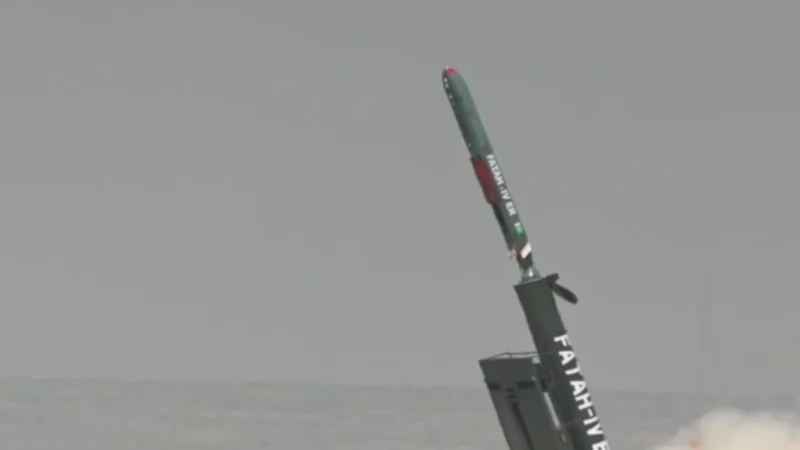
On 21 April, the Pakistan Navy (PN) announced that it test-fired the Taimoor air-launched cruise missile (ALCM), marking a key potential addition to the PN’s anti-surface warfare (ASuW) capabilities.
Background on the Taimoor ALCM
The Taimoor ALCM, developed by the National Engineering and Scientific Commission (NESCOM) and marketed by Global Industrial Defence Solutions (GIDS), has a range of 600 km (capped to 290 km for export).
Capable of engaging both fixed and moving targets on both land and sea, the Taimoor is the conventional-use counterpart of the strategic Ra’ad-2, Pakistan Air Force’s nuclear-capable long-range strike platform. The dual-role ALCM’s guidance suite consists of both dedicated mid-course and terminal-stage systems.
When en route to the target vicinity, the Taimoor uses an inertial navigation system (INS) aided by satellite navigation (GPS/GNSS/BeiDou). In addition, it also uses NESCOM’s own proprietary terrain contour matching (TERCOM) and digital scene matching correlator (DSMAC) system, allowing for terrain-hugging flight and routing so as to avoid anti-air threats. This guidance architecture mirrors that of NATO ALCMs like the MBDA SCALP/Storm Shadow and Turkish SOM systems, making it operationally credible against defended targets.
In the terminal stage, the Taimoor leans on an imaging infrared (IIR) seeker, which can identify and track both moving and fixed targets. With an airframe designed for low-observability and long-range flight, the Ra’ad and Taimoor family is essentially Pakistan’s analogous equivalent to the MBDA SCALP deployed by the Indian Air Force’s (IAF) Rafale fighters—a capability gap the PN is now working to address at the maritime level.
Quwa Plus
Go Beyond the Headlines on Pakistan’s Defence and Security.
Quwa Plus gives you deeper reporting, briefings, and analysis on Pakistan’s defence programs, foreign policy, national security, and regional strategy. Follow the developments that matter to professionals, analysts, and serious readers tracking Pakistan’s security landscape.
Join ($29.99/Year) Already a subscriber?Sign in