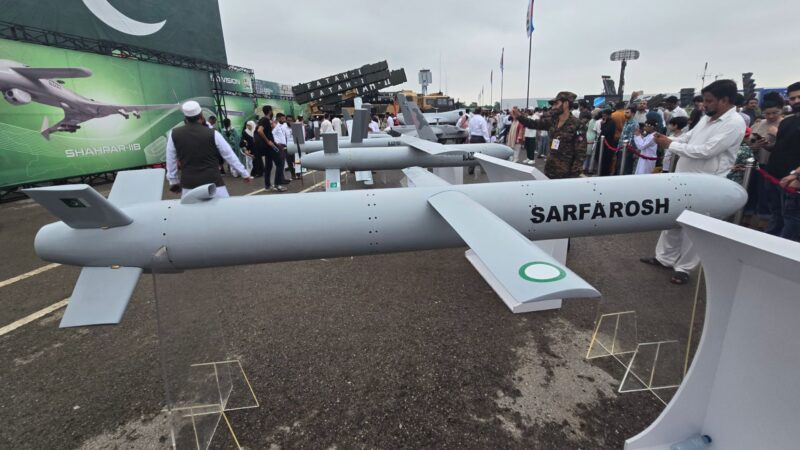
Pakistan’s defence industry recently took the wraps off two new jet-powered one-way attack drones – the Woot-Tech HiMark-25 and the “Baaz Delta” by Global Industrial Defence Solutions (GIDS).
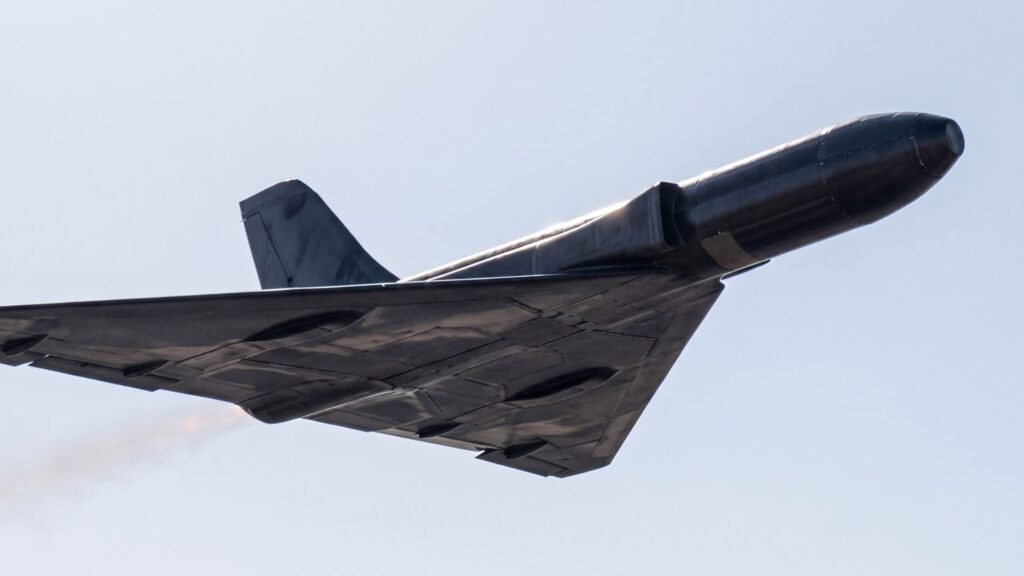
These new munitions are, at their core, relatively low-cost cruise missiles created by integrating loitering-munition platforms with miniature turbojet engines. Similar weapons have already been used by Russia in Ukraine (Geran-3 and Geran-5), while others are entering production in Western Europe (MBDA One-Way Effector or OWE).
The intent behind these jet-powered one-way attack drones (OWAD) or OWEs is to provide a long-range, precision-strike option that is scalable enough to deploy in numbers and provision rapidly at lower costs, at least compared to larger, traditional cruise missiles like the Babur-series or even precision-guided surface-to-surface missiles (SSM) like the Fatah-1 or 2.
The two systems reflect Pakistan’s continuing investment in asymmetrical strike technologies, building on earlier reveals of Shahed-style and several other loitering munition platforms.
In addition, the product reveals build on an earlier Market Intelligence (MINT) analysis by Quwa (from November 2025) that identified Pakistan as having all the groundwork to pursue OWE development.
In that analysis, this author stated: Pakistan is, perhaps more unintentionally than systematically, developing systems that could, in theory, readily become OWEs. However, it doesn’t appear that a cohesive strategy is in place to integrate these systems for the OWE role.”
Quwa Pro
See Where Emerging Defence Markets are Moving
Quwa Pro goes beyond tracking programs and equipment by explaining the policies, incentives, industry dynamics, and competitive pressures shaping South Asia's defence markets.