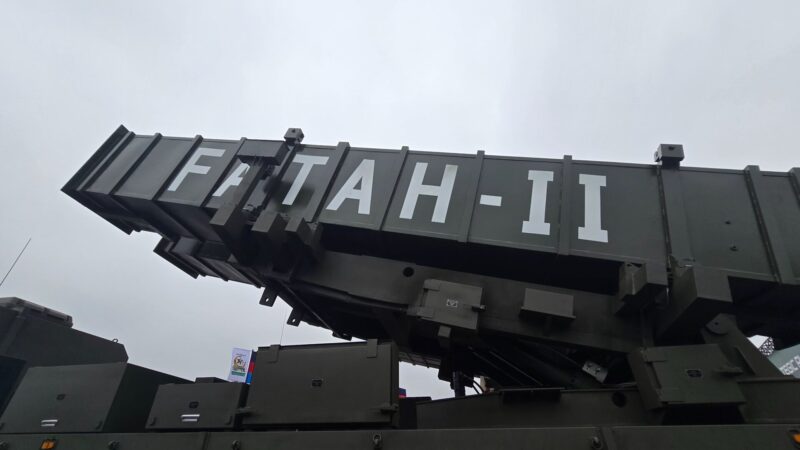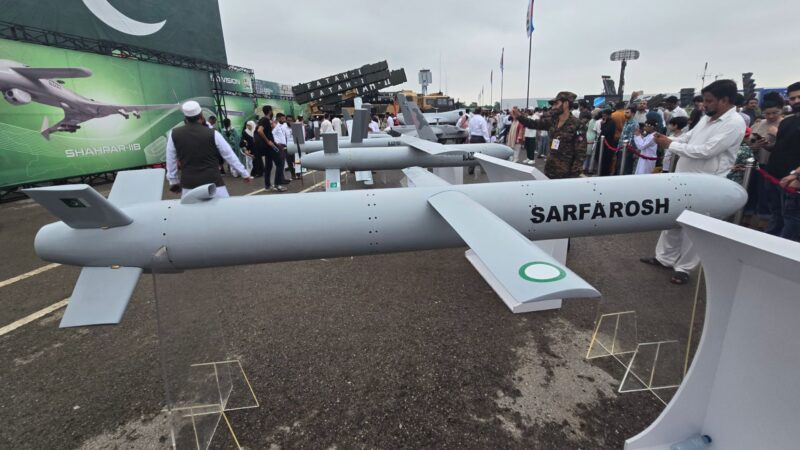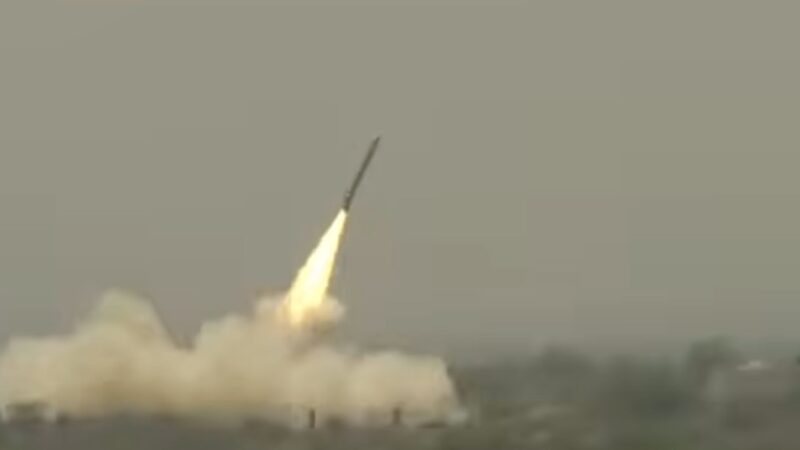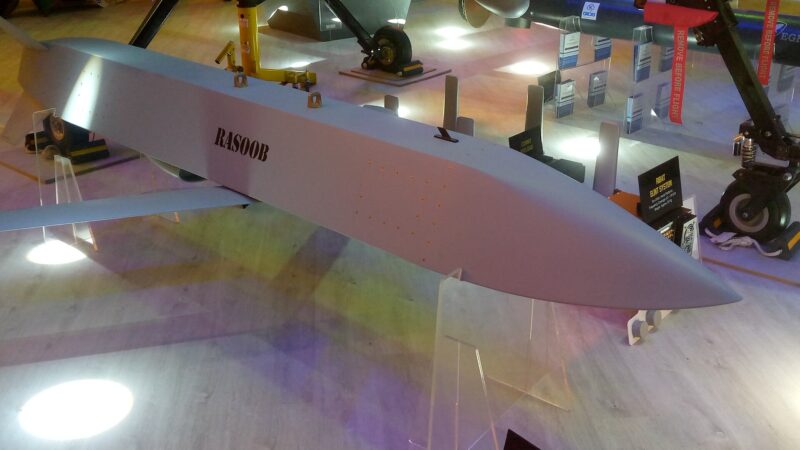
In a video released on 08 May, Pakistan’s Inter Services Public Relations (ISPR) revealed the Fatah-3 to be a ramjet-powered supersonic cruise missile (SSCM). Showing a still image of the weapon mid-launch from a road-mobile transporter-erector-launcher (TEL), the reveal marks the first public acknowledgement that the Pakistan Army has added a supersonic-cruising strike capability to its precision-fire arsenal.
The Fatah-3 bears a physical resemblance to the HD-1 – a supersonic land-attack and anti-ship missile (AShM) developed by China’s Guangdong Hongda Blasting Co., Ltd. – sharing its four lateral ramjet intakes, solid-fuel rocket booster configuration, and overall airframe geometry.
That said, a degree of caution is warranted. ISPR has previously used stock or repurposed footage in promotional videos. There has also been no publicly observed test – no NOTAM, no satellite imagery of a launch event – suggesting the Fatah-3 may not yet be inducted into operational service.
However, even if the system is further out than the imagery implies, the direction is arguably more important than the hardware’s current status. The reveal confirms that the Army Rocket Force Command (ARFC) intends to field a supersonic-cruising capability – and is willing to publicly commit to that trajectory.
In tracking Pakistan’s missile procurement and development activities, Quwa had inferred that Pakistan could procure an SSCM from China. In an article from 2019, this author stated that the HD-1 could emerge as an option:
It would be a mistake for Pakistan to approach supersonic-cruising ASCMs as India had with the BrahMos. The BrahMos, with its mass of 3,000+ kg, cannot be carried by lightweight fighters (such as the Tejas), and that is the reason why India is developing the 1,500 kg BrahMos NG.
However, Pakistan already has access to a supersonic-cruising missile that the JF-17 can potentially deploy – i.e., the Chinese HD-1A. The HD-1A weighs 1,200 kg, but offers a range of 290 km and a warhead of 240 kg. It can cruise at a speed of Mach 2.2 to Mach 3.5 and skim 5-10 m above sea-level.
It is not known how Pakistan is approaching its supersonic missile program. One option (which many observers expect) is that Pakistan will simply buy a Chinese design, potentially with localized turn-key production, and re-brand it with a local name. But while the use of Chinese subsystems is plausible, if one carefully looks at the Babur, Harbah, Ra’ad, etc., they will not find identical Chinese counterparts.
So, for a start, a heavyweight supersonic ASCM/LACM is plausible, especially since it is exclusive to the PN at this time. But Pakistan can also work on an original lightweight design with Chinese (or other overseas) support, which could see a missile similar in concept to BrahMos NG arrive sooner.
Quwa Plus
Go Beyond the Headlines on Pakistan’s Defence and Security.
Quwa Plus gives you deeper reporting, briefings, and analysis on Pakistan’s defence programs, foreign policy, national security, and regional strategy. Follow the developments that matter to professionals, analysts, and serious readers tracking Pakistan’s security landscape.
Join ($29.99/Year) Already a subscriber?Sign in