
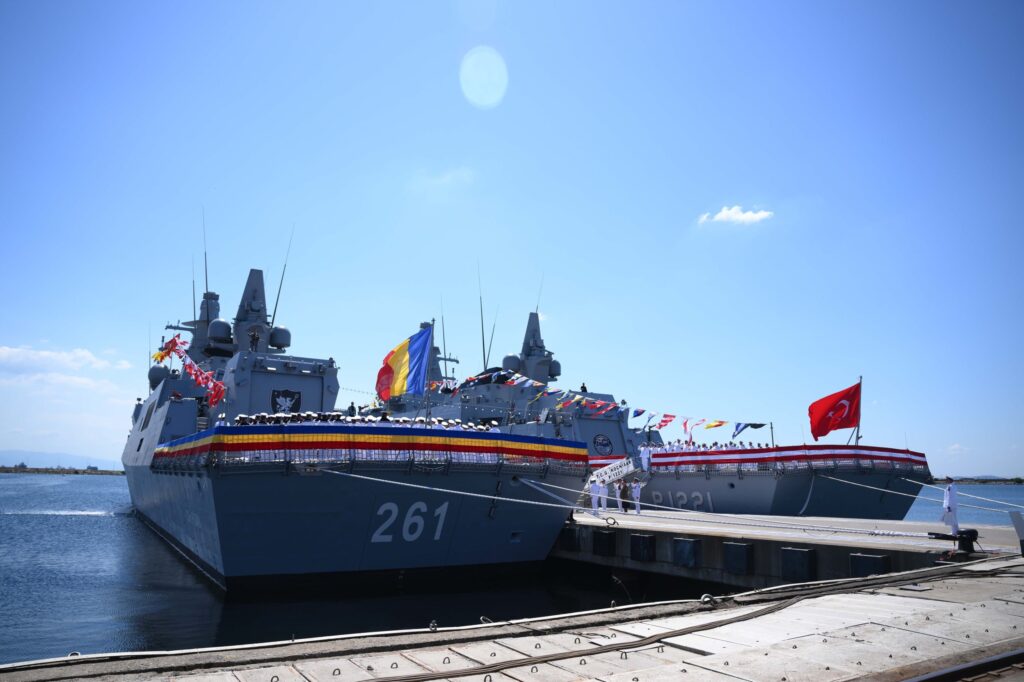
Türkiye has handed over the Hisar-class offshore patrol vessel (OPV) CAm. Roman to the Romanian Naval Forces, its first export of a combat-capable warship to a state that is a member of both NATO and the European Union, as reported by TurDef and Daily Sabah.
The delivery took place on 20 June at the Istanbul Naval Shipyard Command, where President Recep Tayyip Erdoğan and Romanian President Nicușor Dan oversaw the handover alongside Defence Minister Yaşar Güler.
“With the sales agreement we signed with Romania, Türkiye exports a warship to a NATO and EU member country for the first time in its history,” Erdoğan said at the ceremony.
Track Where Türkiye’s Defence Industry Is Finding Demand
Follow the markets Turkish firms are targeting, how they are positioning their products, and which countries are showing interest through reporting and analysis built for serious defence readers.
The ship and the ceremony
The vessel, formerly the Turkish Navy’s TCG Akhisar, enters Romanian service as the Rear-Admiral August Roman, carrying the pennant number 261. It was built by the Turkish state manufacturer ASFAT at the Istanbul Naval Shipyard Command, and is described variously as an offshore patrol vessel or a light corvette.
The handover was paired with the commissioning of TCG Koçhisar (P-1221), a sister Hisar-class ship that entered Turkish Navy service at the same event. Erdoğan noted that the two vessels were built at the same shipyard and by the same engineering teams.
President Dan framed the acquisition as support for Romania’s defence-investment pledge made at The Hague, for NATO’s capability targets, and for common security in the Black Sea. He also welcomed plans to develop maintenance facilities in Romania for the vessels serving its navy.
Turkish systems aboard
Erdoğan said the combat management system, the search and fire-control radars, the sonar, and the close-in weapon systems aboard the ships were developed by Turkish companies, naming Aselsan, Roketsan, Havelsan, the state firm MKE, and the research council TÜBİTAK.
TurDef reported that images of the Romanian vessel appeared to show MKE’s 76mm DENİZHAN naval gun, indicating that the export carries Turkish weapons and subsystems alongside the platform itself. Erdoğan put domestic content across Türkiye’s naval programs at more than 80 per cent.
Romania is expected to adjust the baseline configuration to its own requirements. Naval News reported that this includes integrating the Naval Strike Missile (NSM) to give the ship an anti-ship capability beyond its delivered fit.
How Romania got here
The delivery follows years of failed Romanian efforts to renew its fleet. Naval Group won Bucharest’s 2019 program for four Gowind corvettes and the modernization of two Type 22 frigates, but that effort collapsed in 2023 after disputes over costs, industrial arrangements and implementation.
Several of the years lost in that program overlapped with Russia’s full-scale war against Ukraine, during which the Black Sea became an active theatre of missile strikes, mine threats and contested sea control. Bucharest was left to find a naval solution in a far harsher environment than the one in which its original corvette plan had been drawn up.
Türkiye’s earlier naval export to a NATO and EU member had been STM’s auxiliary oiler for Portugal. The Romanian delivery takes Turkish naval exports into the combat-vessel segment within the Alliance for the first time.
Erdoğan placed the sale within a wider account of Turkish defence growth, describing the country as the world’s 11th-largest defence exporter, citing $996 million in defence and aerospace exports the previous month, and saying Türkiye now has more than 50 warships under construction, including over 15 for allied and friendly states. Ankara and Bucharest, which raised their relationship to a strategic partnership in 2011, also cooperate with Bulgaria on clearing naval mines in the Black Sea.
Quwa Pro
Understand Where Türkiye’s Defence Export Momentum Is Building
Get clearer visibility into which countries are interested in Turkish systems, how firms are competing, and where procurement attention is moving.
Featured & Trusted By






Notes and Comments
Türkiye had already sold a support ship to a NATO and EU member: the fleet oiler for Portugal. A combat-capable hull is a different kind of export. Selling one to an ally puts Turkish industry in a part of the market that European and other established yards have long held.
Since Russia’s invasion of Ukraine, the United States and the United Kingdom have wanted a stronger Allied naval presence in the Black Sea. Türkiye has held to the Montreux Convention, which limits how long non-littoral warships can stay in the basin after transiting the Turkish Straits. Selling a warship to Romania lets Ankara strengthen a littoral ally’s navy without touching those rules. It builds up NATO through a partner’s own fleet, not through a larger outside presence that would test the Montreux limits Ankara wants to keep.
Naval Group’s corvette deal for Romania collapsed in 2023, and the lost years ran through the most dangerous period the Black Sea has seen in decades. Türkiye could hand over a ship that was already built, which mattered more to Bucharest than it would have before the war.
The combat management system aboard the ship is from Havelsan. The radars, electro-optics and the Gökdeniz close-in gun are from Aselsan. The sonar and fire control are Turkish, the 76mm main gun comes from the state firm MKE, and TÜBİTAK and others sit behind individual subsystems. This is the same network that matured on the MILGEM program – the Ada-class corvettes and the Istanbul-class frigates – and it now travels with each ship Türkiye sells. Propulsion has been one of the few areas where Turkish warships still lean on foreign engines.
Türkiye’s own Hisar-class ships carry Roketsan’s Atmaca anti-ship missile and Hisar-D air-defence missiles. Romania plans to fit the Naval Strike Missile, a Western weapon, instead. Türkiye supplies the platform and the core systems; the buyer picks the strike weapons. That widens the customer base, but it limits how much of each ship stays Turkish.
Türkiye’s defence exports to Europe were worth roughly $369 million in 2020. By 2023 they had reached about $1.2 billion, and in 2025 they ran to around $4.3 billion. Total Turkish defence and aerospace exports climbed in step, from $5.5 billion in 2023 to $7.1 billion in 2024 and past $10 billion in 2025. By one industry count, Turkish firms supplied 27 per cent of the new equipment European militaries took on in 2024, ahead of the United States. The deals behind those numbers are spread across the region. Otokar is building more than a thousand Cobra II armoured vehicles for Romania under an €857 million deal, made inside the country. Baykar’s TB2 serves with Romania, Poland, Albania, Kosovo and Bosnia. Nurol Makina and Otokar have sold vehicles to Hungary and Estonia. Baykar has gone further west, into Italy, through its LBA Systems venture with Leonardo. The warship is the naval entry on that list.
The same formula is what makes South Korea Türkiye’s sharpest competitor. Romania bought 54 K9 howitzers and K10 resupply vehicles from Hanwha, and Hanwha began building a large armoured-vehicle plant in Romania in early 2026, with local content of up to 80 per cent. Poland has gone much further, ordering K2 tanks, K9 guns, FA-50 jets and Chunmoo rocket systems in deals worth tens of billions. Korea wins on the same terms Türkiye uses: fast delivery, deep local production and price. In shipbuilding its scale is the bigger threat. HD Hyundai and Hanwha Ocean can build complex warships quickly and in volume, which is exactly where Türkiye wants to go next. At Romania’s BSDA 2026 show, Korean firms were already pushing hard for the country’s large unmanned-vehicle programs.
An offshore patrol vessel is a modest combatant, not a frigate or destroyer. Part of the “first warship” label is political. The harder test is whether Türkiye can sell its heavier designs – the TF-2000 air-defence destroyer or larger frigates – into the same NATO market, against Korean and European yards.
Türkiye has moved from selling drones and support ships to allies toward selling them surface combatants. Romania may be the first of several such customers, or a one-off created by a particular gap. The next few years, and the pressure from Seoul, will show which.