
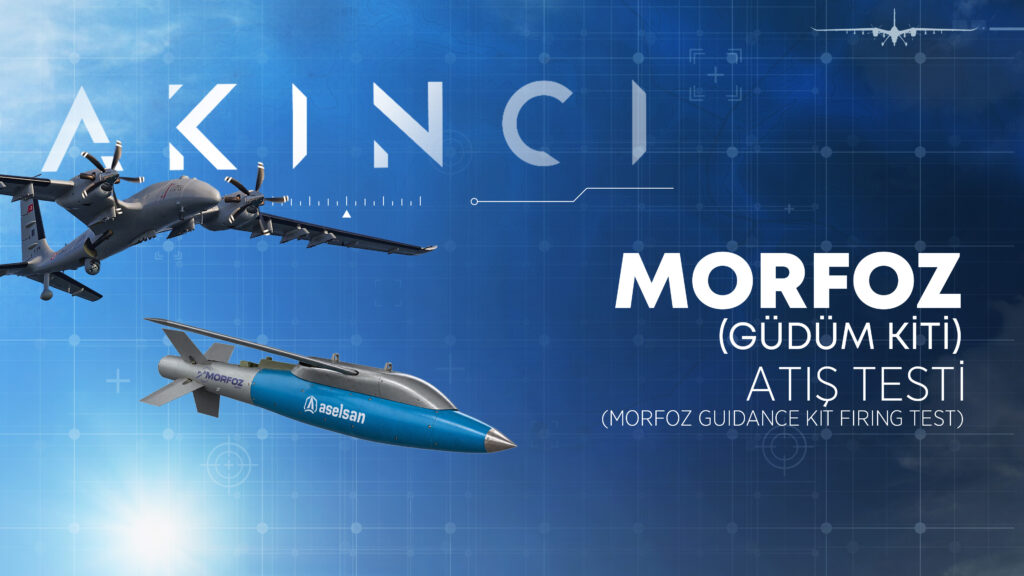
AKINCI completed its first MORFOZ firing over the Gulf of Saros on 8 October 2026, hitting a target with ASELSAN’s guidance kit, according to Baykar. The unmanned combat aircraft’s manufacturer published the result on 9 October, describing the weapon’s initial firing from the platform.
In the accompanying MORFOZ technical account, ASELSAN said the munition separated safely, flew a predetermined series of manoeuvres to validate its autopilot algorithms and struck the target. The company reported both release and guided-flight performance as part of the kit’s integration with AKINCI.
The Çorlu test sortie began at the Flight Training and Test Centre, with AKINCI carrying MORFOZ alongside Roketsan and STM’s ALPAGUT munition. Baykar’s account describes a MORFOZ release followed by the aircraft’s return to Çorlu, without reporting an ALPAGUT firing on that flight.
ASELSAN’s description of the MORFOZ guidance system combines inertial and satellite navigation, waypoint tracking and a choice of impact angles in a winged kit. The company says deployable wings increase its reach and lists use by day or night in different weather conditions.
An eight-channel controlled-reception-pattern antenna is specified for resistance to satellite-navigation jamming, together with onboard telemetry feeding information to the aircraft. ASELSAN’s published account gives no numerical range or accuracy and does not establish whether resistance to jamming was tested during the firing.
The twin-engine AKINCI’s first flight at Çorlu took place on 6 December 2019, lasting 16 minutes and ending in an automatic landing. Alongside reconnaissance, Baykar’s plans at that time included numerous air-to-surface weapons, satellite communications and an electronically scanned radar for the developing aircraft.
For the current aircraft, Baykar’s published AKINCI specifications give a maximum take-off weight of 6,000 kg, a 1,500 kg payload and a 20-metre wingspan. The stated endurance exceeds 20 hours, with an operating altitude of 30,000 feet and a service ceiling of 40,000 feet.
Two turboprop engines and a triple-redundant autopilot feature in the flight and control configuration, with satellite links carrying control and video beyond line of sight. Baykar also specifies three redundant line-of-sight links, autonomous taxiing, take-off and landing, and trailer, shelter or indoor ground-control stations.
The manufacturer’s listed sensor payloads encompass electro-optical and infrared equipment, a laser designator, a multimode electronically scanned radar, signals-intelligence equipment and electronic warfare support systems. AKINCI is marketed for reconnaissance and target acquisition over land and sea as well as the carriage of guided weapons.
Another Baykar aircraft, the jet-powered unmanned KIZILELMA, used ASELSAN’s TOYGUN electro-optical targeting system in a guided-bomb test reported in July. TOYGUN located and designated a fixed ground target for weapons fitted with ASELSAN’s LGK-82 and Roketsan’s TEBER-82 guidance kits during that activity.
The two earlier guidance-kit integrations paired a 500-pound-class bomb with LGK-82 laser guidance, and satellite and inertial navigation with laser guidance in TEBER-82. That earlier activity involved Turkish targeting and guidance equipment on another Baykar aircraft, in a test separate from the October MORFOZ firing.
Baykar’s October announcement adds MORFOZ to the AKINCI integrated weapons inventory, which already includes TOLUN, HGK-82, KGK-82-SİHA and ÇAKIR. The manufacturer also stated that AKINCI export agreements had been signed with a total of 16 countries.