
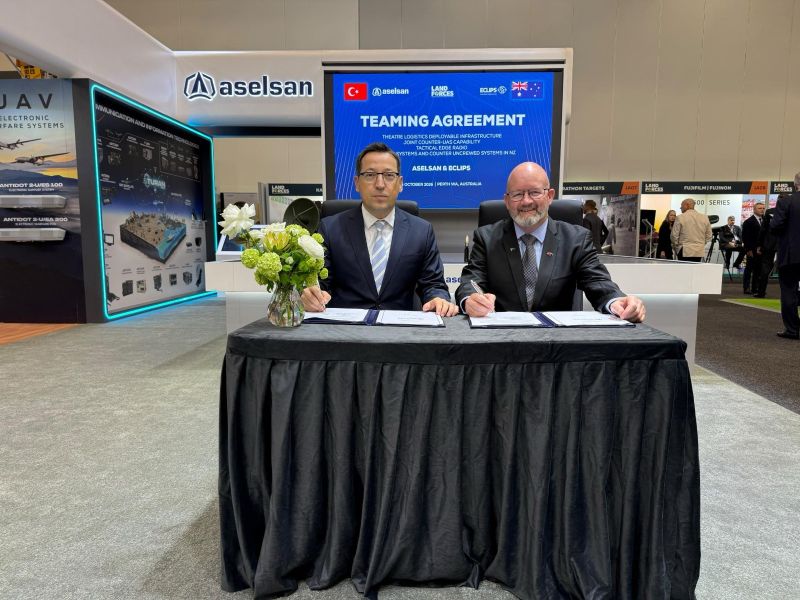
A defence teaming agreement between ASELSAN and Australia’s ECLIPS Engineering covers tactical communications, deployable military infrastructure and counter-drone systems. The Turkish defence electronics company announced the partnership on 6 October while exhibiting at Land Forces 2026 in Perth, where the two companies signed the agreement.
The announced cooperation scope identifies three areas of work but gives no contract value, equipment selection or Australian military purchase. ASELSAN’s partner brings experience in military logistics and transportable infrastructure through its work as a local engineering business.
ECLIPS’s customized modular systems serve military, mining and emergency-services customers, according to the company’s description of its business. It offers transportable military modules configured for different purposes and cites experience with Australian Defence Force requirements, including the documentation needed to manage such projects.
Specialist suppliers work with ECLIPS on module equipment fit-outs for uses including deployable medical facilities and transportable training systems. Alongside military infrastructure, its offering spans logistics platforms, storage and accommodation, as well as water systems and containerized power equipment.
Past defence work includes a container-based trials laboratory supplied furnished and wired to the Defence Science and Technology Organisation. ECLIPS says the expandable unit fitted within a standard shipping-container footprint when closed for transport and increased its floor area by 193% when deployed.
Another recorded project was a transportable Australian Army camp delivered to Cubic, with accommodation, office, storage, kitchen and ablutions modules. ECLIPS presents these earlier projects as examples of adapting container-based structures to the operating and support needs of military customers.
The company’s manufacturing division offers structural and systems engineering, including computer modelling, engineering verification and deployable-module design. Its listed capabilities extend to electrical fit-outs, security needs and protection against compromising electromagnetic emissions, together with the fabrication of steel and aluminium structures.
Its testing and verification services cover vibration, drop and waterproof testing, backed by procedures for checking materials and production. ECLIPS also lists work on the Australian Defence Force’s Joint Modular Intermodal Logistics System, which it describes as moving supplies from factories through to their point of use.
ASELSAN’s international communications work previously included licensed Saudi radio production at a joint factory with Saudi Arabia’s Military Industries Corporation, opened in December 2016. That separate arrangement involved software-defined radios and the training of Saudi engineers and technicians as part of the local production effort.
The company’s counter-drone export activity includes the ŞAHİN system in Pakistan, displayed there in September 2026. Part of ASELSAN’s short-range air defence range, the remotely controlled 40 mm weapon uses programmable ammunition against mini and micro drones, drawing targeting information from electro-optical sensors and radar.
ASELSAN chief executive Ahmet Akyol discussed potential Japanese cooperation in comments published on 4 October, saying talks with the Japanese government were continuing. He named affordable protection against one-way attack drones and systems defending ships from unmanned underwater threats as potential areas for cooperation.
Akyol’s Japanese cooperation proposals also emphasized delivery speed, cost and system performance as advantages ASELSAN could provide to partners. His comments addressed prospective work without identifying a Japanese procurement award or establishing any connection with the separate ECLIPS agreement.