
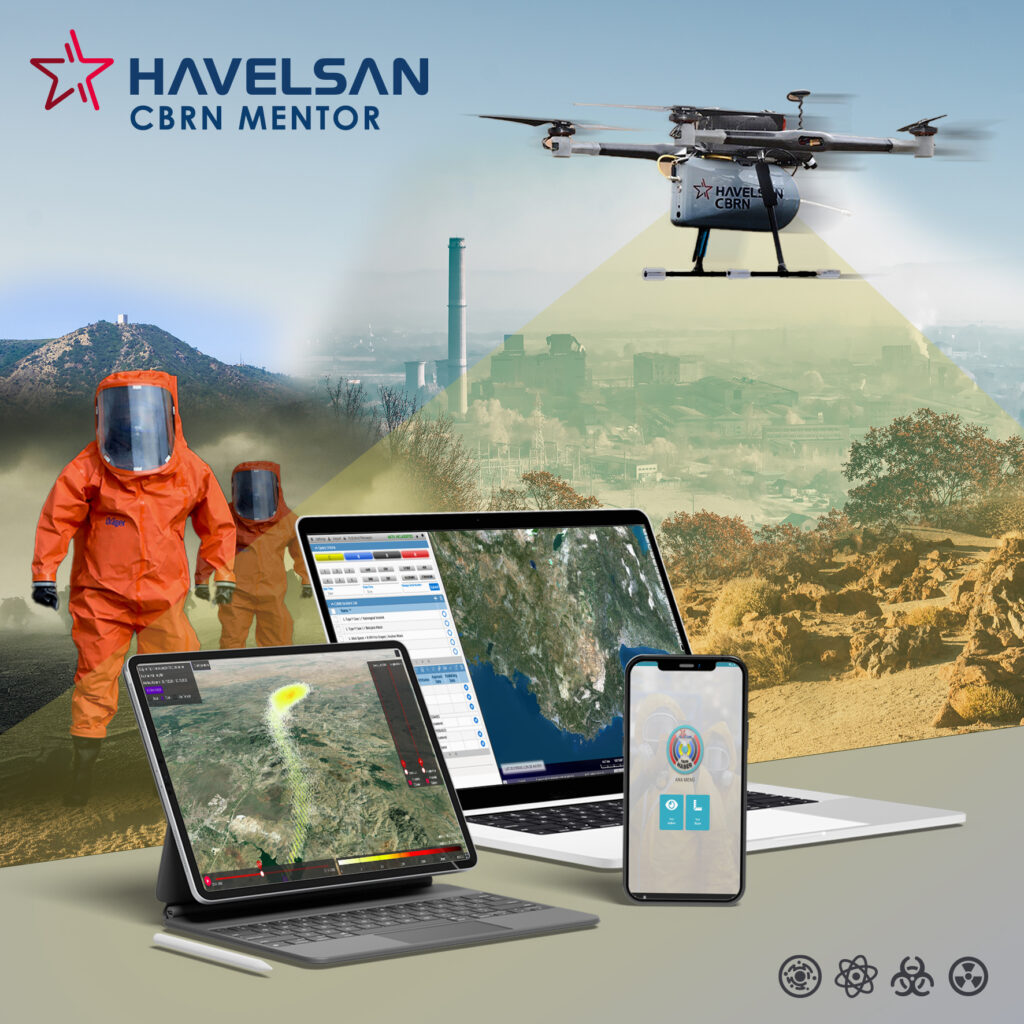
On 9 October, HAVELSAN named DOOB and KBRN MENTOR as its systems for SPECTRA incident response, assigning them responsibility for information assessment and response coordination during chemical, biological, radiological and nuclear (CBRN) incidents. The company said unmanned platforms and sensors feed information into the project's command-and-control software.
Reducing responders' exposure to hazardous conditions during field operations and maintaining a shared, current view of an incident are among the stated aims of SPECTRA's unmanned reconnaissance. Vehicles identify potential threats and take samples, while HAVELSAN's software helps personnel assess the resulting field information.
In the accompanying exercise scenario, protected personnel intervene after aerial reconnaissance, ground robots and a mobile biological-analysis unit have supported the response. Imagery, sensor measurements and location data are brought together to inform the command process.
HAVELSAN offers CBRN MENTOR internationally as an information-management family spanning preparation, response and recovery after an incident. Its applications for both military organizations and civilian response teams combine sensor integration and risk assessment with decision support, warnings and reporting within the same product family.
Measurements reach operators through CBRN BRIDGE's common dashboard, which brings together weather, positioning and video information alongside sensor readings. HAVELSAN describes support for crewed and unmanned vehicles, exchange with external systems, and visual or audible alerts when a sensor registers a threat.
To assess potential contamination, CBRN NEWS hazard modelling uses terrain and meteorological data to estimate affected areas and their development over time. The software identifies potentially exposed units and first responders, supports standardized reporting and exchanges messages in near real time.
Applications range from military units and civilian first responders to protection of critical facilities and large public spaces, including border areas. The family supports North Atlantic Treaty Organization (NATO) reporting standards and integration with other command-and-control systems, according to HAVELSAN.
Information exchange across command levels is provided by Defense Out of Box, or DOOB, HAVELSAN's command, control, communications, computers and intelligence product family. Headquarters, tactical and mobile applications share an architecture, with interfaces tailored to headquarters staff, vehicle crews and personnel operating on foot.
Fixed or deployable headquarters use DOOB to assemble a joint common operational picture, with modular applications that expand as organizational requirements grow. Its tactical version supports low-bandwidth radio connections and can synchronize information once communication resumes after a loss of connectivity.
Field users can submit CBRN hazard and casualty reports, request medical assistance and update unit status through DOOB. Personnel-location and health-status monitoring, messages, images and video are among the mobile application's functions, carrying reports to higher command through the shared software family.
The company's earlier DOOB-HQ interoperability testing took place under Federated Mission Networking Spiral 4 at the Coalition Warrior Interoperability Exercise (CWIX) 2026. HAVELSAN's 24 July announcement said four capabilities completed testing for assurance, verification and validation, moving them forward within NATO's certification process.
DOOB-HQ, DOOB-MOBILE and CBRN capabilities were among 16 systems deployed to Poland with 43 HAVELSAN personnel taking part in that earlier interoperability exercise. Following broader participation in joint operations, cyber and modelling-and-simulation activities, General Manager Mehmet Akif Nacar said the company intended to add artificial-intelligence-enabled command and control in subsequent work.