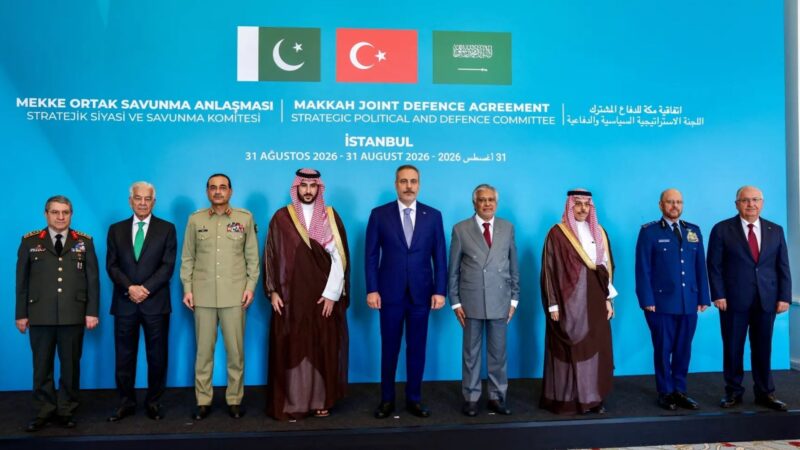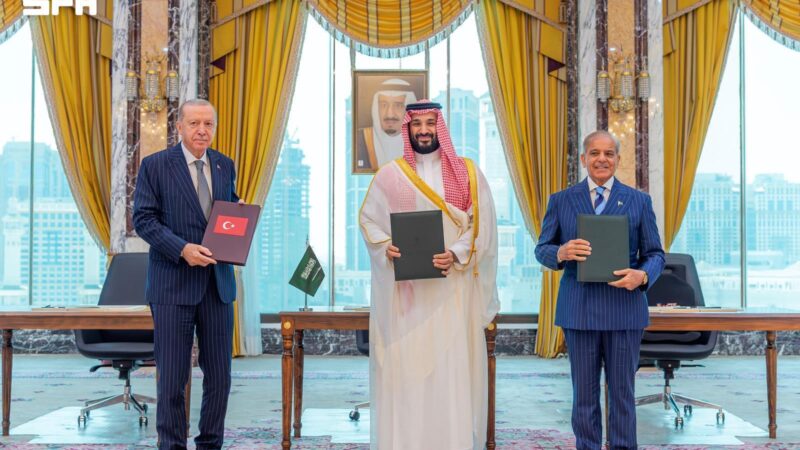

Since the signing of the Mecca Joint Defence Agreement (MJDA) in mid-August, the pact’s founding members – i.e., Saudi Arabia, Pakistan, and Türkiye – have faced tests from Iran and Yemen that increasingly suggest this new regional framework is likely to fail. Granted, one could foresee that the MJDA would not lead to joint combat operations (e.g., due to the absence of inter-services integration, expeditionary assets, and/or no joint headquarters or imperative for active wartime coalitions).
However, that in itself was not the MJDA’s gap; rather, as with the bilateral Saudi-Pakistani defence framework before it, it was the lack of real policy and concrete details regarding what the MJDA would achieve that was the problem. Instead of a clear-cut charter or even mission statement from the MJDA (i.e., as an institution), each of the member states (or, more specifically, certain officials from each) offered interpretations about the MJDA, but not concrete policy.
For example, Turkish officials spoke of plans and opportunities for joint production and industry integration. Pakistani officials reiterated that the MJDA was “not aggressive” in nature and it was built on the idea of “collective deterrence” (but without defining what the actual teeth for this deterrence would be). Finally, the Saudi intelligentsia apparently expected tangible support from Pakistan and Türkiye, while Riyadh continues doubling down on securing America’s security guarantees via massive multi-billion-dollar deals for fighters and munitions they can buy from Türkiye.
In one sense, the lack of direct military support (e.g., troops, aircraft, missiles, etc.) – especially for combat operations – was not surprising. Indeed, Quwa – albeit as an optimistic reading of the MJDA – argued that the framework offered a pathway for capacity building across all three countries. Yet, as with the preceding Strategic Mutual Defence Agreement (SMDA), no one – not even Islamabad or Rawalpindi – defined what tangible gains or benefits would make their way to Pakistan.
If this author were at the seat of the Pakistani national security establishment, they would require clearly mapped connections to Pakistan’s vital national interests in relation to India, Afghanistan, America, and the European Union.
For example, has any leader within Pakistan ever asked the Saudis and other Gulf states to, for example, route their oil and gas exports to Pakistan before India? Doing so would immediately give Pakistan real leverage in talks with India about the latter’s upstream water leverage. Granted, this ‘ask’ is unrealistic today, but it would be a good starting point to work from so as to achieve a tangible near-term benefit in other areas, such as fiscal aid.
Quwa Plus
Go Beyond the Headlines on Pakistan’s Defence and Security.
Quwa Plus gives you deeper reporting, briefings, and analysis on Pakistan’s defence programs, foreign policy, national security, and regional strategy. Follow the developments that matter to professionals, analysts, and serious readers tracking Pakistan’s security landscape.