
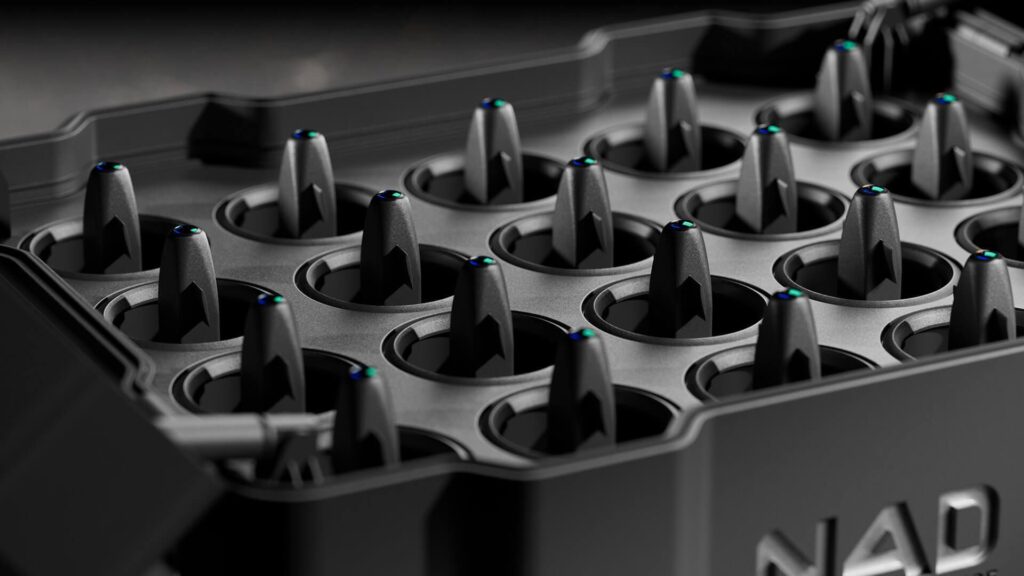
Nordic Air Defence, a Stockholm startup, held the first public demonstration of its K100XR counter-drone interceptor, with press observing a live engagement against target drones in reporting that appeared on 5 July 2026.
The company said on its own account that the system detected and engaged target drones during the event, with journalists also touring the command site and viewing live interceptor video feeds.
The interceptor weighs roughly half a kilogram, measures about 0.3 m, and is credited with more than 354 km/h against an altitude ceiling near 1,000 m.
Range is given as more than 3 km, with a loiter endurance above 20 minutes and a carbon-fibre fixed-wing airframe with folding wings.
Propulsion is battery-electric and propeller-driven rather than rocket-powered, and the round kills kinetically, with an optional 250 g warhead reported as available.
Guidance rests on a thermal infrared seeker paired with embedded artificial intelligence that performs detection, classification and tracking onboard.
That is what enables the headline claim – a fully autonomous, radio-silent mode for use when electronic jamming makes normal ground control unreliable, with the round requiring no continuous operator input once launched.
The framing is worth reading closely. In the announcement of its Volvo Defense partnership, the company described the K100XR as performing autonomous detection, classification and tracking with optional continuous ground control in radio-frequency-stable environments.
In other words autonomy is the default state and the datalink is the accessory, which inverts the arrangement used by competitors such as MARSS, whose operators can cancel an attack mid-engagement.
Each round is also described as operating without connectivity to central servers, carrying its detection and tracking entirely onboard.
Karl Rosander, co-founder and chief executive officer, has described the design goals as high speed, advanced manoeuvrability, autonomy and a low cost per kill.
On price the company says a round costs a few thousand dollars, and that three K100XR rounds come in under the cost of a single $480,000 FIM-92 Stinger.
The XR designation marks a performance variant rather than a new platform, since the baseline Kreuger 100 tops out at 270 km/h against the XR’s 354 km/h.
The firm was founded in 2024, employs around 23 people, and has raised $4.4 million in pre-seed capital across two rounds, the second led by Inflection.
On Ukraine, Dominic Surano, director of special projects, said in November 2025 that the company would test over the winter and then conduct trials in Ukraine against Shahed-type drones.
The company has also said it could reach a production capacity of tens of thousands of units a month once mass production begins, with the decision to scale resting on Ukrainian military feedback.
Two industrial arrangements are in place. The Volvo Defense partnership integrates the round into a vehicle protection pod for military trucks, with launch scheduled during 2026.
The second is a Polish letter of intent with WB Group and Tantalit, and it is instructive on where the company draws its own boundary.
Nordic Air Defence is design authority and lead developer for the interceptor, while its Polish partners supply the artificial intelligence software, system integration and battlefield networking that ties effectors into a working defence.
Rosander framed that arrangement as a response to growing demand for scalable and cost-effective counter-drone systems across Europe, with local production under feasibility study.
Against comparable low-cost interceptors the K100XR sits mid-field on price, above Ukraine’s SkyFall P1-SUN at around $1,000 a round and well below the MARSS Interceptor-MR at under $50,000.
It also sits alongside a widening European field of low-cost effectors, including MBDA’s surface-launched Counter Mass Interceptor and Estonia’s Frankenburg Mark 1.