
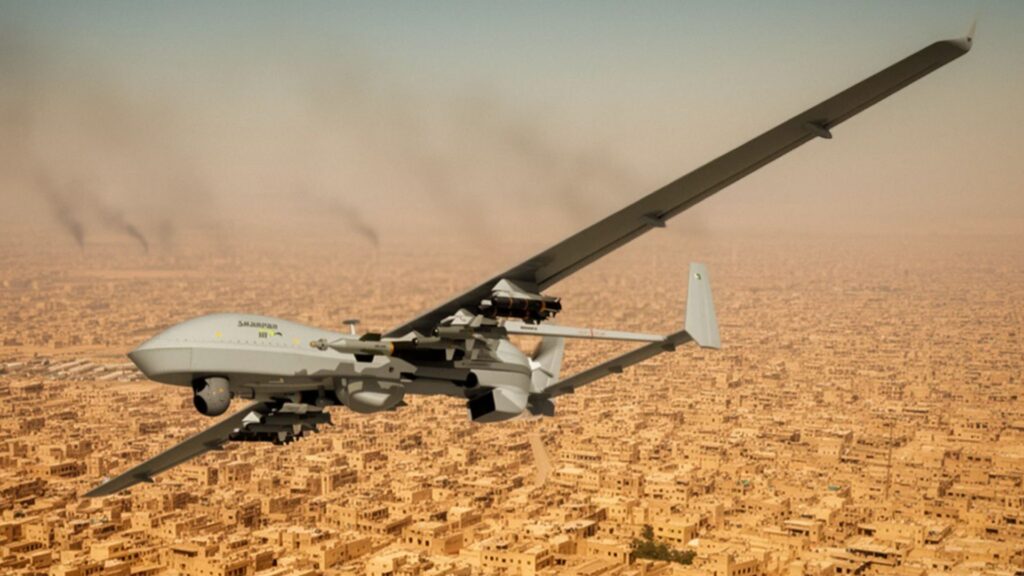
In the late 2000s, Pakistan shifted its long-term drone development and procurement strategy away from the budding private sector – where companies like Integrated Dynamics and Satuma led the field – and towards its stronger, much better-provisioned state-owned enterprises (SOEs), specifically the National Engineering and Scientific Commission (NESCOM). That decision undoubtedly chilled the private sector’s ability to develop, a problem this author discussed in an analysis (available for free). It also explains why Pakistan is only now turning to private firms to build its drones.
However, that same decision – taken independently of other factors – did elevate Pakistan’s drone industry. In 2010, Pakistan’s SOEs rolled out licensed-manufactured designs such as the Selex ES Falco, and they held limited say or capacity to change or upgrade those designs without the original equipment manufacturer (OEM)’s approval. In 2026, NESCOM designs and builds multiple unmanned aerial system (UAS) platforms as well as the internal systems (such as the flight controls, system software, autopilot, etc.), various sensors, mission kits, munitions, and command, control, and communications (C3) architecture. In other words, NESCOM offers a mature drone ecosystem.
NESCOM’s UAS Portfolio: Reusable Platforms and One-Way Attack Drones
Today, NESCOM splits its UAS portfolio into two core categories: reusable UAS platforms (e.g., the Shahpar- and Ranger-series) and one-way attack (OWA) drones (e.g., Yalghar and Sarfarosh). Both portfolios are growing, and complexity (or lack thereof) does not necessarily assign a platform to one category or the other. For example, one might assume that simpler or lighter-weight drones would fall into the OWA category, but NESCOM’s portfolio also offers smaller, lower-cost reusable platforms (e.g., Scout).
Where NESCOM Still Depends on Imports
Upfront, NESCOM imports engines for its larger drones and relies on the overseas market for the critical inputs its subsystems require. Yes, NESCOM designs, integrates, and builds many subsystems – e.g., electro-optical and infrared (EO/IR) turrets – but Pakistan lacks the critical industries to supply advanced lenses, microcontrollers, and other key inputs. Nonetheless, NESCOM’s design, integration, and downstream production capabilities have delivered significant value gains to Pakistan and, more importantly, have empowered the tri-services to pursue solutions and capabilities (e.g., long-range OWAs) that suppliers might otherwise have denied them or, at a bare minimum, priced at a mark-up from a small pool of vendors.
Alsons Group and the Domestic Propulsion Push
That said, large-scale, long-term domestic demand is seemingly pushing domestic suppliers – notably the private sector – to take on some critical inputs, such as propulsion. Alsons Group offers the clearest example: it recently announced that it has begun manufacturing piston engines ranging from 120cc to 280cc – i.e., enough for smaller UAS applications, especially OWAs but also some reusables.
Nonetheless, one should not underplay how far NESCOM’s – and, broadly speaking, Pakistan’s – drone ecosystem support now reaches. When one unpacks the types of drones on offer, their respective capabilities and subsystems/munitions, and the roles or tasks they map onto, Pakistan has value to offer itself and many potential foreign buyers. Moreover, if NESCOM succeeds in its apparent commercialization play, one could see many of these same capabilities extend into joint ventures, offsets, and other trade initiatives that could spur additional growth, foreign currency gains, and global market share for Pakistan.
Quwa Pro
See Where Emerging Defence Markets are Moving
Quwa Pro goes beyond tracking programs and equipment by explaining the policies, incentives, industry dynamics, and competitive pressures shaping South Asia's defence markets.