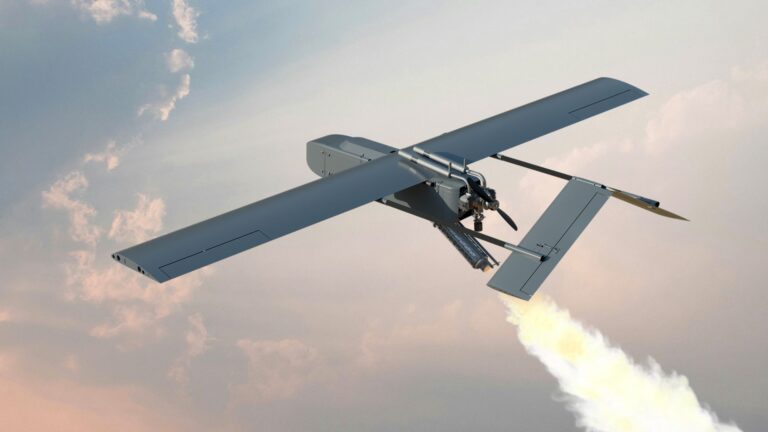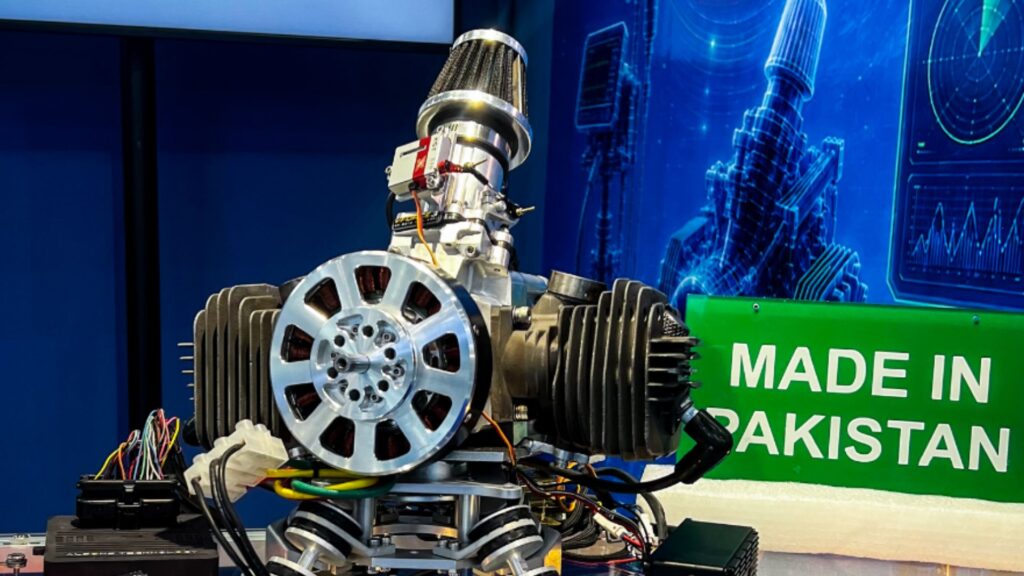
The Alsons Group, a Karachi industrial conglomerate better known for auto parts and electronics, used Eurosatory 2026 in Paris to unveil what it called Pakistan’s first domestically manufactured uncrewed aerial vehicle (UAV) engines, built through a new in-house division named Advanced Kinetic Aerospace Labs.
The stand carried a family of four small piston engines pitched at the lower end of the drone market — the kind of propulsion that turns an inexpensive airframe into a loitering munition or a target drone. For a country whose drone ambitions have long outrun its ability to build the parts that matter, the engines are the more revealing part of the story than the airframes they will eventually push.


What makes the reveal worth watching is who is behind it. Alsons is a private firm, and its move tracks a wider shift in which Pakistan’s military has begun turning to private companies to build the drones and munitions it once reserved for state plants.
Engines like these are usually built on proven, licensed designs rather than clean-sheet engineering, and that is a practical choice for attritable hardware meant to be expended. The same pattern runs through the wider trade, where almost every drone-producing nation still leans on Chinese components and design know-how to reach scale.
The pull behind all of this is cost. Pakistan has moved low-cost strike to the centre of its procurement thinking, drawing on a war in Ukraine where cheap, mass-produced systems have reset the price of holding a target at risk. Engines paid for in rupees, rather than hard currency, are what make a domestic loitering munition line affordable at volume.
The arithmetic is sharpened by the budget. Pakistan’s 17.65% defence spending increase for 2025–26 was partly eaten by a weaker rupee, which strengthens the case for localizing as much of the supply chain as possible.
That logic is visible across the industry, from Western primes down to Pakistani workshops. At DSEI 2025, MBDA unveiled its Crossbow “one-way effector heavy,” a ground-launched strike weapon carrying payloads up to 300kg out to ranges in excess of 800km, designed around commercial off-the-shelf subsystems so it can be produced at scale.
The Crossbow’s appeal is its simplicity, with the missile built around the compact PBS TJ100 turbojet to hold down cost and complexity. It is the same approach — i.e., fewer sensors, cheaper engines, faster production — now reshaping Russian and Ukrainian cruise missiles such as the Swiwin-powered S8000 Banderol.
Pakistan already holds the building blocks for that approach in its Fatah-series and Babur cruise missiles, and in smaller programs that trim flight-control sensors back to satellite guidance to cut unit cost. The input it has lacked is propulsion at the small end, which is exactly the gap Alsons and its peers are now moving to fill.
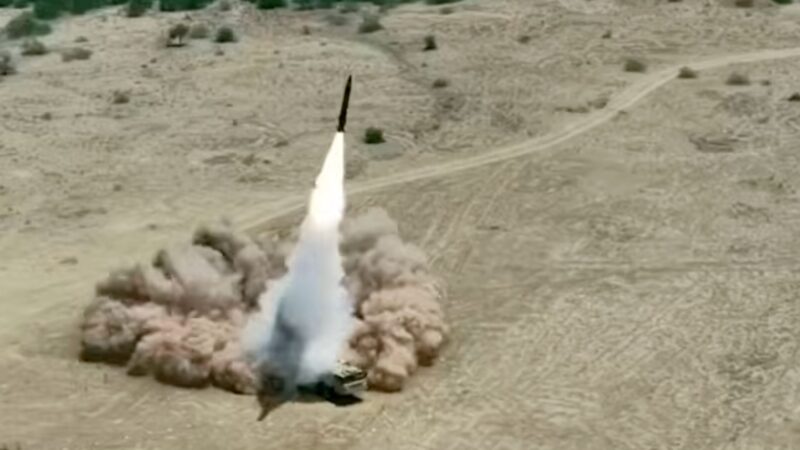
The distribution question follows close behind. Pakistan has been testing ways to launch drones and missiles from dispersed, improvised sites rather than fixed airfields, a model that only works when the munitions feeding it are cheap and locally made.
For now the engines are a starting position rather than a finished capability, and Alsons used Eurosatory to court the interest — and possible export deals — that would justify scaling the line. Whether that interest holds, and whether other firms follow with electric and turbojet designs, is the thread to watch through the rest of 2026.
The full breakdown — including the loitering-munition push, the cruise-missile shift, and a listener Q&A on robotic ground vehicles and Army Aviation’s under-used potential — is in this week’s episode of Defence Uncut, Quwa’s Pakistani defence podcast.
Quwa Plus · In-Depth Pakistan Coverage
Understand Pakistan’s Defence and National Security in Unmatched Depth
Understand what Pakistan is acquiring, how its armed forces are evolving, and where national security policy is heading through dedicated defence news, force analysis, procurement tracking, Pulse Check briefings, and more than a decade of documented reporting.
Featured & Trusted By