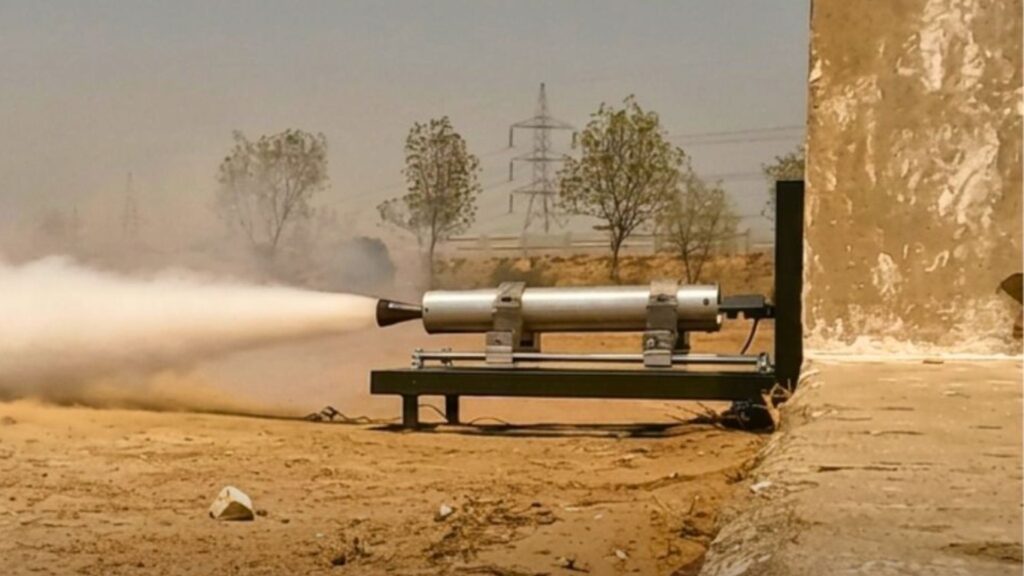
On 06 June, Woot-Tech, a privately owned Pakistani defence contractor, revealed that it had tested a rocket-assisted take-off (RATO) booster for unmanned aerial vehicles (UAV).
Designated RATO-150, Woot-Tech describes it as a 2,500 Ns-class system built for reliable assisted launch. In a company announcement, Woot-Tech pitched the booster as both cost-effective and mass-producible, enabling the end-user to dispense with large pneumatic catapults and long runways, while supporting rapid deployment/launch from austere sites. Woot-Tech is marketing the RATO for tactical, reconnaissance, and defence missions, and tagged for zero-length launch and loitering munition use.
Overall, Woot-Tech is positioning the RATO-150 to support loitering or one-way attack (OWA) munitions, which currently comprise the majority of Woot-Tech’s solution offerings. In other words, the RATO-150 is primarily a launch enabler for the systems Woot-Tech is already producing and marketing.
A 2,500 Ns Booster and Its Class
Woot-Tech specifies 2,500 Ns – i.e., Newton-seconds – a measure of total impulse rather than thrust. The total impulse is the quantity that determines how much momentum a booster can transfer to an air vehicle, so it sets the ceiling on what the RATO-150 can launch.
A RATO booster is a short-burn solid- or hybrid-rocket motor. It accelerates an air vehicle to flying speed from a rail, canister, or zero-length launcher, then separates once the air vehicle’s own engine takes over.
This is the standard launch method across the loitering-munition and OWA class. IAI’s Harpy and Harop fire from sealed canisters with rocket assist before unfolding their wings, while the Shahed-136 launches via RATO from truck-mounted rails.
Quwa Pro
See Where Emerging Defence Markets are Moving
Quwa Pro goes beyond tracking programs and equipment by explaining the policies, incentives, industry dynamics, and competitive pressures shaping South Asia's defence markets.