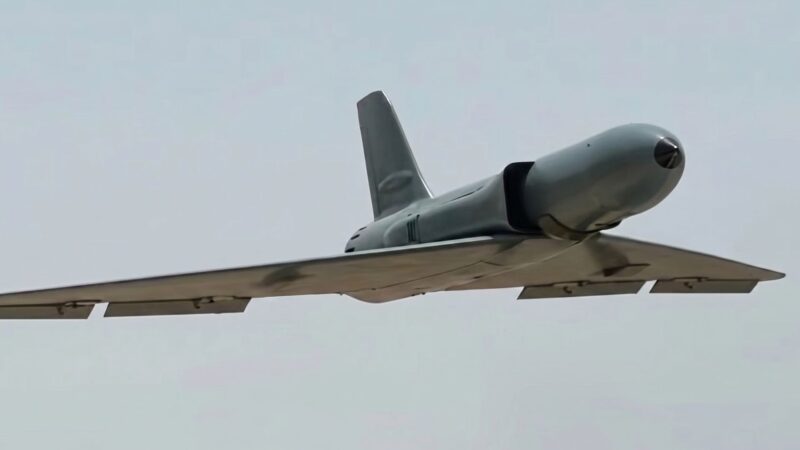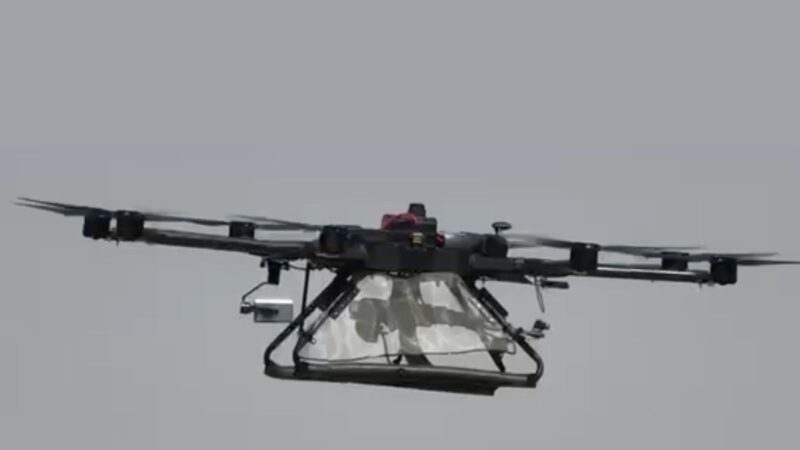

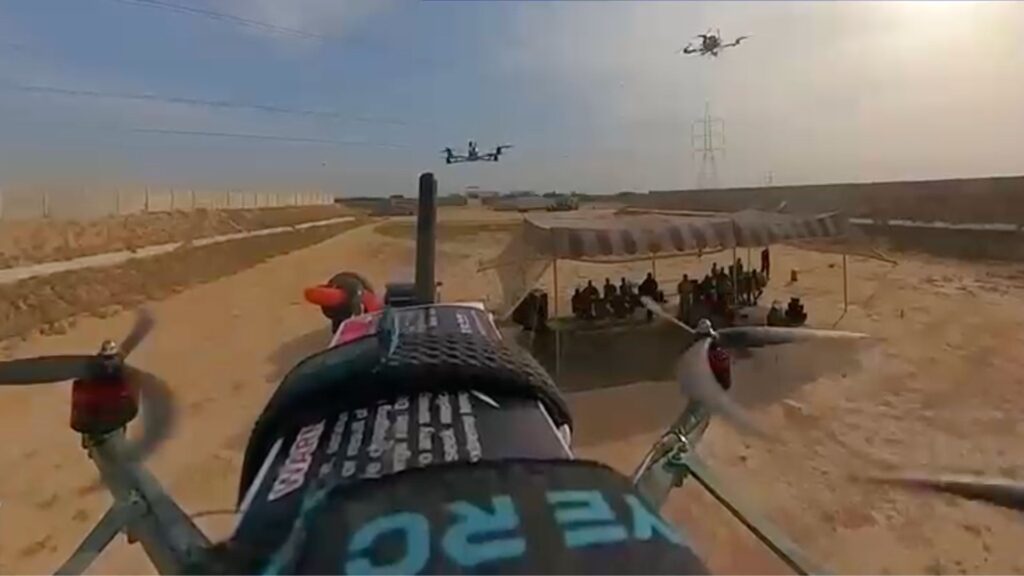
SHARDS (Single-Human Assisted Rapid Deployment Swarm) is a kamikaze drone swarm system developed by Woot Tech Aerospace and Defence.
Revealed in April 2026, SHARDS enables a single soldier to deploy and control an entire fleet of expendable strike drones through simple, intuitive commands.
The system is powered by Woot-Tech’s proprietary Decentralized LSS control laws, i.e., a swarm coordination architecture that eliminates the single point of failure vulnerability present in centrally controlled drone swarm systems. SHARDS is categorized as an infantry standoff offensive system.
Background and Development
Woot Tech Aerospace was founded in 2021 and has developed a broad portfolio of unmanned systems, including loitering munitions, armed multirotor drones, target drones, and a cruise missile.
SHARDS represents the company’s entry into the drone swarm domain – a technology area attracting substantial investment from the United States, China, Israel, and others.
In the US, the Pentagon’s Defence Innovation Unit (DIU) awarded prototype contracts under the Autonomous Collaborative Teaming (ACT) programme to Anduril, L3Harris, and Swarm Aero in late 2024.
L3Harris subsequently revealed its Amorphous programme in early 2025, demonstrating single-operator control of multiple drones across domains with minimal data exchange between operator and swarm.
Israel’s Elbit Systems has developed the LANIUS, a small indoor tactical drone with swarm capabilities. China has demonstrated large-scale drone swarm technology in both civilian and military contexts.
SHARDS enters this space from a different entry point.
Where the ACT programme and Amorphous are vehicle-launched, multi-domain systems backed by the resources of large Western defence primes, SHARDS appears oriented toward lighter, infantry-portable deployment.
The emphasis on single-soldier operation suggests a system designed for forward-deployed infantry and special operations forces (SOF) rather than battalion-level coordination.
Woot-Tech’s previous experience with swarm-adjacent technology includes the mesh-network swarming capability built into the HiMark-25 TJ turbojet loitering munition. SHARDS takes this concept further by introducing a dedicated swarm control architecture rather than simply networking individual munitions.
Decentralized LSS Control Laws
The core technology behind SHARDS is Woot-Tech’s proprietary Decentralized LSS control laws.
In conventional drone swarm architectures – including those used in commercial drone light shows – a central controller issues commands to individual drones. If the central controller is jammed, destroyed, or loses connectivity, the entire swarm degrades or fails.
Decentralized LSS eliminates this vulnerability.
Each drone in the SHARDS swarm operates as an autonomous node, coordinating with neighbouring drones through local communication without depending on a central controller. The swarm autonomously distributes tasks, selects approach vectors, and coordinates timing.
The operator provides high-level intent – designating targets, assigning areas, or initiating attack sequences – rather than controlling individual flight paths.
This architecture provides three advantages.
- Resilience: if individual drones are jammed or destroyed, the remaining swarm continues its mission.
- Scalability: additional drones can be added without increasing operator workload.
- Anti-jamming resilience: because the swarm does not depend on a centralized command link, electronic warfare (EW) systems face a harder task degrading the swarm’s operational coherence.
The EW dimension is particularly relevant.
As GIDS noted for its Blaze-series loitering munitions, the ability to operate autonomously in dense EW environments is becoming a baseline requirement for modern expendable strike systems. The evolving counter-UAS landscape reinforces this point.
Demonstrated Mission Concept
Woot-Tech demonstrated SHARDS in a simulated assault scenario in April 2026. The demonstration featured two concurrent attack profiles.
In the first, a single drone from the swarm threaded a narrow window to strike inside a bunker, engaging personnel and equipment within an enclosed fortified position. This demonstrated precision terminal guidance at the level of individual drones.
In the second, the remainder of the swarm simultaneously attacked a fortified machine gun nest. Multiple drones arrived on target from different vectors within a compressed time window to overwhelm the position. Woot-Tech describes this as “death by a thousand shards.”
The entire sequence was directed by a single operator using simple commands. The swarm autonomously distributed attack roles between the bunker-penetration and saturation-attack tasks.
It should be noted that this was a simulated demonstration, not a live-fire test.
Per-drone specifications – weight, warhead, range, endurance, and maximum swarm size – have not been publicly disclosed as of May 2026.
SHARDS remains at an earlier maturity level than the HiMark-25 TJ, which has published specifications and pricing, or the Juggernaut Gunship, which has confirmed military induction.
Strategic Context
SHARDS sits within a broader shift in Pakistan’s defence technology toward expendable, scalable, and autonomous strike systems.
Pakistan’s state-owned and private-sector defence producers are now developing systems across the full expendable-strike spectrum: handheld loitering munitions (GIDS Blaze 25), medium-range loitering munitions (NASTP KaGeM V3), long-range OWEs (GIDS Sarkash-I, HiMark-25 TJ and GIDS Baaz Delta), and now drone swarms.
What distinguishes SHARDS is its focus on the infantry echelon.
Most of Pakistan’s loitering munition and one-way effector (OWE) programmes are designed for battery-, battalion-, or service-level deployment – they require dedicated launcher vehicles, command-and-control infrastructure, and integration with higher-echelon targeting systems.
The Army Rocket Force Command (ARFC) and its growing Fatah-series inventory exemplify this approach. SHARDS, by contrast, is designed for a single soldier at the tactical edge.
If it matures as described, SHARDS would give Pakistani infantry squads an organic deep-strike swarm capability without relying on external fire-support coordination – a capability that, to date, only the US, China, and Israel have pursued at a systemic level.
For export, a commercially available drone swarm system would attract considerable interest. Most drone swarm programmes globally – ACT, Amorphous, and various Chinese programmes – are either classified, restricted to domestic use, or embedded within large defence packages.
A standalone, infantry-portable swarm system from a private manufacturer could find a market among mid-tier defence buyers.
However, SHARDS requires further validation.
The milestones to watch are: live-fire demonstration with actual munitions, disclosure of per-drone specifications, and any operational trials or adoption by Pakistani or foreign armed forces.
Until these markers are met, SHARDS remains a promising concept backed by a proprietary control architecture, but one that has not yet demonstrated the maturity of Woot-Tech’s other products.