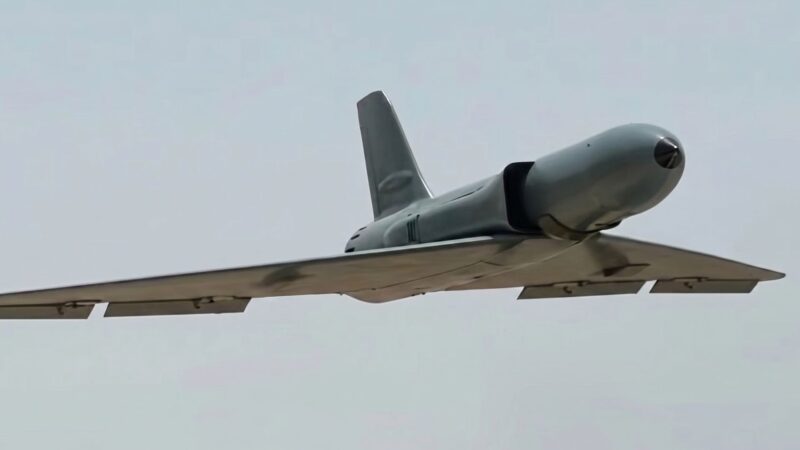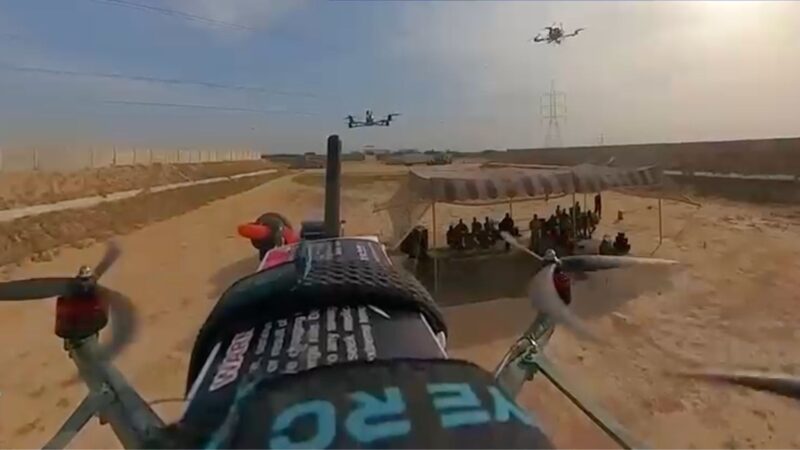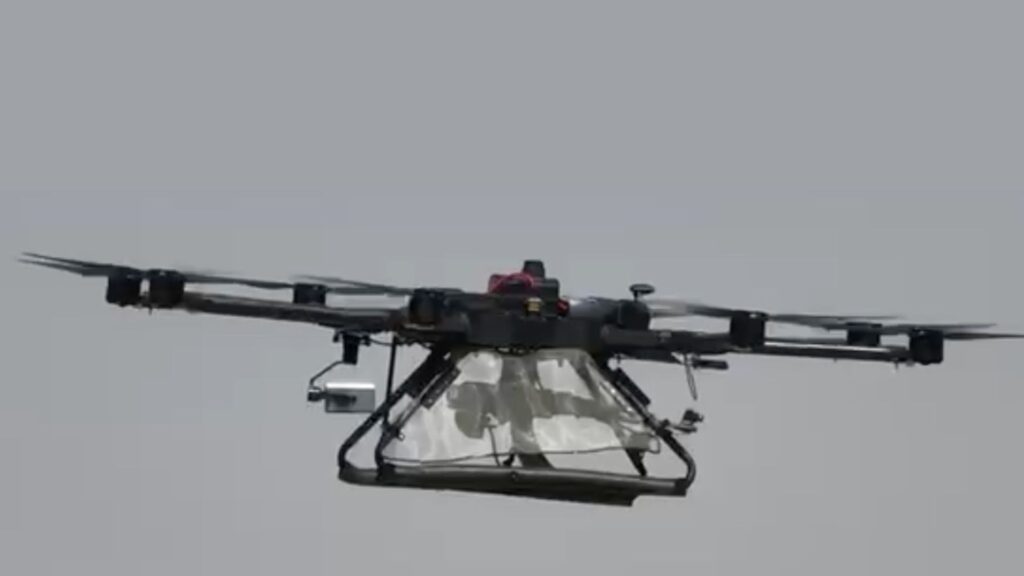
The Juggernaut Gunship is an armed multirotor drone manufactured by Woot Tech Aerospace.
Revealed in April 2026, it is a close air support (CAS) variant of the Juggernaut J8 Bomber – an 8-axis (octa-copter) platform that replaces the original mortar payload with stabilized 7.62mm and 5.56mm automatic machine guns.
Woot-Tech states that the Juggernaut has been inducted into the Pakistan Navy (PN) and special operations forces (SOF).
Background and Development
Woot-Tech first revealed the Juggernaut as a mortar-armed bombing drone in 2024.
The original platform was an 8-axis multicopter with a maximum take-off weight (MTOW) of 50 kg, designed for urban and conventional battlespace operations.
In its bomber configuration, the Juggernaut could carry up to 12 × 60mm mortars, 6 × 81mm mortars, or a single 120mm mortar – a high munition capacity for a platform in its weight class.
The Gunship upgrade represents a conceptual shift. Rather than delivering discrete mortar rounds, the Gunship provides sustained, stabilized automatic fire from a loitering overhead position.
The upgrade adds a 3-axis day/thermal gimbal camera with laser rangefinder and a boresight aiming system that synchronizes the weapon with the sensor suite.
This evolution mirrors a broader trend in armed drone development. While most armed multirotor drones globally are configured to drop munitions – grenades, mortars, or small guided bombs – the Juggernaut Gunship converts a rotary-wing drone into an airborne weapon station. This capability has traditionally been the domain of manned rotary-wing platforms or substantially larger unmanned systems.
Specifications
The Juggernaut Gunship shares its airframe with the J8 Bomber. MTOW is 50 kg, with a maximum payload capacity of 25 kg. The platform cruises at 55 km/h, operates at altitudes up to 1,000 m, and has an endurance of up to 45 minutes.
Communication range extends up to 150 km, while the maximum flight range is 40 km. In Gunship configuration, the stabilized 7.62mm and 5.56mm automatic machine guns engage targets at ranges up to 300 m while operating over 10 km from the launch site.
The 3-axis day/thermal camera and laser rangefinder provide target acquisition, tracking, and battle damage assessment (BDA) in day and night conditions. The boresight aiming system aligns the weapon with the gimbal-mounted sensor suite for precision engagement.
In the J8 Bomber configuration, the same airframe carries mortar munitions in three configurations: 12 × 60mm, 6 × 81mm, or 1 × 120mm. The mortars can be controlled directly by the operator or released autonomously. This dual-mode capability – Gunship or Bomber – from a common airframe provides mission-specific flexibility without requiring separate platforms.
Operational Deployment
The claimed induction into the Navy and Special Forces is significant for two reasons.
First, it establishes that at least one branch of Pakistan’s armed forces is procuring armed drones from private Pakistani manufacturers – not solely from state-owned enterprises (SOEs) like GIDS, NESCOM, or Pakistan Aeronautical Complex (PAC).
As Quwa’s IDEX 2025 analysis noted, Pakistan’s defence industry is increasingly driven by asymmetric warfare solutions. The Juggernaut’s induction suggests the military is willing to source these from private vendors.
Second, the Gunship configuration fills a capability gap in Pakistani special operations.
Dismounted SOF teams and naval special forces operate in environments where organic air support is either unavailable or where the footprint of a manned helicopter would compromise the mission. A 50 kg armed drone that provides on-demand overhead gunfire from 10+ km away offers a low-signature CAS alternative.
Market Positioning
The Juggernaut occupies a distinct niche within Pakistan’s growing drone portfolio. Pakistan’s OWE market and loitering munitions programmes are oriented toward expendable strike – one-way munitions designed for a single mission. The Juggernaut Gunship, by contrast, is a reusable platform that launches, engages, and returns.
This makes it complementary rather than competitive with loitering munitions such as the HiMark-25 TJ, GIDS Sarkash-I, or NASTP KaGeM V3.
For export, the Juggernaut Gunship addresses a gap in the global market.
Few armed multirotor drones combine the payload capacity (25 kg), sensor suite (day/thermal with laser rangefinder), and confirmed military induction that the Juggernaut offers.
Chinese manufacturers such as ZIYAN (Blowfish A3) and several Turkish firms produce armed multirotors, but the Juggernaut’s dual-mode gun/mortar flexibility is a key differentiator.
Gulf states, African Union nations, and Latin American countries with counter-insurgency and perimeter-defence requirements represent the most likely export addressable markets.
However, the regulatory pathway for exporting a machine gun-armed drone is more complex than for a loitering munition, given the additional weapons-transfer implications. Woot-Tech’s split US-Pakistan corporate structure may also create export-control considerations if US-controlled components are present in the sensor or communications suite.
Pakistan’s broader armed-drone ecosystem – encompassing the GIDS portfolio, the PAF’s emerging MUM-T and attritable UCAV roadmap, and a growing number of private-sector entrants – suggests the Juggernaut Gunship will not remain the only platform in its category for long.
The question is whether Woot-Tech can convert its first-mover advantage and operational adoption into serial production contracts before larger competitors enter the same niche.