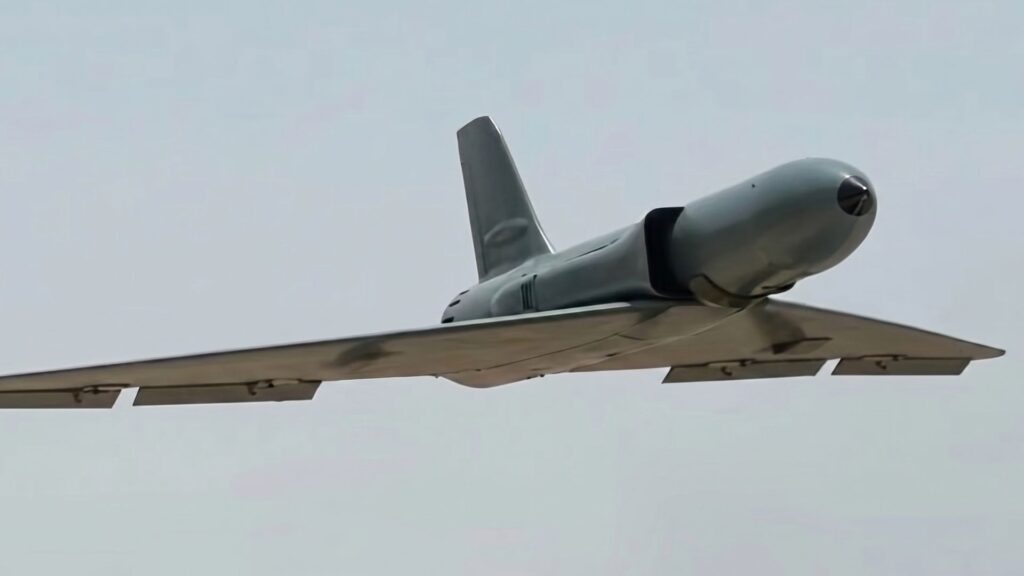
The HiMark-25 TJ is a turbojet-powered one-way attack drone manufactured by Woot Tech Aerospace. Revealed in April 2026, it is the jet-powered variant of the propeller-driven HiMark-25 loitering munition.
The HiMark-25 TJ is designed for deep-strike missions against soft, semi-hardened, and mobile targets at ranges up to 250 km. It is among the lowest-cost entries in the emerging one-way effector (OWE) segment that Quwa first examined in a November 2025 Market Intelligence analysis.
A Quwa analysis from April 2026 examined both the HiMark-25 TJ and the GIDS Baaz Delta as evidence of Pakistan’s shift toward jet-powered expendable strike munitions.
Background and Development
Woot Tech Aerospace LLC was founded in 2021.
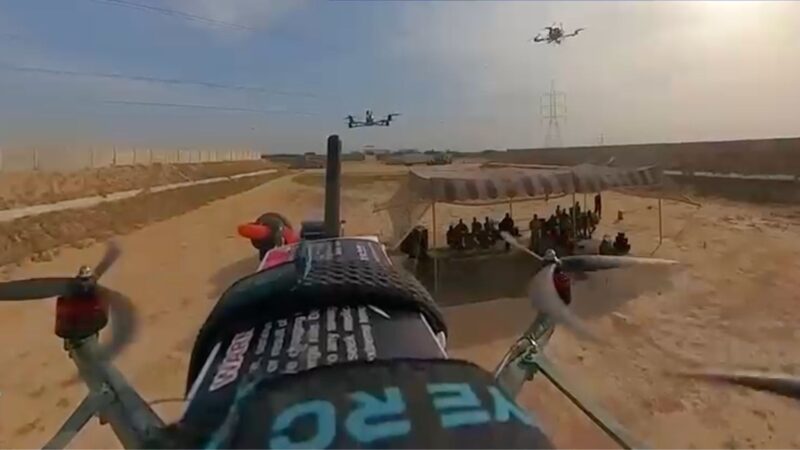
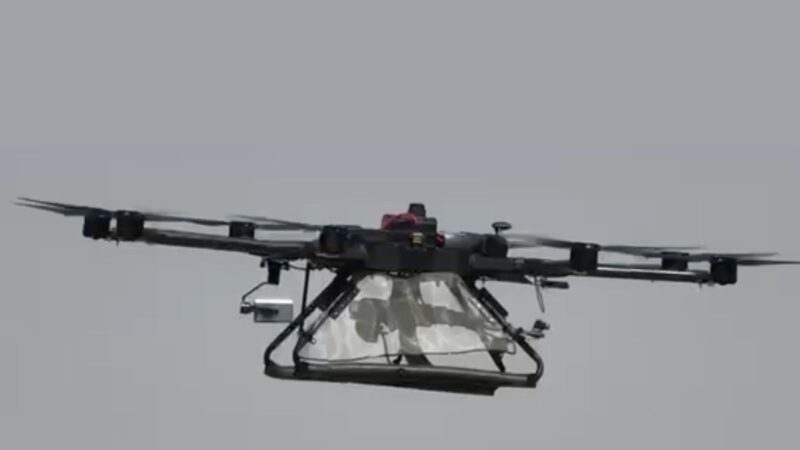
Woot-Tech began with commercial VTOL hybrid drones for agricultural and survey applications before expanding into defence. Its current portfolio spans loitering munitions, armed multirotor drones, target drones, a cruise missile (Nimbus 2K), and the SHARDS drone swarm system.
The original HiMark-25 used a piston/propeller propulsion system.
The turbojet variant replaces this with a 25 kg thrust turbojet engine – the same design approach that drives Russia’s Geran-3 and Geran-5 from the propeller-driven Geran-2 (Shahed-136), and MBDA’s One-Way Effector (OWE) program in Western Europe.
As examined in a Defence Uncut episode on Shahed-class drones, the transition from propeller to turbojet propulsion is driven by the need for speed and resilience against air defences that have largely adapted to intercept slower loitering munitions.
Woot-Tech’s earlier OWE-adjacent product was the Nimbus 2K, a 75-kg jet-powered cruise missile with a 150-km range and anti-radiation targeting capability. The HiMark-25 TJ is a substantially different platform – larger, longer-ranged, and designed for mass production rather than niche anti-radiation missions.
Specifications
Industry sources confirmed the following regarding the HiMark-25 TJ:
- Maximum take-off weight (MTOW): 70 kg
- Empty weight: 15 kg
- Length: 3.0 m
- Wingspan: 2.5 m
- Height: 0.5 m
- Fuel capacity: 30 kg
- Warhead payload: 25 kg
- Warhead options: High-explosive (HE) fragmentation, blast, or shaped-charge configurations
- Propulsion: 25 kg thrust-class turbojet engine
- Cruising Speed: 240 km per hour (140 knots)
- Dash Speed: 320 km per hour (180 knots)
- Range: 250 km
- Endurance: 60 minutes
- Service Ceiling: 4,500 m (15,000 ft)
- Wind tolerance rating: 35 knots
Launch methods include mobile ground and vehicle-mounted rail launchers, such as those mounted on pickup trucks and light tactical vehicles. Rocket-assisted take-off (RATO) is available to extend the range from mobile launch sites.
The guidance suite integrates GPS/INS with autonomous waypoint routing, an electro-optical (EO) terminal seeker for real-time target confirmation, a secure datalink, and mesh-network swarming capability. Woot-Tech also states that the HiMark-25(TJ) can achieve beyond-line-of-sight (BLoS) capability through Starshield- or Starlink-based satellite communications (SATCOM).
Mission Capabilities
The HiMark-25 TJ is designed for autonomous loiter-and-strike operations. It follows a pre-programmed flight profile to the target area, loiters for 60 minutes, and then executes an AI-driven terminal dive with EO sensor confirmation.
Swarm operations are central to the design. Multiple HiMark-25 TJ units share real-time data via mesh networking, enabling coordinated saturation attacks from multiple axes. This concept is also being pursued by manufacturers such as Baykar with its K2 kamikaze drone.
The intent is to overwhelm integrated air defence systems (IADS) through volume – the same approach that has proven effective with Shahed-class drones in Ukraine and the US-Iran conflict.
Vehicle-integrated launch is a priority. The HiMark-25 TJ is optimized for shoot-and-scoot deployment from light tactical vehicles and pickup trucks using simple rail launchers. This dispersed launch concept mirrors tactics used operationally in Ukraine and Yemen, providing survivability against counter-battery targeting.
Woot-Tech claims anti-jamming resilience and states the platform is designed for contested electromagnetic environments. Starshield/Starlink SATCOM compatibility provides an alternative communications path when terrestrial datalinks are degraded by electronic warfare (EW).
Market Positioning and Strategic Context
The HiMark-25 TJ enters a competitive domestic segment.
GIDS offers the Sarkash-I, a turbojet-powered loitering munition/cruise missile with a 1,000 km range and 50 kg warhead, developed by a Strategic Plans Division (SPD) entity.
The GIDS Blaze family covers shorter ranges, with electric and piston propulsion options. The GIDS Baaz Delta, also jet-powered, occupies a niche similar to that of the HiMark-25 TJ.
State-owned entities such as the Air Weapons Complex (AWC) and the National Aerospace Science and Technology Park (NASTP) are also developing solutions, including the KaGeM V3 miniature air-launched cruise missile.
What distinguishes the HiMark-25 TJ is its private-sector origin. Pakistan’s defence production has traditionally been dominated by state-owned enterprises – NESCOM, GIDS, Pakistan Aeronautical Complex (PAC), and Heavy Industries Taxila (HIT).
Woot-Tech’s ability to bring a jet-powered OWE to market from a private company founded five years ago signals that barriers to entry in Pakistan’s munitions sector are lowering, at least for expendable systems where the technology stack – e.g., small turbojets, GPS/INS, commercial EO sensors – is commercially accessible.
As Quwa’s IDEX 2025 recap noted, Pakistan’s defence industry is increasingly positioning itself around asymmetric warfare solutions where global demand is surging, and Western suppliers face their own export constraints.
Woot-Tech states that its multi-vendor production pipeline targets output in the hundreds of thousands of units. If realized, this would position the HiMark-25 TJ alongside Shahed-class production volumes – a claim that requires further validation given the company’s current scale.