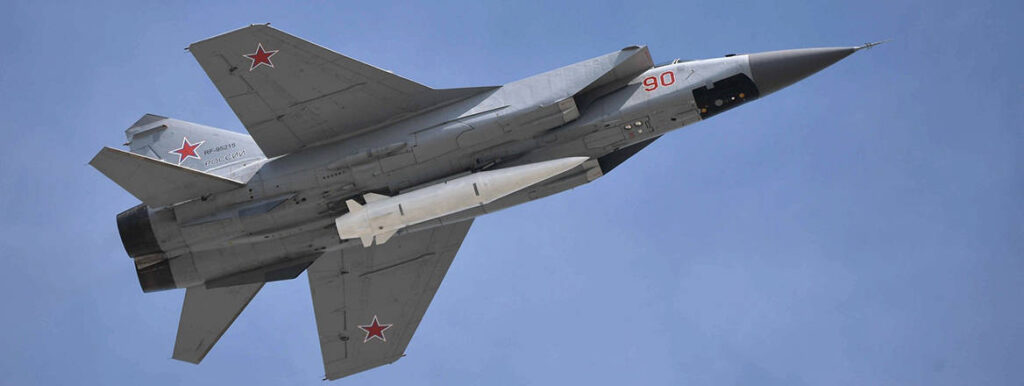
Ukraine’s Cascade Systems has credited its Lima electronic warfare (EW) system with diverting 58 of 59 Russian Kh-47M2 Kinzhal aeroballistic missiles fired at the facilities it protects, i.e. a near-perfect result against one of Russia’s most feared weapons.[1][2] The developers have since raised that figure to more than 60, as of early July 2026.[3] What makes the claim notable, however, is not that Lima is another jammer, but how it works: it attacks the satellite navigation that Russian precision-guided munitions depend on, and it does so through a combination of jamming, spoofing, and a data-corruption technique that reaches beyond conventional EW into the domain of cyber warfare.
In effect, Ukraine appears to have arrived at a low-cost, non-kinetic answer to some of Russia’s most prized strike assets. It is precisely this intersection of EW and cyber that makes Lima worth close study for the Pakistan Air Force (PAF), which has moved EW towards the centre of its air warfare doctrine and is building cyber capability across all three services.[12] Pakistan is not where Ukraine is today, but the direction is arguably one it is already pursuing.
Electronic Warfare as a Decisive Lesson from Ukraine
The war in Ukraine has turned the electromagnetic spectrum into a contested domain in its own right. Both sides now depend on it for targeting, communications, drone control, and satellite navigation, and both have invested heavily in denying it to the other, i.e. through dense layers of jamming, spoofing, and electronic support measures (ESM) that shape almost every engagement. For most of the war, however, this contest played out at the tactical level: jammers severed the control links of first-person-view (FPV) drones, spoofers pushed loitering munitions off course, and ESM sensors located emitters in order to cue artillery.
Lima is interesting because it applies these same principles at a strategic scale, and against far harder targets. Rather than jamming a single drone at close range, it sets out to defeat cruise missiles, guided glide bombs, and even aeroballistic missiles across a wide protective zone. In this respect, it is one of several wide-area systems Ukraine now fields – alongside the Pokrova spoofing network used against Shahed drones since 2024, and a system known as AI-Petri – though Lima is generally regarded as the most advanced against Russia’s newest guidance.[6]
What makes Lima an evolutionary step, however, is its economics. Cascade Systems prices a single Lima unit at up to 3 million Ukrainian hryvnia, i.e. roughly €58,000, and estimates that 30 to 100 units are enough to cover a major city – about €5 million, or the cost of a single Patriot PAC-3 interceptor missile.[7][8] By the company’s own costing, nationwide coverage against drones and missiles would run near $1 billion, with a further $800 million for ballistic threats; in other words, $1.8 billion in total, or roughly the price of two Patriot batteries.[2] More than 400 Lima units have reportedly been delivered since deployment began.[7]
How Lima Attacks Satellite Navigation
Lima is a ground-based system, built by Cascade Systems – a Ukrainian start-up registered in the United States – and it works by denying and manipulating the satellite navigation feeding Russian weapons. It does so through three distinct techniques. The first is jamming, i.e. flooding the satellite navigation bands with noise such that a receiver cannot acquire the real signals from constellations like the United States’ GPS and Russia’s GLONASS. The second is spoofing, wherein Lima transmits counterfeit satellite signals carrying false position and timing data, so that the weapon continues to fly on a computed fix that is wrong; the developers describe shifting a weapon’s coordinates by several kilometres in order to steer it into an open field.[2]
This spoofing is more sophisticated than simple noise. Night Watch operators describe transmitting a signal in binary form that, in certain flight modes, produces severe anomalies in one of the missile’s navigation channels, thereby driving the autopilot to stabilize on that channel while effectively ignoring its other sensors.[6] Moreover, the effect covers a wide area rather than a single track. As one Night Watch operator put it to Forbes, “we influence all missiles flying through it simultaneously,” i.e. an entire salvo entering the zone can be diverted at once.[6]
It is the third technique, however, that is the most novel, and it is where EW crosses into cyber. A satellite receiver must download a block of navigation data in order to compute a position, and Cascade’s developers describe corrupting that download such that the receiver ingests bad data and cannot resolve a valid fix. “The third type of signal is a cyberattack,” the Night Watch commander known as Alkhimyk told the Kyiv Independent; it targets the missile’s receiver and, critically, leaves it working on incorrect data long after the weapon has left the covered zone.[2] In practical terms, this is precisely what distinguishes Lima from a conventional jammer: ordinary jamming lapses the moment a weapon clears the beam, whereas a poisoned navigation solution travels downrange with the weapon.
The Antenna Duel and the Fall to Inertial Guidance
The reason these techniques are difficult to pull off is that Russian weapons no longer carry simple navigation antennas. To resist jamming and spoofing, Russia fields controlled reception pattern antennas (CRPAs) of the Kometa family across its drones, glide bombs, cruise missiles, and ballistic missiles alike. A CRPA is an adaptive array, i.e. it combines the signals from its multiple elements with phase adjustments in order to place ‘nulls’ – directions of near-zero sensitivity – onto sources of interference, while preserving gain towards the real satellites overhead. The constraint, in effect, is arithmetic: an array can null roughly one fewer interfering source than it has elements, so the traditional way to defeat a CRPA is to surround it with more emitters, from more distinct directions, than it has channels to null.
Quwa Pro
See Where Emerging Defence Markets are Moving
Quwa Pro goes beyond tracking programs and equipment by explaining the policies, incentives, industry dynamics, and competitive pressures shaping South Asia's defence markets.
Subscribe Already a subscriber?Sign in