Just as loitering munitions, swarming drones, and other unmanned aerial systems (UAS) advance in capabilities and proliferate to adversaries on both the eastern and western fronts, the Pakistani armed forces are, correspondingly, investing more in counter-UAS (C-UAS) solutions.
Thus far, Pakistan’s C-UAS efforts have materialized in different forms, with induction being led through electronic warfare (EW)-based solutions aimed at interfering with the drones’ communications, either to satellite-based guidance/location systems or to remote operators.
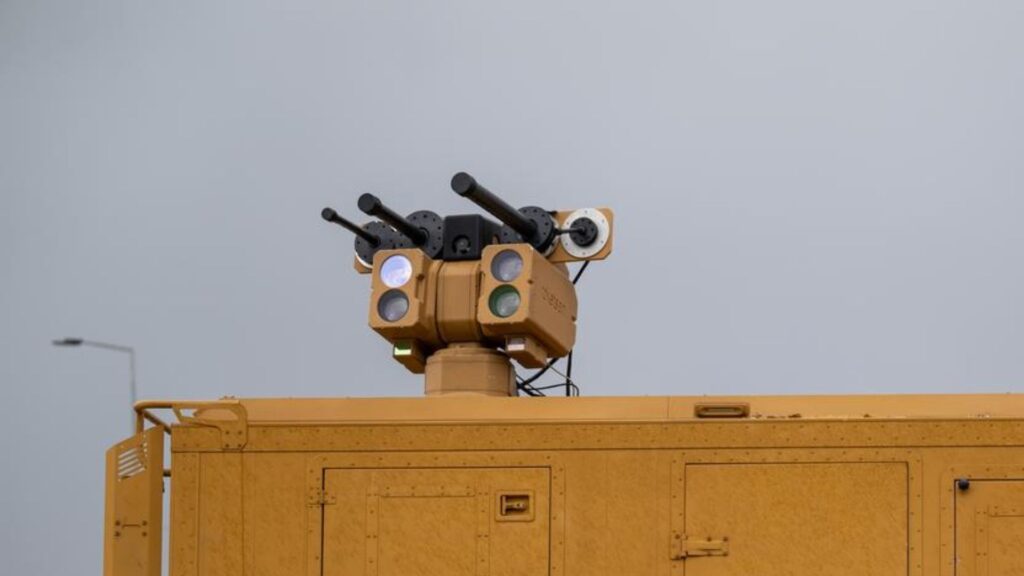
In tandem, Pakistan’s hard-kill element has largely trended towards anti-air guns (AAG), with, potentially, interceptor drones also being added to reinforce the hard-kill element.
So, as it stands today, Pakistan’s C-UAS strategy leverages EW for initial denial coverage, especially at scale against salvos, with AAG being the mainstay hard-kill layer.
However, since 2024, there has also been an effort to leverage directed energy weapons (DEW) as well.
The first known DEW program came through the Pakistan Navy’s (PN) tender for two high-energy laser (HEL) systems. But before that, the Pakistan Air Force (PAF) signalled via a promotional video that it was also planning to – or, at least, exploring – both HELs and high-powered microwave (HPM) systems.
That said, aside from the PN’s tender (which is likely a pilot-scale project to configure two Tughril-class or Type 054A/P frigates), Pakistan has generally kept the details of its C-UAS efforts close to its chest, thus leaving little in the way of understanding the actual scale and direction of its programs.
The details are scarcer regarding the PAF’s DEW goals. However, in fairness to the PAF, it is difficult to see current DEW plans – especially for HELs – as anything more than pilot-scale testing.
In fact, most countries at this time are treating HELs as small-scale orders and, in some cases, as integrated parts of larger air defence architectures. For example, Israel is inducting small numbers of 100 kW ‘Iron Beam’ systems to augment its Iron Dome missile/munition defence system.
Quwa Plus
Go Beyond the Headlines on Pakistan’s Defence and Security.
Quwa Plus gives you deeper reporting, briefings, and analysis on Pakistan’s defence programs, foreign policy, national security, and regional strategy. Follow the developments that matter to professionals, analysts, and serious readers tracking Pakistan’s security landscape.
Join ($29.99/Year) Already a subscriber?Sign in