
Defence Uncut opens on Pakistan’s conventional ballistic missile push and the logic of a shared launcher, then turns to defending PAF air bases, cheaper warships, and the fighter decisions that will define the 2030s.
There was no single blockbuster on the Pakistani defence beat this week. So on the latest episode of Defence Uncut – the first English-language podcast dedicated to Pakistani defence – hosts Bilal Khan and Arslan Khan used the quieter cycle to work through the questions that will define the 2030s.
The thread that ran deepest started with a single word dropped in a state-television interview: ‘Fatah-5.’
From there, the conversation kept circling the same underlying question in every domain – how a mid-sized force with a constrained budget builds real capability without overreaching. That logic runs from Pakistan’s growing conventional missile force to the defence of its air bases, the next generation of warships, and the fighter fleet it has to rebuild in the decade ahead.
Get the Full Picture on Pakistan’s Defence and National Security
Get dedicated Pakistani defence news, force analysis, procurement tracking, and national security policy insight, backed by more than a decade of documented reporting and depth general news coverage cannot match.
The Fatah family and the Logic of a Shared Missile Stack
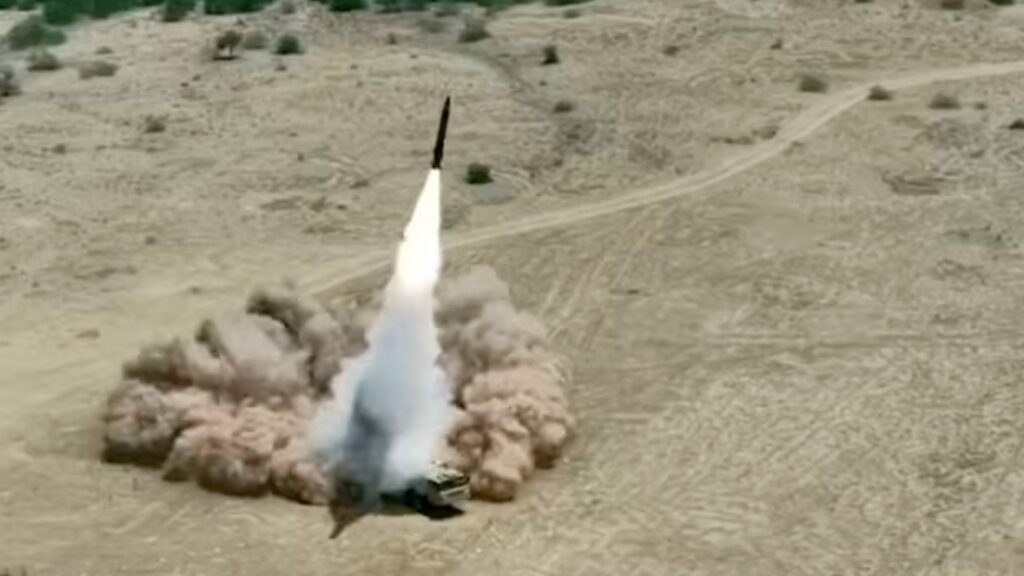
That interview aired around the anniversary of the May 2025 conflict, when a Pakistan Army rocket officer noted – almost in passing – that a Fatah-5 had been tested. Speculation about hypersonics followed. Bilal Khan’s assessment was deliberately restrained.
“The most conservative outlook is to expect a range extension of the Fatah-2 lineage,” he said. The reasoning is that the National Engineering and Scientific Commission (NESCOM) designed the Fatah-2 for scale.
“NESCOM built the Fatah-2 around standardization and modules so it could be repurposed,” he explained. “The Pakistan Navy’s SMASH anti-ship ballistic missile is practically identical – the guidance system is the main difference.” He laid out the full case in a recent Quwa analysis on what the Fatah-5 might actually be.
The parallel he drew was to Turkey’s Tayfun, which grew from a roughly 500 km Block-2 to a near-1,000 km Block-4 by enlarging the same baseline. Both hosts read the Fatah family the same way – a common building block, iterated for range.
Arslan argued the real organizing principle is the launcher, not any single missile. “The key behind the Fatah name is maybe less about the system and more about the common launcher,” he said. “It’s our HIMARS version” – a single wheeled platform that can carry a mix of Fatah rounds.
More significant, in his view, is that the services are now funding a shared production base. “For the first time, I can confidently say everyone’s pooling their money into common production lines, then making their own modifications at the final stage,” he said, spanning the Army Rocket Force Command (ARFC), the Navy, the strategic forces, and eventually the Pakistan Air Force (PAF). The full family and its ARFC integration are catalogued in our Fatah missile overview.
On the ARFC itself, Bilal was clear about its intended role. “The ARFC’s purpose is to operate like the PAF, but from the ground,” he said – “to deprecate the radars, air-defence sites, bridges, and fuel depots that help India fight, and slow the pace of escalation.”
Responding to an audience question about whether the force can absorb so much new equipment at once, he argued the harder problem is organizational, not technical. “The training has been dealt with for years,” he said. “The bigger challenge is on the process front – how you manage these new hybrid service arms that draw across all three services,” such as the ARFC’s reliance on the PAF’s Space Command for targeting.


Defending the Air Bases: Lasers, Microwaves, and Interceptor Drones
If the Fatah family is about holding India’s high-value targets at risk, the mirror-image problem is protecting Pakistan’s own – and the most valuable nodes are the PAF’s air bases. That is where the hosts landed on the counter-drone question, and specifically on whether the PAF should fast-track high-energy lasers (HEL).
Bilal’s framing drew a useful distinction. “High-energy lasers aren’t horizontally scalable – they’re not going to stop swarms,” he said. “But they are sequentially scalable. If you’re perpetually dealing with sporadic drone activity, each shot costs pennies on the dollar, and it lets you intercept without depleting your kinetic stores.”
For the western border in particular – where Taliban-linked groups have experimented with loitering munitions and improvised drone attacks – he sees lasers as a redundancy layer at fixed sites. “These militants need one successful shot. They need one good day, and it’s a bad day for the PAF. A laser adds another point of redundancy.” Our full read on the PAF’s high-energy laser requirement and likely suppliers goes deeper on the power class and vendor field, including Poland’s roughly 150-unit program.
Arslan agreed on the use case, and made the base-defence logic explicit. “These systems are really just intended for localized area defence – air bases or key installations,” he said. Those bases, he noted, are the “big, juicy targets” for the Indians and non-state actors alike, which is exactly why they justify dedicated protection. What lasers cannot do is cover open ground: “You can’t do wide-area air defence against something that small and low-flying.”
The limitations stack up quickly. “With lasers you’ve got dwell time – two or three seconds per intercept – which is a bad time when twenty or thirty are coming at you,” he explained. “And you’ve got atmospheric degradation: fog, haze, and pollutants scatter the beam.”
High-powered microwave (HPM) systems can strike multiple targets at once, he noted, but come with their own constraints – directional coverage, recharge cycles, and sharply reduced effectiveness against dense or multi-axis swarms.
Both hosts were more enthusiastic about kinetic interceptor drones stationed near the bases they protect, and about where the technology is heading. Bilal expects the current, manually flown interceptors to give way to autonomous ones.
“Right now these interceptors are essentially manually operated,” he said. “But within one to two years, I think this gets solved through some form of AI or machine learning.” The scalability bottleneck today is that each interceptor still needs an operator in the right place at the right time.
The clearest proof of concept is European. In March 2026, Airbus Defence and Space flew its uncrewed ‘Bird of Prey’ interceptor – a modified Do-DT25 target drone – which autonomously detected a one-way attack drone and engaged it with a Frankenburg Technologies Mark I missile, a fire-and-forget interceptor weighing under 2 kg with a range of about 1.5 km. Crucially, it plugs into Airbus’s integrated battle-management system.
Bilal’s point was that this is not exotic for Pakistan. “The Airbus one is a flying, tested solution right now,” he said. “And Pakistan can do this – it already has several target-drone platforms in production.” He pointed to the National Aerospace Science and Technology Park (NASTP), NESCOM, and private-sector firms. Positioned around air bases and forward units, he argued, such interceptors would form a miniature version of the PAF’s own radar-cued command-and-control loop. The idea maps directly onto the retrievable airborne interceptor concept discussed in our C-UAS demand tracker.
Arslan underscored how low the barrier to entry is. “The Sonix was designed to be built by the average Joe in his garage,” he said of the hobbyist kit that inspired one loyal-wingman concept. “This isn’t out of this world – it’s straightforward stuff.”
Warships on a Budget: Commercial Hulls and Modular Payloads
The same instinct – get capability without paying for excess – runs through the Navy’s thinking on hulls. The segment started with Germany’s decision to scrap its troubled F126 frigate program and fall back on the older, more mature MEKO A-200 design. Bilal saw a familiar pattern, and a Pakistani parallel.
“It wouldn’t surprise me if the MEKO A-200 was a benchmark the Pakistan Navy used for where to take the Jinnah-class frigate,” he said. Germany, he noted, is now the third or fourth navy to claw back an over-specified ‘super-frigate’ in favour of a smaller, cheaper, proven hull.
That fed into the episode’s central naval argument – the trade-off between proprietary and commercial shipbuilding standards. The Babur-class (MILGEM) corvette and Jinnah-class frigate are built to bespoke naval standards, which makes them capable but costly and reliant on tight supplier chains. The Yarmook-class (Damen OPV 1900), by contrast, is built to commercial standards, which slashes hull cost and opens sourcing.
Arslan’s preferred model – one he returns to often – is the Danish approach. “This is one I’ll never stop talking about. It’s probably the best solution anyone’s come up with,” he said. “The Danes built their hulls around modules. Anti-ship, anti-air, anti-submarine – you can fit anything into them.”
The logic is about amortizing the expensive part of a warship over time. “Hulls are designed to last decades. It’s the sensors and weapons that get swapped out,” he said. “The key is a hull with room to grow.”
Because containerized payloads are not tied to a specific ship, a fleet does not need a full vertical launch system (VLS) fit for every hull – a serious saving when, as he noted, a single VLS set can cost more than a commercial patrol hull.
Bilal added an important caveat in the Pakistan Navy’s favour. Its proprietary MILGEM standard has aged well. “Outside of China, the MILGEM might be the most prolific standard out there – rivalled only by the FREMM,” he said, pointing to the family’s spread across Turkish, Pakistani, and export variants.
Still, he sees commercial standards as the route to scaling the surface fleet affordably. “Commercial standards give you the flexibility to go bigger up front, because a good chunk of the engineering is already done,” he said. “You’re adapting, not designing from scratch.”
He pointed to Damen’s Crossover (XO) series – large hulls designed from the outset with empty modular volume that can later be repurposed for unmanned underwater vehicles, loitering munitions, or amphibious roles. The lead Jinnah-class frigate is now under contract at Karachi Shipyard, which makes these design philosophies more than academic.
Related reading
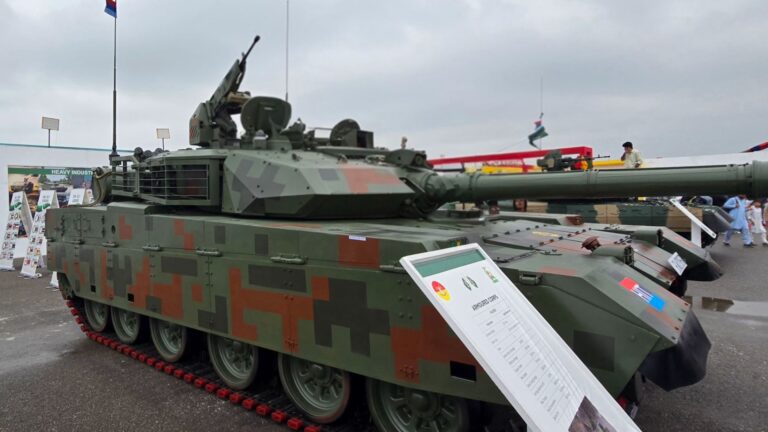
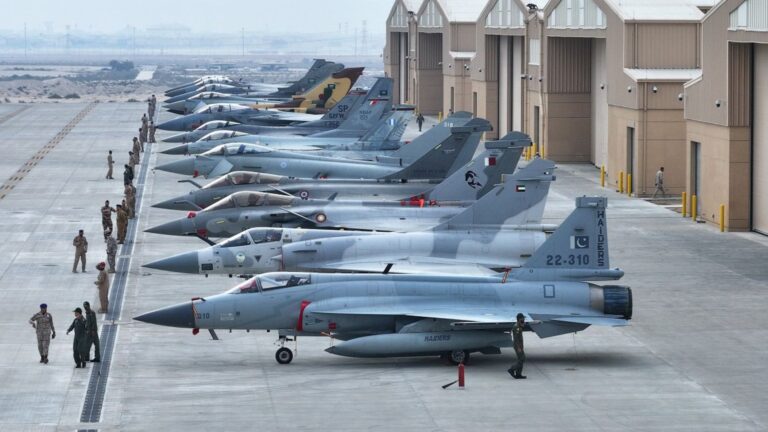
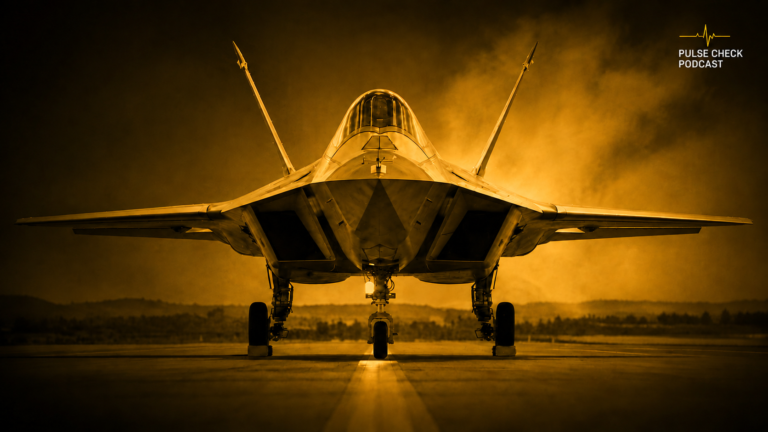
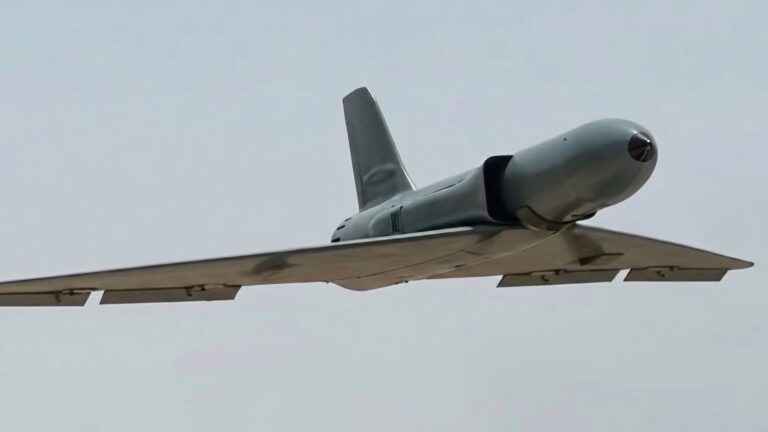


The PAF’s 2030s Cycle: New Fighters, SAMs, Special Mission Aircraft
Warships are one slice of a much larger acquisition decade. The biggest and most contested piece is the fighter fleet, and it is where the episode’s most against-the-grain argument surfaced.
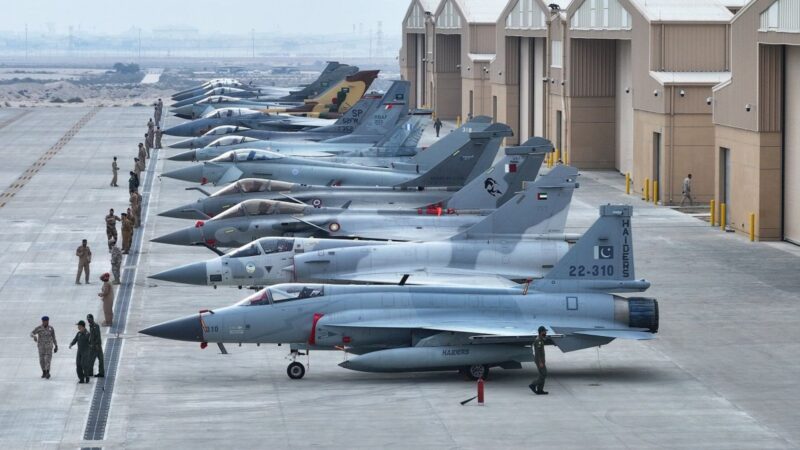
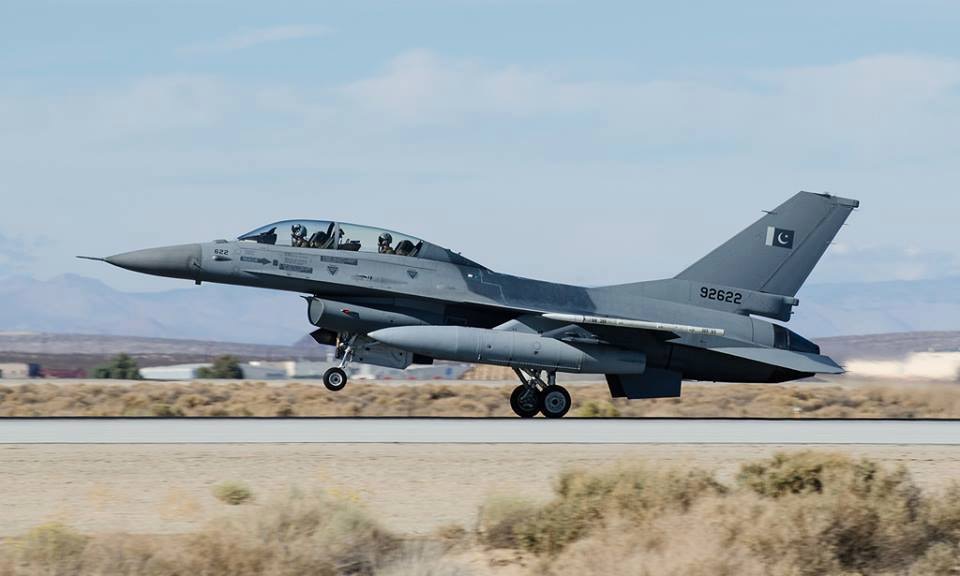
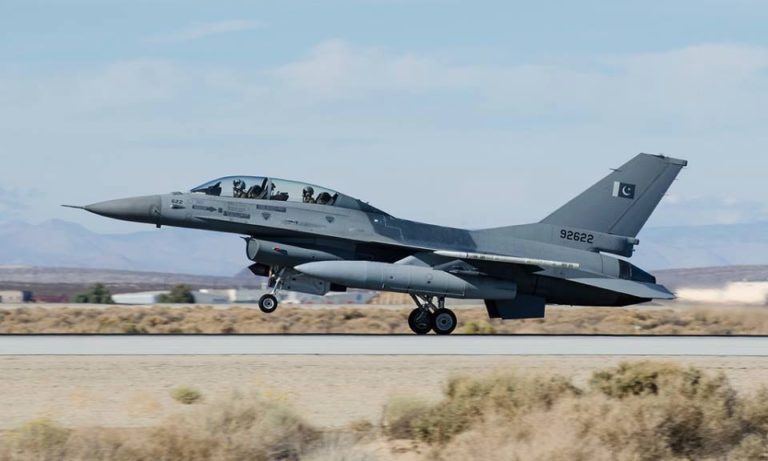
The PAF is entering a replacement cycle for its oldest F-16A/B Block-15s, which begin reaching the end of their service lives from around 2030. That has already produced soft requests for information across the industry.
The frontrunner is clear. It is the Shenyang J-35AE, which a since-withdrawn 2025 government post described as part of a Chinese package alongside the KJ-500 airborne early warning and control (AEW&C) aircraft and the HQ-19 ballistic missile defence system. We unpacked how China ended up as the apparent sole bidder in Multi-Billion Dollar Missteps.
On that package, Bilal’s read was that it reflects an offer, not a decision. “My perspective is that it was an offer the Chinese made to a preliminary PAF request,” he said, noting the air force asked the government to withdraw the post because nothing had been signed.
An audience question pushed on a related claim – a satellite photo said to show a KJ-500 already in Pakistani service. Arslan was blunt. “No. That picture is just a ZDK-03. I don’t see any scenario where the Pakistan Air Force inducts the KJ-500.” In his view, the ZDK-03 Karakoram Eagle’s airframe was never a strong platform, and any future AEW&C purchase is far from settled.
Where the conversation turned genuinely against the grain was on the Eurofighter Typhoon. Bilal argued that a Western fighter should not be written off, even as the J-35 leads.
“I would not discount the Typhoon,” he said. “It’s a proven platform, with decades of ironed-out kinks, an established supply chain, and a multilateral pool of users already – not least the Saudis, and, most of all, Turkey.”
The Turkish angle is the crux. With Turkey now inside the Typhoon program and securing source-code access to integrate its own subsystems, Bilal sees a durable industrial anchor forming – one that matters because the indigenous TAI KAAN is a hard, long project.
“The KAAN is a very difficult project, and its timelines will slip,” he said. “As those timelines slip, what fills the gap? The Typhoon.” KAAN’s own export push and its growing European interest are covered in our report on Spain’s talks with Türkiye over the KAAN.
Then there is interoperability. Bilal framed the aging F-16 fleet as the one point of contact Pakistan has with Western air forces, and warned that it is about to disappear. “The one hook the Western world has for engaging with Pakistan is about to get phased out in the 2030s – and vice versa,” he said. “The interoperability you get from NATO to NATO is far deeper than J-10 to NATO.” A Typhoon contingent, he added, would be far easier to absorb into a Saudi deployment than a Chinese type.
Arslan was more sceptical of any near-term fifth-generation buy – but for reasons that reinforced the same budget logic that ran through the whole episode.
“There’s no pressing need for a fifth-generation fighter anyway. The PAF is still operating third-generation aircraft – the Mirages are really struggling now,” he said. Making the leap to a stealth fighter without first fixing the training pipeline and the fourth-generation backbone, he argued, “seems very short-sighted. We’d end up recreating that iconic picture of the F-22 flying alongside the F-7s.”
He also pushed back on the reflexive framing of Pakistani procurement as opportunistic. “There’s nothing ungrateful about it – we’re literally paying the money. It’s not a loan, it’s not a gift, it’s not free.”
Underneath both positions sat a single non-negotiable, and it was sovereign control. Bilal’s objection to buying a closed, out-of-the-box Chinese system is that it forecloses Pakistan’s ability to modify it. “We value Pakistan controlling the stack,” he said. “We want it to control the tactical data link for the next generation, just as it does for this one, so it can integrate its own indigenous uncrewed combat aerial vehicles (UCAV), decoys, and missiles.” That build-versus-buy tension is a recurring Defence Uncut theme, explored in a previous episode on the Bayraktar Kızılelma.
The fighter question does not sit alone. Bilal expects the 2030s to bring parallel decisions on AEW&C, air defence, and an air-to-air refuelling requirement – the PAF’s earlier interest in the Airbus A330 MRTT stalled on regulatory blockers, and Turkey faces the same aging-tanker problem with its KC-135s. Much of it, he stressed, was planned well before the 2025 conflict.
He grounded the point in Quwa’s own record. “We forecast how the MILGEM deal would go, and it went exactly as we predicted,” he said. “We said the Navy would put a VLS on it – the Turks said it wasn’t possible. It happened: the Babur class. We said an original frigate was coming – the Jinnah class. We even called the Embraer-based aircraft as the maritime patrol platform.”
His parting note was as much an invitation as a forecast. “The 2030s are going to be a major procurement cycle for the PAF,” he said.
Quwa Plus · In-Depth Pakistan Coverage
Understand Pakistan’s Defence and National Security in Unmatched Depth
Understand what Pakistan is acquiring, how its armed forces are evolving, and where national security policy is heading through dedicated defence news, force analysis, procurement tracking, Pulse Check briefings, and more than a decade of documented reporting.
Featured & Trusted By