
Pakistan’s private sector has started to enter the country’s military drone effort, a space it has long been kept out of.
Three developments across 2026 point to the shift. The Ministry of Defence Production (MoDP), fronted by a serving Directorate General Defence Purchase (DGDP) official, has openly called on private firms to help meet the armed forces’ drone requirements.
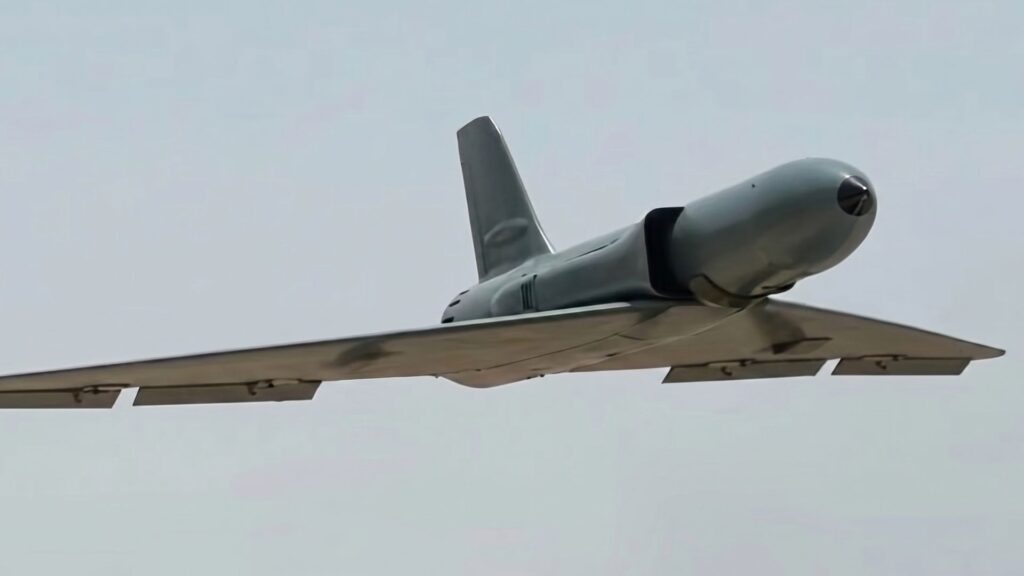
In this vein, Woot-Tech recently tested a rocket-assisted take-off (RATO) motor that lets a loitering munition launch without a runway. Alsons Group, in turn, unveiled a family of indigenously built piston engines for small unmanned aerial vehicles (UAVs) at this year’s Eurosatory exhibition in Paris.
Get the Full Picture on Pakistan’s Defence and National Security
Get dedicated Pakistani defence news, force analysis, procurement tracking, and national security policy insight, backed by more than a decade of documented reporting and depth general news coverage cannot match.
A Market Moving Toward Volume
Pakistan’s drone build-up since 2020 has run largely through state-owned enterprises. NESCOM has driven the Shahpar line, while the Pakistan Air Force‘s National Aerospace Science and Technology Park (NASTP) worked with Turkey’s Baykar on the Yiha-3.
However, the 2022 Russia-Ukraine war and the May 2025 conflict with India have pushed demand toward large numbers of smaller, cheaper systems. The armed forces now want Shahed-style loitering munitions, first-person-view (FPV) drones, interceptors, swarms, and low-cost cruise missiles in volume.
Given that shift, the economics have changed. Producing thousands of low-cost, attritable airframes is a different task from building a handful of complex platforms, and it is one where private manufacturers can compete.
The Cost of Leaning on SOEs
State-owned enterprises (SOEs) carry a structural burden. They hold capacity and the long-term cost of sustaining it, which means continued spending on underused labour and idle production lines even when a programme stalls.
These enterprises do not run on profit-and-loss terms, so they face little pressure to advance. Pakistan Ordnance Factories (POF) remains built around the G3 rifle and MP5 submachine gun even as frontline units reach for newer designs, and the Pakistan Aeronautical Complex (PAC) still draws funding through gaps in JF-17 orders.
The way these bodies are run adds friction of its own. Because PAC is managed closely by the air force, the officials handling a project can rotate out every few years, leaving private partners to re-explain their work to a successor who may not share the same priorities.
Related reading
The talent picture compounds this. Hiring at the SOEs has slowed sharply since the late 2010s, leaving several overstaffed, while a steady flow of aerospace engineers has left for the UAE, Australia, and Europe.
Thus, a private sector that cannot afford idle capacity offers a different model. Firms that answer to profit and loss must track what their buyers want and what their main markets will pay, or they do not survive.
Whether the Opening Holds
The firms making the running are not defence-first companies. Alsons Group built its base in the automotive sector – where it has long supplied piston engines and transmissions – which is why it can fund an internal research-and-development (R&D) effort from that cushion.
That pattern matters, because a business needs steady orders to pay salaries and keep factories running. One can see why the private entrants tend to keep a civilian arm or an export market alongside any defence work, spreading risk rather than depending on a single domestic buyer.
Pakistan’s military ranks among the world’s largest, which should make supplying it an attractive business. In this vein, one can see the export incentive pulling firms further, much as Alsons chose to show its engines at Eurosatory rather than at home.
The clearest precedent sits to the west. Turkey has spent roughly 26 years moving from an import-dependent, aid-reliant posture to a self-sustaining defence industry and a major export business, which suggests the balance between state and private industry can be shifted over time.
Whether Pakistan follows depends less on any single engine or motor than on policy. One could see these 2026 openings harden into durable capacity, or fade if the incentives to sell, invest, and hand work to industry are not built into how the state buys.
Please log in or subscribe to complete the article.
Quwa Plus · In-Depth Pakistan Coverage
Understand Pakistan’s Defence and National Security in Unmatched Depth
Understand what Pakistan is acquiring, how its armed forces are evolving, and where national security policy is heading through dedicated defence news, force analysis, procurement tracking, Pulse Check briefings, and more than a decade of documented reporting.
Featured & Trusted By