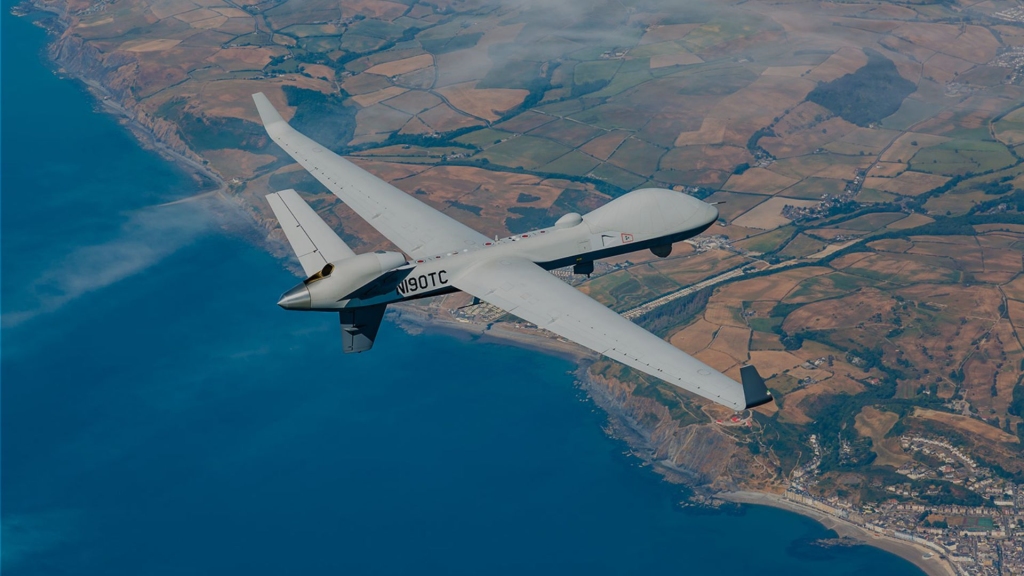
On 17 August 2026, the Government of India signed a USD $203 million deal with General Atomics Aeronautical Systems (GA-ASI) to lease two MQ-9B SeaGuardian high-altitude, long-endurance (HALE) unmanned aerial vehicles (UAVs) to the Indian Navy (IN) for 30 months.
Currently, the IN operates two leased MQ-9Bs under a contractor-owned, contractor-operated (COCO) arrangement dating to November 2020, and that contract will end in early 2027. The new pair keeps an orbit running until the 31 MQ-9Bs India ordered in 2024 start arriving.
Through the MQ-9B, the IN – alongside the Indian Air Force (IAF) and Indian Army (IA) – will reinforce three core capabilities. The first one is a wide-area intelligence, surveillance, target acquisition, and reconnaissance (ISTAR) net. This will be done through a 360-degree surface search radar alongside two electronic support measures (ESM) suites and a communications intelligence (COMINT) payload. The second capability is an extended anti-submarine warfare (ASW) search net through the AN/SSQ-62F directional command-activated sonobuoy system (DICASS), the AN/SSQ-53G directional frequency analysis and recording (DIFAR) sonobuoy, and the AN/SSQ-36 bathythermograph. And finally, the third capability is strike, namely using AGM-114R Hellfire air-to-ground missiles and GBU-39B/B Small Diameter Bombs (SDB).
It is also worth noting that the MQ-9B seamlessly integrates into the IN’s wider ISTAR ‘stack’, adding to the P-8I Neptune and the MH-60R Seahawk. Thus, when it comes to ISTAR, ASW, and anti-ship warfare (AShW), the IN will operate a fully networked and interoperable system cutting across large, long-range fixed-wing patrol aircraft, multi-mission rotary crafts, and, not least, advanced HALE drones.
In terms of the IN, workflows will include manned-unmanned teaming (MUM-T) between the MQ-9B and P-8I, with the former providing a scalable – and more attritable – method for both extending surveillance reach and covering more contested areas. While not a low-cost asset in itself, the IN will feel more comfortable placing MQ-9Bs closer to harm than a P-8I; but the MQ-9B’s networking with the P-8I will allow the latter to see the former’s feeds in real-time. In addition, the MQ-9B will also be able to cue the P-8I’s munitions, extending the latter’s reach, so to speak, in terms of over-the-horizon situational awareness and targeting.
With this context in mind, it is interesting how, in one domain, the IN has increasingly moved towards a closed-end, out-of-the-box-ready ISTAR/ASW/AShW system. Yet, within this very domain, the Pakistan Navy (PN) has arguably moved in the opposite direction by pursuing a locally designed, open-ended system. The PN’s ISTAR/ASW/AShW system is to comprise the Sea Sultan long-range maritime patrol aircraft (LRMPA), the Shahpar 3 Group 4+ drone, and a pending multirole naval helicopter platform. Granted, the work to bring this homegrown system to fruition is running into trouble on various fronts (most notably with the Sea Sultan), but that is the cost and friction of the sovereign-controlled pathway.
Compared to the IN, the PN’s approach certainly leans upon lighter weight platforms. For example, the MQ-9B has a maximum take-off weight (MTOW) of 5,670 kg, well over three times that of the Shahpar 3, which has an MTOW of 1,650 kg. Moreover, the MQ-9B also utilizes a larger powerplant, i.e., the Honeywell TPE331-10 turboprop (671 kW), while the Shahpar 3 currently relies on a 170 hp (127 kW) piston engine. Thus, the output and weight gap shows across key areas, notably payload capacity, with the MQ-9B wielding 2,155 kg externally via nine hardpoints versus the 400 kg to 500 kg of the Shahpar 3. Likewise, the MQ-9B has a ceiling of over 40,000 ft, while the Shahpar 3 can (albeit in ISR mode) operate at 28,000 ft to 35,000 ft. However, if armed, the Shahpar 3’s flight ceiling drops to 30,000 ft.
However, despite the limitations in capacity, the Shahpar 3 does maintain comparability with the MQ-9B in terms of range and endurance. So, with endurance, the Shahpar 3 offers over 30 hours (albeit conditional on the configuration). Moreover, using satellite communications (SATCOM) data links, the Shahpar 3 can operate at ranges of 2,500-3,000 km.
So, one can see that when it comes to range and endurance, the National Engineering & Scientific Commission (NESCOM) designed Shahpar 3 with naval requirements in mind. Moreover, it is likely that when NESCOM was designing the Shahpar 3, its powerplant or engine options were also likely much more limited. Thus, NESCOM likely focused on two areas: a minimally viable product (MVP) for naval-ready reach and endurance on one end, and a sharp initial focus on full-fledged ISTAR, ASW, and AShW capacity from the onset.
Quwa Plus
Go Beyond the Headlines on Pakistan’s Defence and Security.
Quwa Plus gives you deeper reporting, briefings, and analysis on Pakistan’s defence programs, foreign policy, national security, and regional strategy. Follow the developments that matter to professionals, analysts, and serious readers tracking Pakistan’s security landscape.
Join ($29.99/Year) Already a subscriber?Sign in