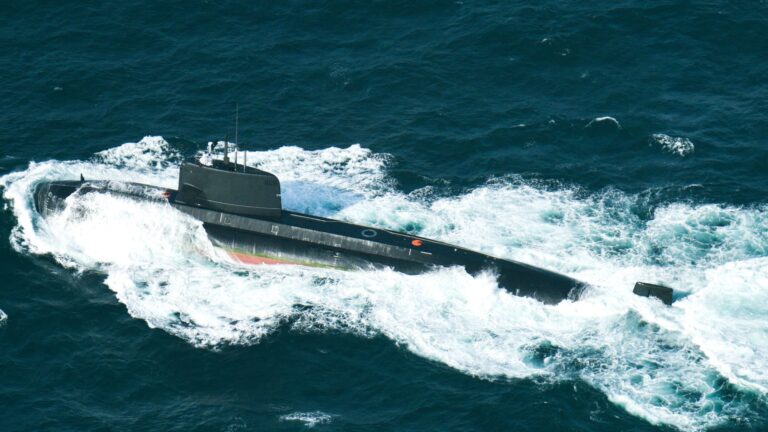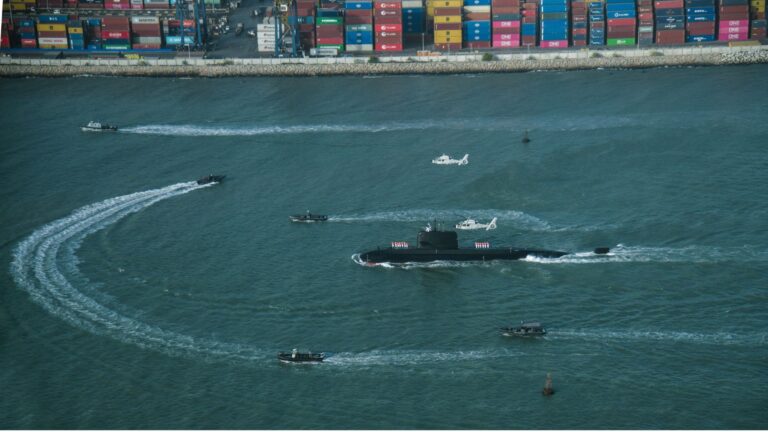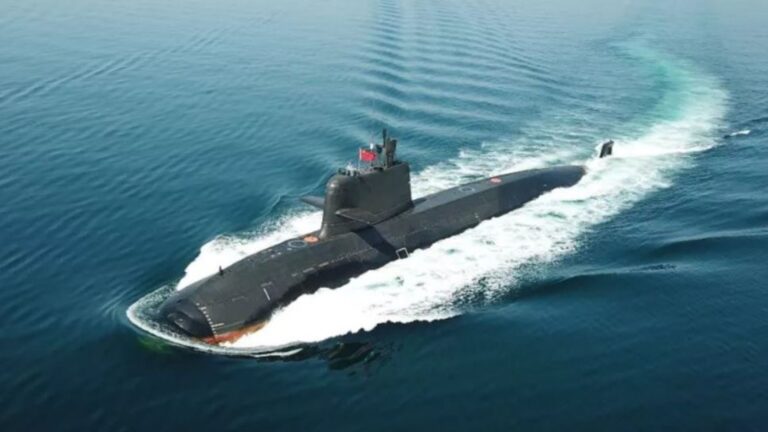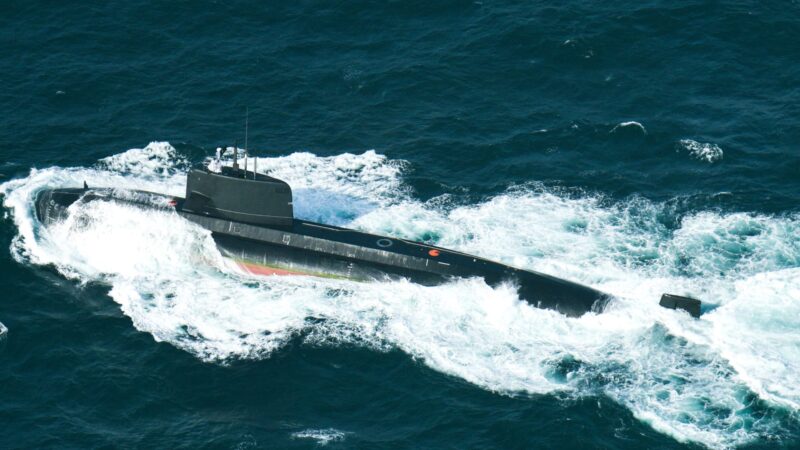

The Pakistan Navy (PN) will design an original submarine once its Hangor-class (S26) boats are inducted, the Chief of Naval Staff (CNS), Admiral Naveed Ashraf, confirmed in a recent interview with Asian Defence Journal.
The remark is brief, but for anyone who has followed Quwa over the past few years, it settles a question rather than opening one.
The PN set a vision some years ago to become a “submarine-building navy,” and the CNS has now placed an original design at the end of that road. Like the Jinnah-class frigate and the Sea Sultan long-range maritime patrol aircraft (LRMPA), the PN wants a submarine of its own — a third in-house naval program. Quwa laid out the wider eleven-boat trajectory this sits on top of in an earlier piece; the interview fills in what comes after it.
Get the Full Picture on Pakistan’s Defence and National Security
Get dedicated Pakistani defence news, force analysis, procurement tracking, and national security policy insight, backed by more than a decade of documented reporting and depth general news coverage cannot match.
Conventional, and Aimed at the Agosta 90B
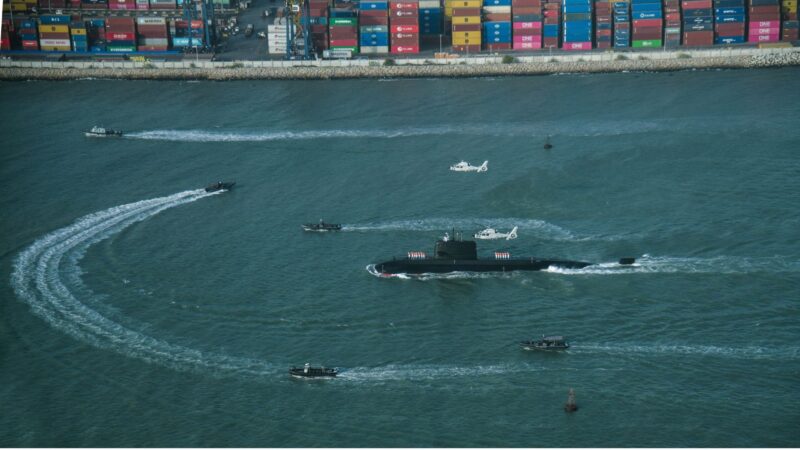
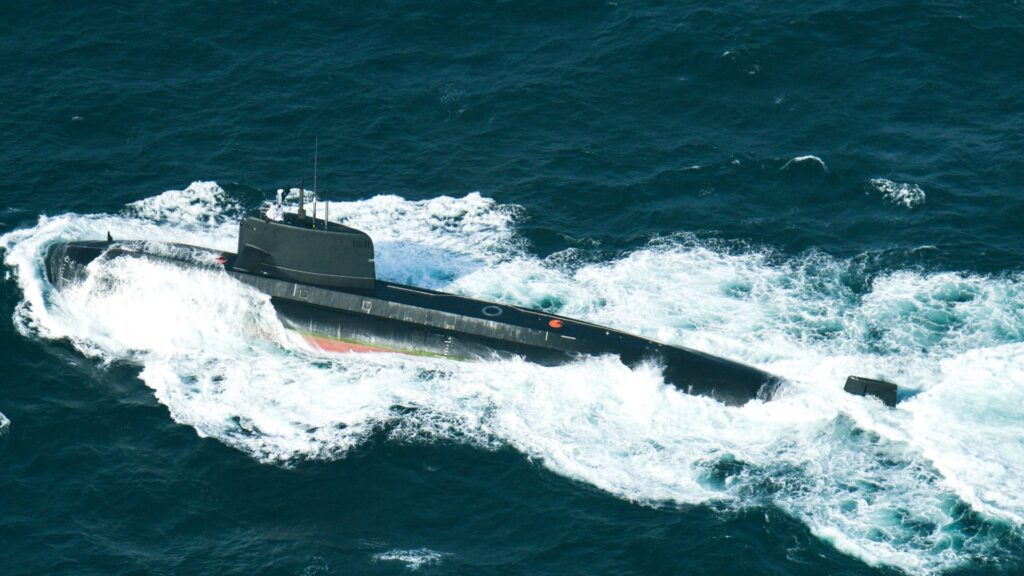
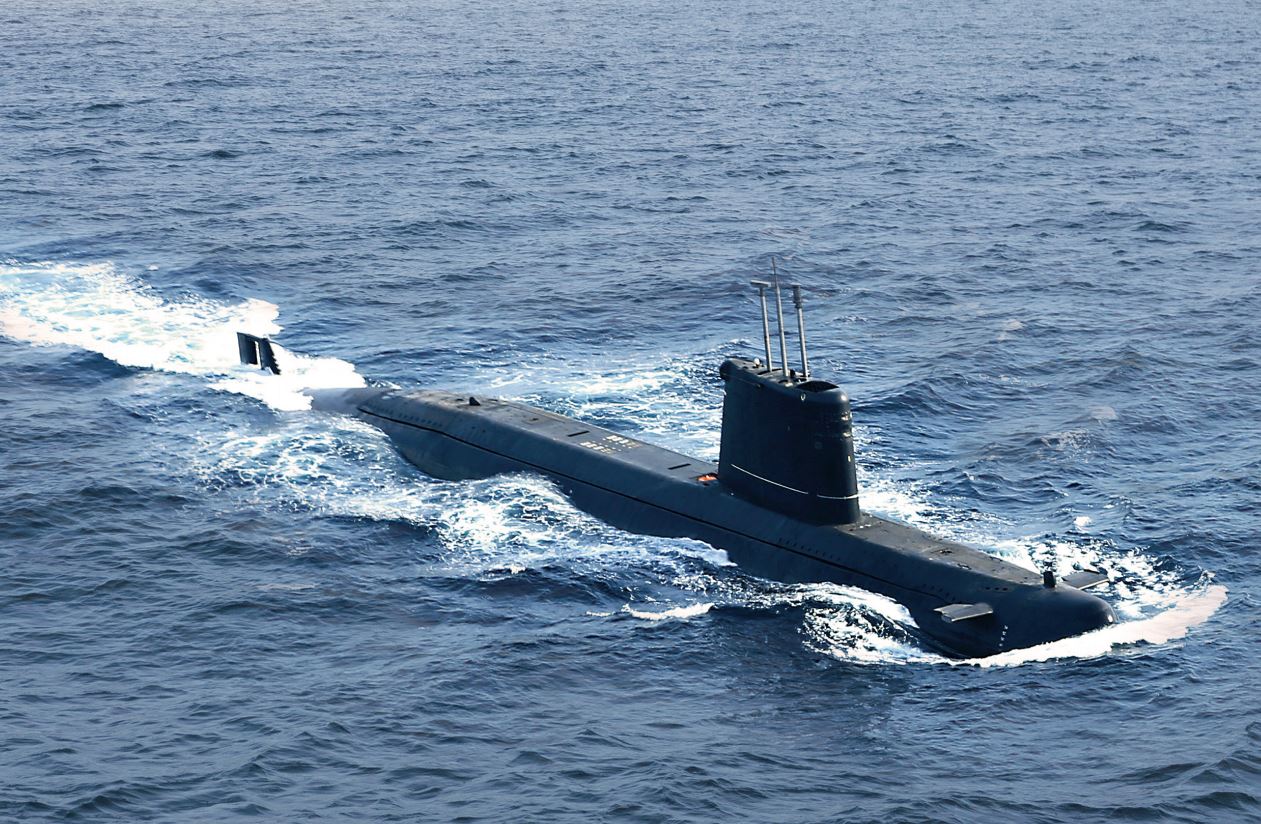
In context, the CNS is describing a conventional boat rather than a nuclear one — a separate question Quwa has examined elsewhere. The platform it is ultimately meant to replace is the Khalid-class (Agosta 90B).
The Agosta 90Bs are not old boats, but their support position is thinning. Sustainment from Naval Group — formerly DCNS — is limited, and with submarines, once original-equipment-manufacturer (OEM) support dries up, keeping the boats running becomes both difficult and costly.
This is not to say the PN will retire the class soon.
The more useful question is how it reaches a successor over the coming decade. A reasonable reading has work on an original design starting before 2030, with a first boat entering sea trials around 2040 — a point that would coincide with roughly 40 years of service for the lead boat, PNS/M Khalid, and a fair moment to begin discussing its replacement.
What Hangor Builds
Read closely, the CNS’s remarks put as much weight on industry as on the boats themselves — and the industrial half is where an original submarine actually becomes feasible.
With Chinese assistance, the PN has moved Hangor construction from the naval dockyard to Karachi Shipyard & Engineering Works (KSEW). That shift opens up the sort of capacity a submarine program needs.
In 2017, KSEW acquired a ship-lift-and-transfer system — the Syncrolift — from Norway’s TTS Group, configured to feed 13 inland workstations, so that hulls can be assembled on land and moved to the water only for launch and trials.
The value is that it removes a bottleneck: the coastline offers only so much working space, and it is exposed besides. One can see the model extending further over time — more inland workstations, and eventually dedicated facilities for submarine construction and for the maintenance, repair, and overhaul (MRO) work that follows. The same infrastructure already carries a Babur-class (MILGEM) corvette on one of those stations.
The contrast with the Agosta 90B experience is the point.
On that program, KSEW assembled one boat from French semi-knocked-down kits and built a second largely on its own — a hard, one-off effort, and Pakistan’s first attempt at submarine construction under licence.
With Hangor, the Chinese have helped stand up something closer to a genuine production line, one that can carry several boats at once and, along the way, teach KSEW to manage submarine supply chains and sequencing at scale.
Just as important, the program is building the end-to-end capacity to keep these boats running through domestic means — the deeper prize the whole effort is meant to secure, and the foundation any original design would rest on.
That same capacity keeps a second door open. The CNS suggested that more Hangors remain available should the PN need a proven design to shore up numbers, separate from the original program.
Given that Pakistan is now building the Type 039B Yuan-class derivative at home and standing up the means to sustain it, one can even see second-hand Chinese boats absorbed and overhauled locally. Between an original design, further Hangors, and second-hand boats, the current and future naval leadership is left with solid options for growing the fleet.
Designing for Sea Denial
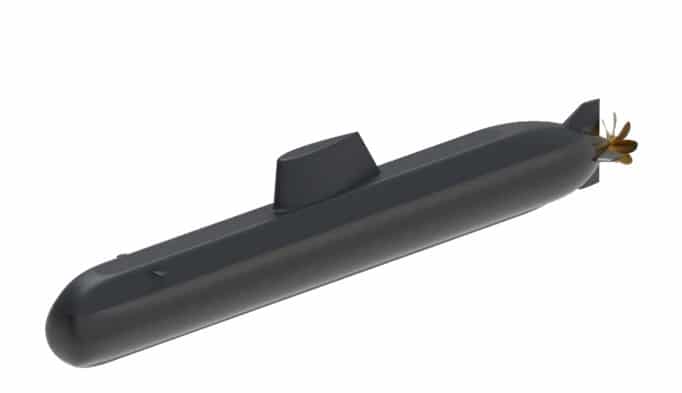
What would an original PN submarine look like? Based on how the requirement has developed, the likely starting point is a focused anti-ship and anti-submarine warfare boat — smaller than the Hangor, closer to the Agosta 90B’s 1,700-to-2,000-ton range, and tailored to Pakistan’s anti-access and area-denial (A2/AD) needs rather than to open-ocean patrol.
There is a reference point for the concept. At IDEAS 2018, Türkiye’s STM displayed the xTS-1700, a design it went on to promote to officials at the Ministry of Defence Production and the PN’s Directorate of Procurement.
The PN is unlikely to buy that boat off the shelf, but the core concept — a compact, stealth-focused hull in that displacement band — is a fair approximation of what it appears to want.
Stealth is where an original effort earns its keep. One can see the PN prioritizing acoustic quieting, and with it a different air-independent propulsion (AIP) architecture than it operates today — most plausibly a fuel cell, the quietest of the major options, in place of the Stirling system on the Hangor and the MESMA on the Agosta 90B. Lithium-ion batteries would follow, for greater charge retention, along with more advanced hull steels.
This is the deeper case for owning the design. When a navy buys a European or Chinese boat off the shelf, it accepts the OEM’s subsystem and supplier choices; the OEM becomes the middleman between the customer and every input, and the room to customize is limited and costly.
That trade-off can be worth it for a proven system, but it locks the buyer into the design on offer, often without access to the newest technology on the market unless the OEM is paid to integrate it. Designing the boat in-house removes the middleman.
The PN has been assembling the means to do exactly that through the Naval Research and Development Institute (NRDI), also known as the Platform Design Wing (PDW).
Its method is to pair with foreign OEMs — Türkiye’s ASFAT on the Jinnah-class, South Africa’s Paramount Group and Italy’s Leonardo on the Sea Sultan — on terms that require the partner to transfer design-and-development capability alongside production know-how.
The parallel with the PAF’s JF-17 is close, but with a difference: where that program centred on production, the NRDI arrangements add in-house design work on top. The institute has been signing agreements with an interesting set of partners, Turkish Aerospace among them, and the aim is a point at which NRDI is itself the OEM — specifying what the PN wants, and dealing with suppliers in China, Türkiye, Europe, South Korea, or elsewhere directly.
The SWATS Bridge
None of this is quick, and the PN has been candid that NRDI remains a novice — one that still needs help with knowledge transfer, with integrating systems of different origins, and with managing suppliers.
That is why its original programs have leaned on larger, more experienced partners — on the Sea Sultan, the PN has largely deferred to Paramount Group and Leonardo, the latter a European prime of the first rank — and why the submarine will too. On the mechanism, Adm. Ashraf pointed to technology transfer: through it, he said, Pakistan would “gain expertise in advanced submarine design, construction techniques, systems integration and quality control processes.” The original submarine, in other words, would arrive through a ToT deal much like the Jinnah-class — an off-the-shelf purchase with design work appended to it.
The quieter bridge is the PN’s second, lower-profile submarine effort: the Shallow Water Attack Submarine (SWATS).
Offers have come from China (a small single-hull design floated around 2017-2018), Türkiye (the STM-500, now under construction with Pakistani requirements in mind), and Italy’s Fincantieri (the S800, a scaled-down S-1000).
Fincantieri’s promotion of the Type 212 NFS at IDEAS 2024 — comparable to the xTS-1700 on displacement and length, but heavier on stealth and endurance — hints at how a SWATS partnership could open the door to the fuel cells, steel, and batteries a next-generation boat would need.
Whoever wins SWATS, the likely outcome is twofold: near-littoral boats to succeed the Agosta 70s, and a partner to help NRDI design the original submarine that follows.
Outlook
Read together, the struggle of the Agosta 90B program, the capacity built through Hangor, and the focused, stealth-minded work of SWATS point towards a single destination — the PN as a submarine-building navy. The direction is now on the record from the top, even if the destination sits a decade or more away.
And once NRDI matures, the submarine need not be the end of it. One can see the same design capacity extending into the miniature end of the fleet — boats in the 200-to-300-ton class, smaller platforms of 100 to 150 tons, and the autonomous underwater vehicles and extra-large uncrewed systems below them. The boat Adm. Ashraf described may be the headline, but once the design skills are in hand, it is unlikely to be the last thing the institute builds.
Quwa Plus · In-Depth Pakistan Coverage
Understand Pakistan’s Defence and National Security in Unmatched Depth
Understand what Pakistan is acquiring, how its armed forces are evolving, and where national security policy is heading through dedicated defence news, force analysis, procurement tracking, Pulse Check briefings, and more than a decade of documented reporting.
Featured & Trusted By