
One year after the May 2025 conflict with India, Pakistan’s defence establishment is investing heavily in the material capacity to create situational openings – degrading Indian air defences through coordinated one-way effector (OWE) saturation, suppressing air bases with Fatah-II salvos, and disrupting command-and-control (C2) nodes via precision cruise missile strikes. The Army Rocket Force Command (ARFC), the expanding satellite constellation, and the emerging Integrated Battlefield Management System (IBFMS) are all designed to identify, track, and strike the highest-impact nodes available to India – and to do so at speed.
However, a harder question sits beneath the procurement activity: has the policy mindset of Pakistan’s national security leadership caught up to the capacity being built? The material infrastructure increasingly enables Pakistan to create windows of suppressed enemy capability – moments in which the operational balance temporarily shifts in its favour. Yet there is no visible doctrinal framework, disclosed capability, or public articulation of what Pakistan would do once those openings exist. In effect, Rawalpindi is building the tools to force open a door, but it is unclear whether anyone has planned what to do on the other side.
The Schelling Problem
Thomas Schelling, writing in Arms and Influence in 1966, drew a distinction between deterrence (dissuading an adversary from acting) and compellence (persuading an adversary to change its behaviour).3 Both depend on credibility, and credibility requires more than the possession of military capability – it requires the demonstrated willingness to use it. The intelligence, surveillance, target acquisition, and reconnaissance (ISTAR) layer, the precision-strike infrastructure, and the OWE saturation capacity under development are all instruments of compellence; they are designed to force India to de-escalate by degrading its warfighting capacity so rapidly that continuing the fight becomes untenable.
The problem is that compellence is inherently harder than deterrence because it demands action, not restraint. A state that possesses the tools of compellence but whose political leadership defaults to measured, calibrated retaliation effectively converts a compellent capability into a deterrent posture – forfeiting the initiative the hardware was designed to seize. Herman Kahn’s escalation ladder framework, developed in On Escalation in 1965, makes a complementary point: escalation dominance requires not only capacity at each rung of conflict intensity but the willingness to climb.4 A state that builds capacity at a given rung but lacks the institutional disposition to employ it cedes dominance to an adversary who may possess less capability but greater willingness to act. The risk for Pakistan is precisely this: investing in the material prerequisites of escalation dominance while retaining a policy culture calibrated for measured, post-hoc retaliation.
The Masoud Critique
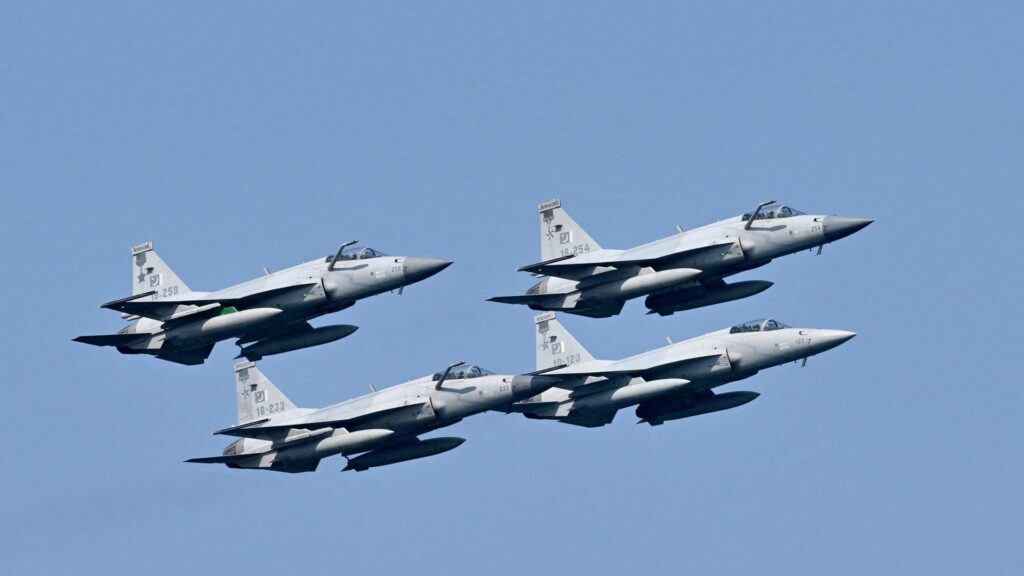
Retired Air Marshal Aamir Masood has given voice to this tension more directly than most. In his assessment, the Pakistan Air Force (PAF) achieved air superiority within the first 30 minutes of the May 6/7 engagement – 42 PAF fighters walling off 72 IAF aircraft, downing multiple Indian jets, and disrupting the Indian Air Force’s (IAF) strike packages.12 The result, per Masoud, was that India’s fighter fleet was grounded in the days that followed. India’s subsequent reliance on drones and BrahMos cruise missiles was not a choice but a consequence – its aircraft had been its centre of gravity, and the shock of losing them forced a shift to stand-off weapons.
Masoud’s critique is that Pakistan did not exploit this window. In his view, the days during which the IAF was grounded represented an opportunity to impose a heavier cost – to strike Indian air bases and infrastructure while the advantage held, rather than waiting for India to regroup. He draws an explicit parallel to the 1967 Six-Day War, in which Israel destroyed over 400 Arab aircraft on the ground within the first two days; the lesson, as Masoud frames it, is unambiguous: when you achieve air superiority, you press the advantage immediately, because the deterrence and psychological effect of destroyed aircraft compounds with speed. Instead, Pakistan opted for restraint. India reconstituted, re-planned, and escalated on May 10 with BrahMos strikes against PAF bases. Masoud’s judgment is direct: the escalation control was not Pakistan’s responsibility, and it could and should have struck harder while the opening existed.
Quwa Plus
Go Beyond the Headlines on Pakistan’s Defence and Security.
Quwa Plus gives you deeper reporting, briefings, and analysis on Pakistan’s defence programs, foreign policy, national security, and regional strategy. Follow the developments that matter to professionals, analysts, and serious readers tracking Pakistan’s security landscape.