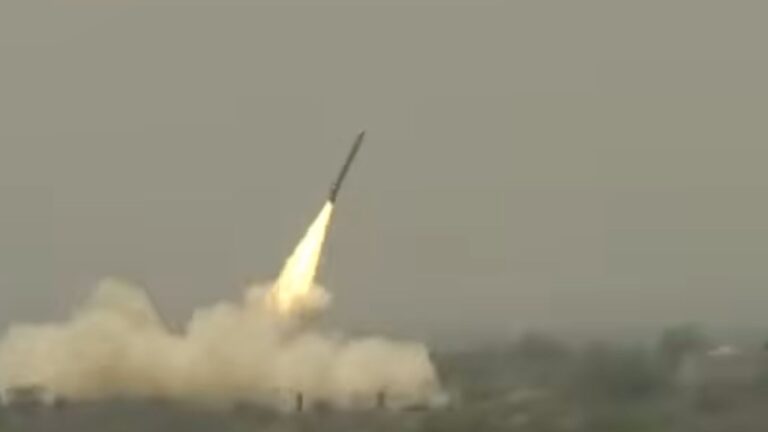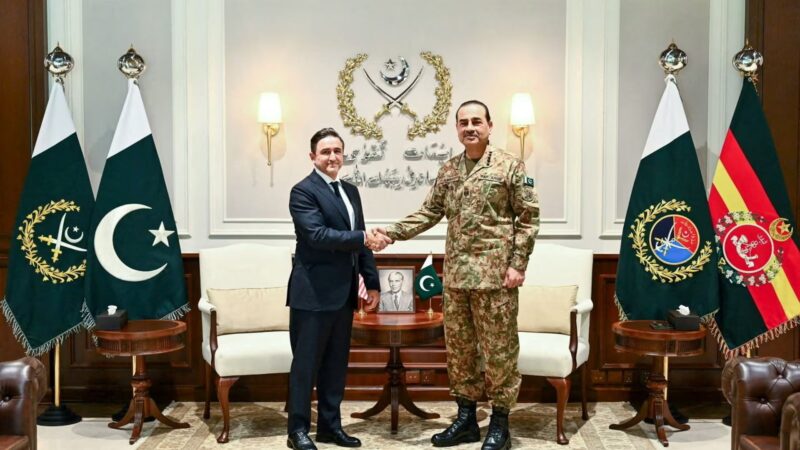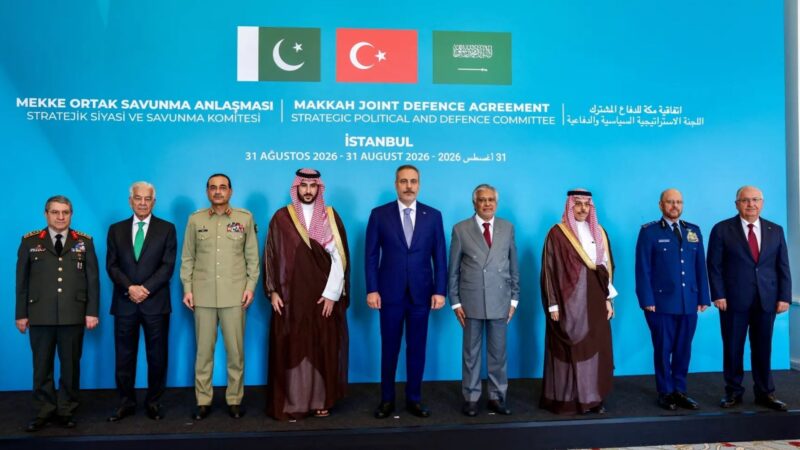
Shortly before Pakistan’s Joint Services Press Conference on May 7th, Inter Services Public Relations (ISPR) released a video outlining the major defence procurements, inductions, and organizational changes undertaken by the tri-services in the one year following the brief but intense conflict with India.
While framed as discrete, individual programs, there is a unifying theme underpinning them all, from the new satellite launches to the missile tests to the drone factories.
That theme is that since the May 2025 conflict, Pakistan has reworked its conventional deterrence efforts to strike at scale – irrespective of India’s capabilities. In other words, rather than solely interdicting a preemptive Indian operation, Pakistan is now shifting towards the model of directly degrading India’s warfighting capacity.
Get the Full Picture on Pakistan’s Defence and National Security
Get dedicated Pakistani defence news, force analysis, procurement tracking, and national security policy insight, backed by more than a decade of documented reporting and depth general news coverage cannot match.
The Shift From Denial to Deprecation
Until May 2025, Pakistan’s conventional deterrence operated on what might be called a denial model: show India that it cannot execute a military operation cleanly, and New Delhi’s leadership will decide the costs outweigh the benefits and choose not to act.
The idea was, at its core, defensive: intercept the strike, blunt the incursion, impose a proportional cost, and the adversary backs down.
Quwa has covered this framework before, and the important thing to understand is that it actually worked for a long time — i.e., India attempted a limited operation at Balakot in 2019, Pakistan denied it a clean outcome via the Swift Retort engagement, and the crisis wound down within 48 hours.
Then came May 2025, and the denial model broke completely.
India absorbed the air-to-air losses of May 6/7 and escalated anyway by sending smart munitions and drones right after and, by May 10, launching BrahMos strikes against PAF airbases. Pakistan had denied India a clean win in the air, but the denial alone did not stop the next rung of escalation, meaning that imposing costs by itself was no longer sufficient to end a crisis.
What has replaced it might be called deprecation-centric deterrence, and it rests on a fundamentally different reference point: instead of proving to India that an operation will fail, Pakistan is building the capacity to degrade India’s warfighting infrastructure so rapidly that sustaining a campaign becomes materially untenable.
The targets are the assets that keep India’s military running (e.g., aircraft on the ground, air defence batteries, fuel depots, munitions stores, and command nodes), and the goal is to destroy capacity rather than merely impose cost.
Where denial asks “can we stop them?”, deprecation asks “can we break enough of their stuff that they physically cannot continue?”
That distinction has reshaped every major procurement decision Pakistan has made over the past twelve months, and it is arguably the single most important lens through which to read the disclosures from the May 7th 2026 press conference.
Step 1: An Expansive ISTAR Layer
Every aspect of this new posture starts with the same question: where are the targets, and how quickly can they be engaged?
To answer that question, Pakistan is building target management infrastructure designed to detect, classify, track, and prioritize Indian military assets persistently enough that a strike decision can be made with confidence.
The satellite constellation is the most visible component of this effort, and the one that has moved fastest over the past two years.
SUPARCO has placed six satellites since May 2024, culminating in the PRSC-EO3, Pakistan’s first satellite with onboard AI processing for real-time image analysis.
The PRSC-S1 is the country’s first known SAR satellite, capable of imaging through cloud cover and at night, while the HS-1 hyperspectral satellite can detect material signatures invisible to conventional EO imagers, such as camouflaged equipment or disturbed terrain.
On top of that, a $406 million deal with China’s PIESAT will deliver a 20-satellite interferometric SAR (InSAR) constellation capable of persistent change-detection across the Indian border.
Below the satellites, NASTP has disclosed nine original radar programs, including an in-house airborne early warning (AEW) system, multi-function air defence radars, and passive sensors designed for both surveillance and targeting.
The VERA-NG passive sensor and drone-mounted ESM/radar feeds round out the current layered architecture that fuses active and passive inputs across airborne, ground-based, and space-based domains.
Here is what makes this architecture particularly interesting: it closes the BDA loop — i.e., the capacity to confirm whether a target has been neutralized and, if not, to cue a follow-up strike. Without credible BDA, a strike force is flying blind after the first wave, unable to determine whether to re-engage, shift to secondary targets, or pause, and Pakistan’s satellite constellation, for the first time in the country’s history, provides the architectural basis for a persistent strike-BDA-restrike cycle that does not depend on manned overflight of contested airspace.
Step 2: Parallel Strike Systems in the Air and on Land
The PAF’s procurement often dominates the headlines, but the Pakistan Army’s parallel investment in independent precision strike is just as consequential to this emerging posture and, in some respects, more revealing.
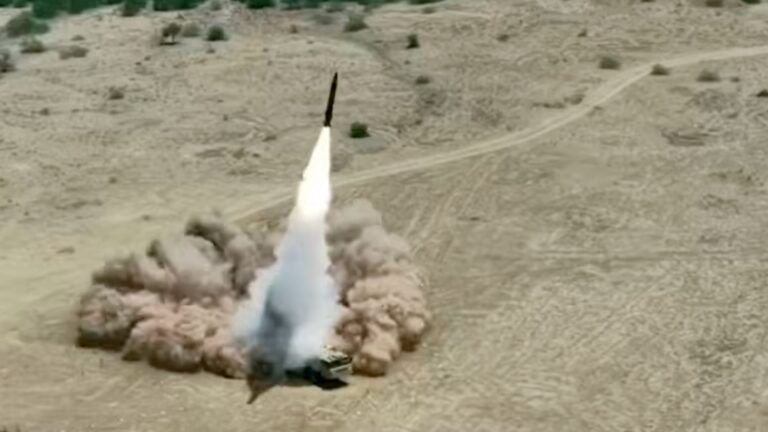
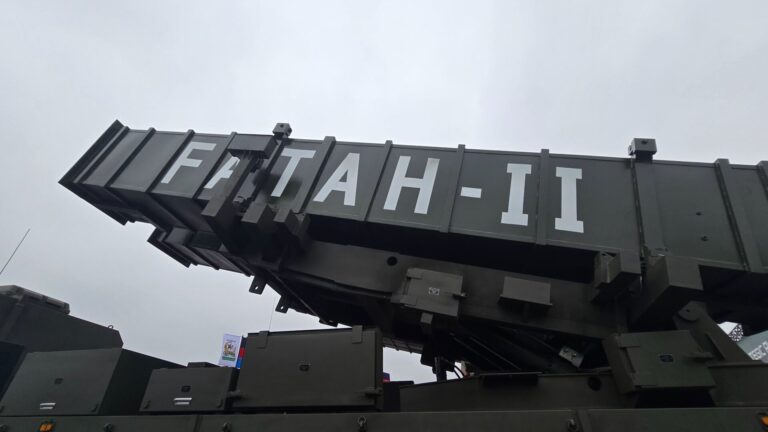
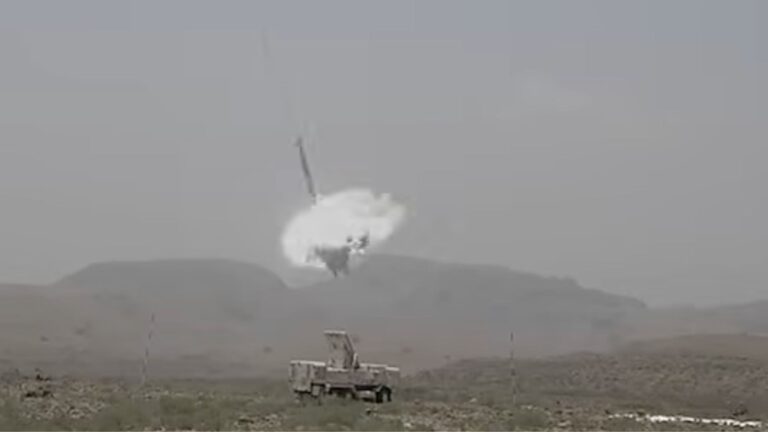
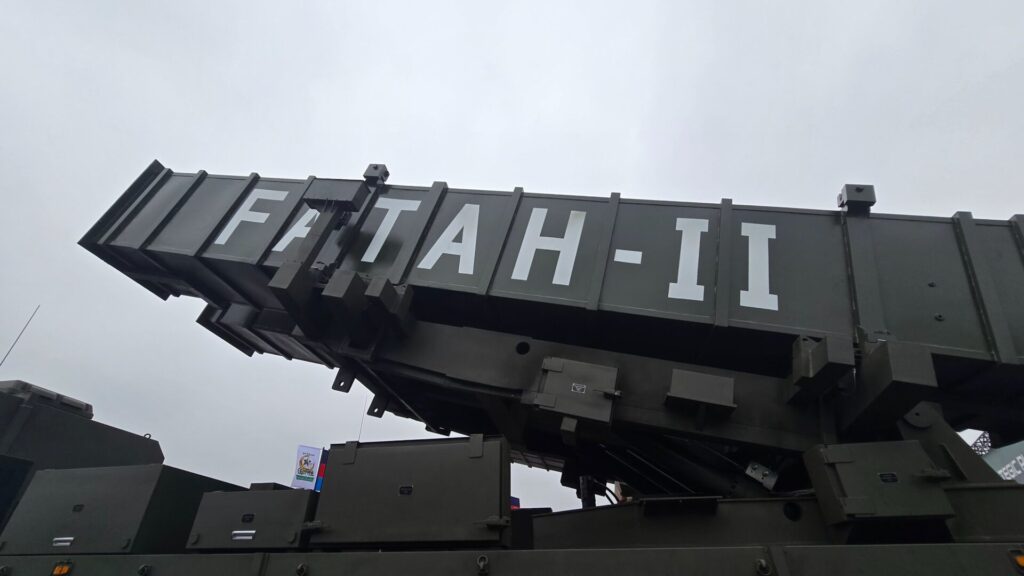
The Army Rocket Force Command (ARFC), which stood up as a dedicated formation, now fields a growing family of Fatah-series missiles, i.e., Fatah-I as a tactical GMLRS analogue, Fatah-II as a tactical ballistic missile, Fatah-III as a supersonic-cruising missile, and Fatah-IV as a ground-launched cruise missile.
This suite gives the Army autonomous strike capacity, from close-range suppression to deep interdiction, without relying on PAF sortie availability or Air Headquarters tasking.
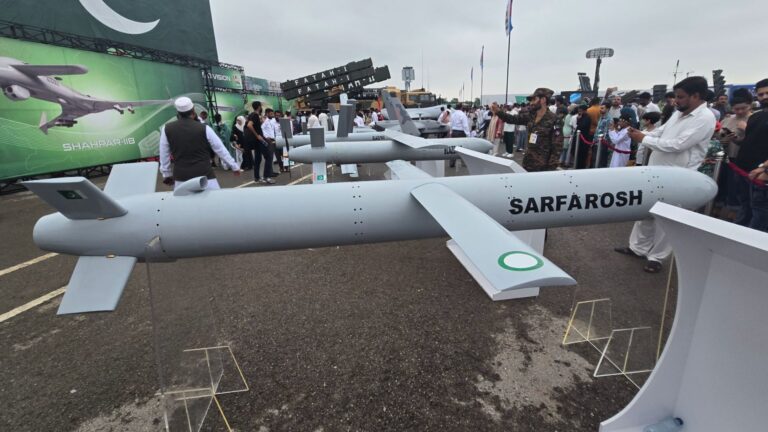
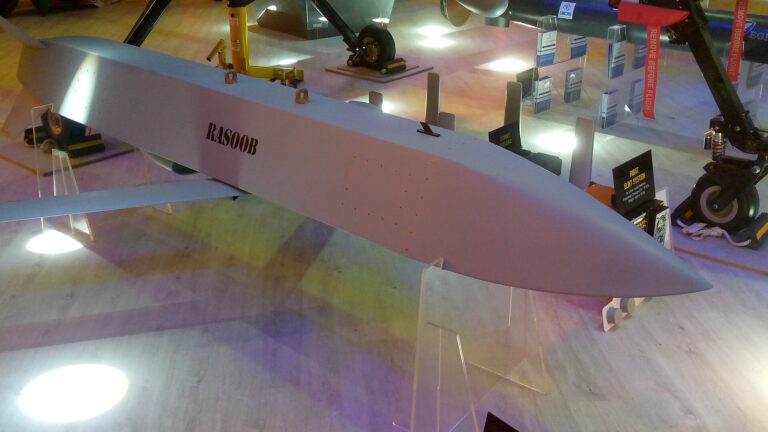
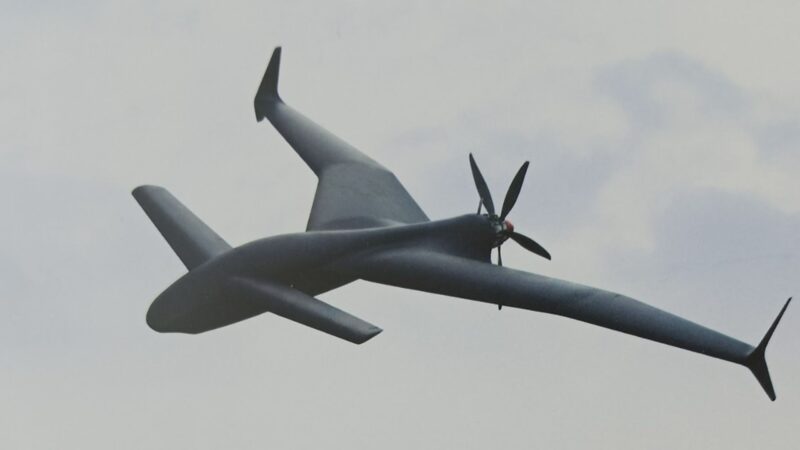
Alongside large missiles, Pakistan is rapidly scaling its inventory of one-way effectors, including Shahed-style loitering munitions and propeller-driven kamikaze drones.
GIDS, NASTP, and Woot-Tech are all moving into jet-powered loitering munitions, which offer longer range and higher speed, allowing them to function as low-cost cruise missiles, while the Woot-Tech SHARDS drone swarm system takes this a step further — i.e., a coordinated mass-launch capability designed for saturation attacks against defended targets.
The layering here is deliberate and worth spelling out: cheap one-way effectors saturate and suppress enemy air defences, creating the conditions for Fatah-I and Fatah-II salvos to hit airbases, dispersal areas, and logistics nodes at ranges that keep launch platforms outside the threat envelope of most point-defence systems.
Fatah-III and Fatah-IV, the supersonic and cruise missile variants, respectively, then reach deeper into the operational rear to hit higher-value command-and-control infrastructure.
In effect, the Army is building a scalable, long-range, precision-strike capability that now operates separately of the PAF and the Strategic Plans Division (SPD), which traditionally managed this type of capability.
Step 3: The PAF Scales Its Platforms and Stockpiles
The PAF’s contribution centres on two priorities that reinforce each other, namely platform depth and munitions scalability, and the way the fighter fleet is being divided tells you a lot about the underlying doctrine. Air Vice Marshal (AVM) Ghazi confirmed plans for additional J-10CEs and upgraded JF-17s, consistent with Quwa’s earlier assessment that the PAF would need ‘quantitative mass’ through 4+/4.5-generation fighters before a stealth-led doctrine becomes viable.
The J-10CE, with its AESA radar, PL-15 long-range air-to-air missile, and 1,240 km combat radius, is being positioned as the air-superiority asset, better suited to the beyond-visual-range fight and the escort role than to mass-strike operations.
The JF-17, by contrast, is becoming the mass strike workhorse, built around deploying multiple lighter-weight guided munitions per sortie via the AZB-series of precision-guided bombs and range-extension kits.
The AZB family ranges from GPS/INS-guided glide bombs to turbojet-powered variants with imaging infrared (IIR) seekers, each offering progressively greater standoff range at a cost below a purpose-built stand-off weapon, while the Taimoor air-launched cruise missile (ALCM) provides a 500-600 km subsonic strike option for extended-range strikes against fixed, high-value infrastructure targets.
The result is a force designed around many platforms carrying many cheaper guided munitions — i.e., fed by the same ISTAR architecture that tells those munitions where to go. As Quwa has argued before, the ISTAR-led approach and the scalable munitions approach are two sides of the same coin, each dependent on the other to function, and the press conference confirmed that the PAF sees it the same way.
Step 4: Scale and Optimization
Pakistan has frontloaded the ISTAR layer: the satellite constellation is in orbit, the radar programs are underway, and the target management architecture is being assembled. The harder problem is what comes next, namely building the munitions stockpile necessary to sustain a strike campaign beyond the first wave.
Smarter targeting helps stretch limited stocks further, but it does not replace the volume of weapons needed to prosecute a sustained campaign.
A target management system that identifies 300 high-value Indian military assets still needs 300 munitions to address them, and more once attrition, re-strike, and wartime fog are factored in, which is why industrial reality will ultimately dictate the credibility of Pakistan’s conventional deterrence.
This is where China enters the picture, and it is arguably the most underappreciated dimension of the entire posture shift. CSIS reported in October 2025 that China is expanding munitions manufacturing at a rate five to six times faster than the United States, while the Heritage Foundation’s 2026 assessment found that China’s surge production capacity is enabled by domestic control of key bottleneck inputs, specifically energetic materials, rare earth elements, inertial navigation modules, and composite casings. China refines over 85 per cent of the world’s rare earths and produces nearly 90 per cent of high-performance rare earth magnets, according to the Modern War Institute at West Point.
The opportunity for Pakistan is not just buying finished weapons off the shelf, but accessing the critical inputs needed to assemble them domestically at scale.
The precedent is already evident in how Russia and Iran have leveraged this same Chinese industrial depth: Russia scaled up Iskander production from roughly 36 missiles per year to approximately 50 per month thanks to Chinese ammonium perchlorate, a key solid-fuel propellant for which China supplies 70% of Russia’s imports. Iran, separately, received 2,000 tons of sodium perchlorate from China in 2025 — i.e., enough precursor for an estimated 500 ballistic missiles, per Newsweek reporting. The Atlantic Council documented how Chinese components, propellant precursors, and BeiDou navigation systems underpin both Russia’s drone production and Iran’s missile reconstitution.
Money, of course, remains the binding constraint, as Pakistan cannot match India’s defence budget and no amount of Chinese industrial access changes that arithmetic. But the economics shift if Beijing starts treating its defence sales to Pakistan less as commerce and more as a strategic investment — i.e., one that pins India’s military attention on its western border and reduces the bandwidth New Delhi can contribute to US-led containment in the Indo-Pacific.
Why This Matters
It is worth returning to where this analysis started, because the press conference on 7 May was important not just for what it revealed about specific platforms, but for what it confirmed about the underlying theory of the force Pakistan is building.
The inaugural episode of Defence Uncut, published almost exactly a year ago, argued that the fight Pakistan got in May 2025 was not the fight it had prepared for, and that the assumption that blunting an Indian operation would, by itself, prevent further escalation proved wrong.
Pakistan appears to have absorbed that lesson with unusual speed, and every major procurement decision in the twelve months since has reflected it.
The pre-2025 denial model assumed that a tactical rebuff would be enough to end a crisis, but India’s decision to press on with BrahMos strikes after the air-to-air losses of May 6/7 shattered that assumption: the PAF blunted the IAF’s initial thrust, yet India still chose to climb to the next rung of escalation.
Every procurement and operational decision since then has pointed towards deprecation rather than denial, meaning Pakistan is no longer banking on the idea that India will choose not to fight because the price looks too high; instead, it is building the capacity to destroy enough of India’s warfighting infrastructure that the campaign becomes physically unsustainable.
As Quwa assessed earlier, the ISTAR layer, the precision-strike infrastructure, and the one-way effector saturation capacity are all instruments of compellence, designed to force India to de-escalate by degrading its warfighting capacity so rapidly that continuing becomes untenable.
That is the thread connecting the satellite constellation, the ARFC’s Fatah family, the PAF’s J-10CE and JF-17 procurement, the AZB munitions program, the Taimoor ALCM, the Woot-Tech jet-powered loitering munitions, and the 160 NASTP programs: they are components of a single posture, a conventional force designed to strike at scale, informed by persistent ISTAR, sustained by Chinese industrial depth, and aimed at making the cost of an Indian offensive not just high but materially unbearable.
The open question, as Quwa has separately examined, is whether Pakistan’s political leadership has internalized this shift as fully as its military planners have.
The hardware is being built to create the openings that a deprecation-capable posture demands, but whether those openings are exploited in time, before India reconstitutes, remains unresolved.
Quwa Plus · In-Depth Pakistan Coverage
Understand Pakistan’s Defence and National Security in Unmatched Depth
Understand what Pakistan is acquiring, how its armed forces are evolving, and where national security policy is heading through dedicated defence news, force analysis, procurement tracking, Pulse Check briefings, and more than a decade of documented reporting.
Featured & Trusted By