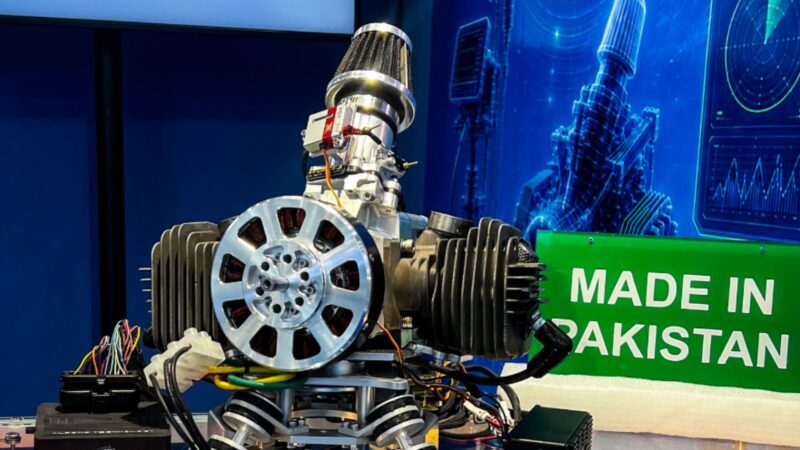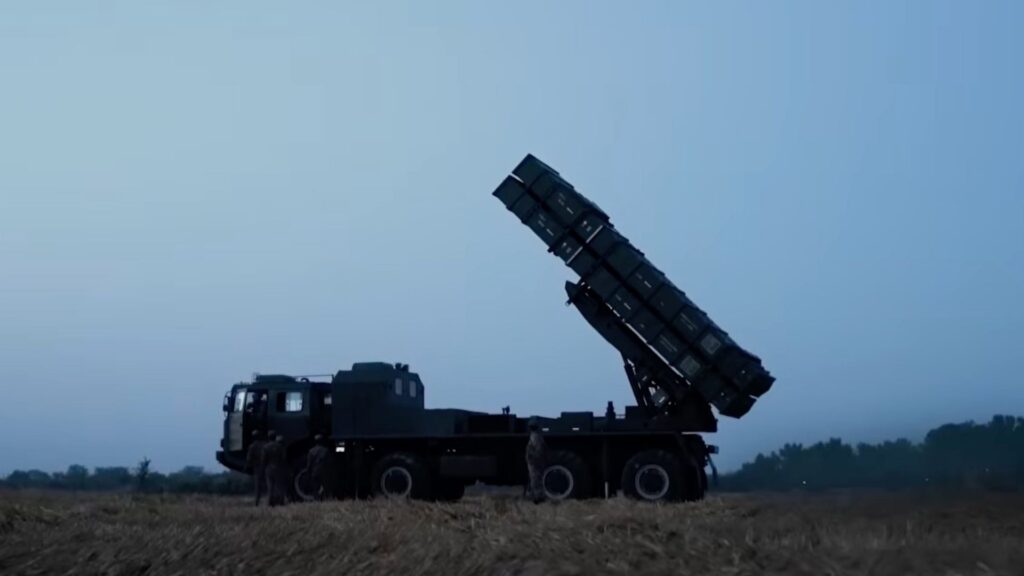
One year after the May 2025 India-Pakistan conflict, the Fatah-3 supersonic missile, Army Rocket Force Command, PAF fighter fleet expansion, Shahed-style drone factories, and a growing satellite constellation signal a fundamental shift in Pakistan’s conventional deterrence posture — but the hardest question remains unanswered.
Rawalpindi, Pakistan – On the morning of May 7, 2026, Lieutenant General Ahmed Sharif Chaudhry stood before reporters at the Joint Services Press Conference and told the country that Pakistan had shown India only “10 percent” of its military potential. Behind him, a presentation rolled through a cascade of newly inducted weapon systems — supersonic cruise missiles, turbojet-powered loitering munitions, reconnaissance satellites, counter-drone systems, and the formal operationalization of the Army Rocket Force Command (ARFC).
But exactly one year earlier, on the night of May 6–7, 2025, Indian BrahMos supersonic cruise missiles were slamming into Pakistan Air Force (PAF) airbases at Nur Khan in Rawalpindi and Bholari in Sindh. Israeli-made Hermes and Harop drones had penetrated as far as Karachi and Lahore. The PAF had won the opening aerial engagement — its Chinese-built J-10C multirole fighters downing Indian aircraft including Dassault Rafale jets — but what followed exposed gaps in Pakistan’s air defence, base hardening, and escalation management that no amount of victory rhetoric could conceal.
In the twelve months between those two events, Pakistan has undertaken one of the most compressed military modernization efforts in its history. The question, according to defence analysts who have tracked every procurement disclosure in granular detail, is not whether the hardware is arriving — it is — but whether the institutional, doctrinal, and command-authority changes run deep enough to change the outcome of the next India-Pakistan conflict.
Get the Full Picture on Pakistan’s Defence and National Security
Get dedicated Pakistani defence news, force analysis, procurement tracking, and national security policy insight, backed by more than a decade of documented reporting and depth general news coverage cannot match.
Pakistan’s Post-Conflict Military Modernization: A Fight It Wasn’t Fully Prepared For
On the latest episode of Defence Uncut, a defence commentary podcast produced by Quwa Pakistan Defence Journal, editor-in-chief Bilal Khan and co-hosts Arslan Khan and Aseem offered their most comprehensive assessment yet of Pakistan’s post-May 2025 procurement landscape — spanning the Pakistan Army’s precision-strike build-up, Pakistan Air Force fighter fleet expansion, Pakistan Navy missile integration, and the rapidly expanding space and ISTAR (intelligence, surveillance, target acquisition, and reconnaissance) architecture.
Their opening premise was blunt.
“Pakistan got into a type of fight that it wasn’t fully prepared for,” said Bilal Khan. “The PAF was able to wall off the IAF from cleanly completing its strikes, resulting in several downed IAF fighters. But from there, the conflict went in a direction Pakistan was not fully prepared for — India arguably controlling the escalation ladder with persistent drone and loitering munition activity, and then concluding with hits on the PAF’s bases.”
“What I described was not the narrative Pakistan would like you to hear,” he added. “But advancing narratives isn’t Quwa’s mission. Instead, our goal is to advance the best outcomes, especially for Pakistan’s key decision-makers.”
It is a framing that places the podcast at odds with the official ISPR (Inter-Services Public Relations) presentation — which characterised the past year as an unbroken arc of military triumph — and closer to the assessment offered by independent analysts such as those quoted in Al Jazeera’s anniversary reporting on the India-Pakistan conflict, where the International Crisis Group’s Praveen Donthi described the war as an “opaque conflict” between two nuclear-armed nations where “neither side wants to concede its losses.”
Army Rocket Force Command and the Fatah Missile Family: Pakistan’s Answer to BrahMos
The centrepiece of Pakistan’s post-conflict military adaptation is the Army Rocket Force Command — a formation modelled in principle on China’s PLA Rocket Force that consolidates surface-to-surface ballistic missiles, subsonic cruise missiles, supersonic cruising missiles, and one-way attack drones under a single command chain, independent of both the Pakistan Air Force and the Strategic Plans Division (SPD).


As Quwa’s own reporting has tracked, the ARFC’s creation reflects a fundamental doctrinal shift from denial-centric to deprecation-centric deterrence — from proving to India that a military operation will fail, to building the capacity to degrade India’s warfighting infrastructure so rapidly that sustaining a campaign becomes materially untenable.
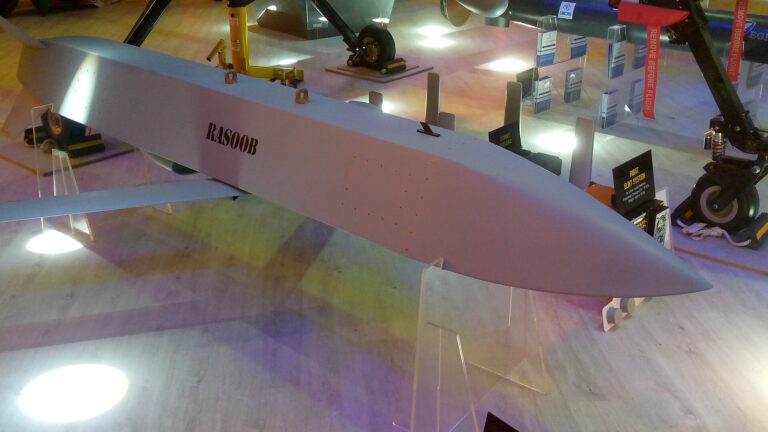
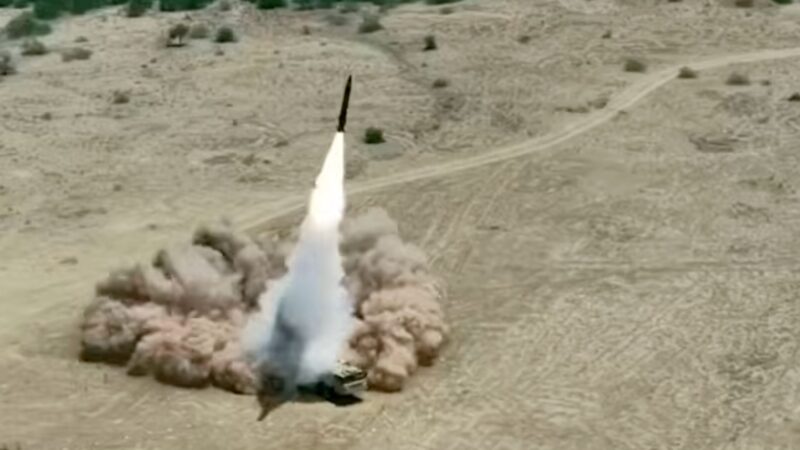
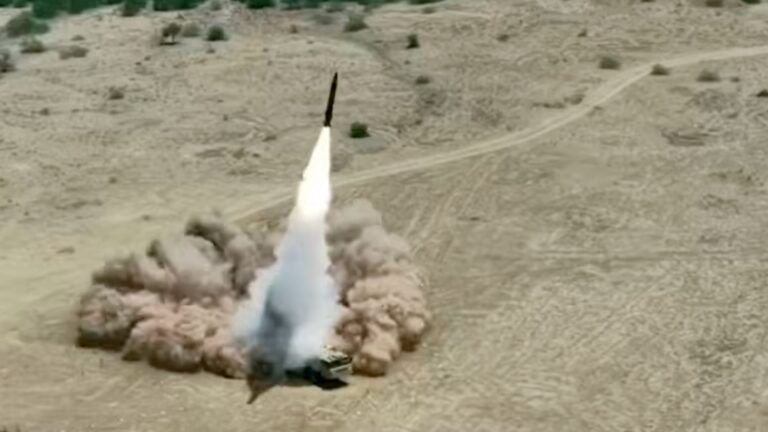
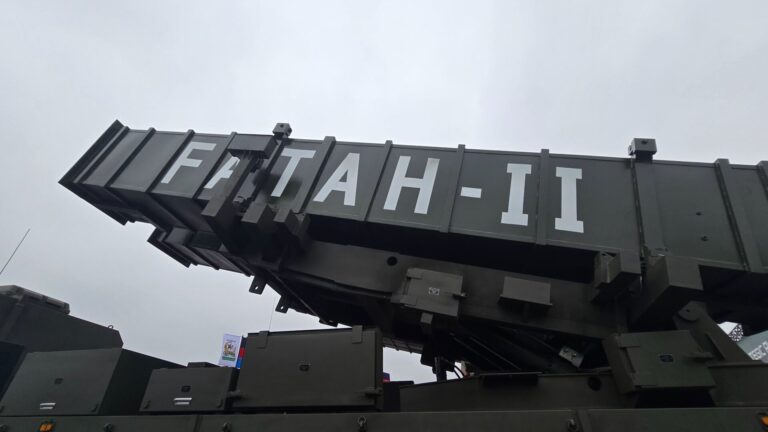
In practical terms, the ARFC fields the Fatah guided missile family — a suite of conventional munitions spanning multiple mission profiles. The Fatah-1 is a guided multiple launch rocket system (GMLRS) for tactical targets within 140 km. The Fatah-2 is a tactical ballistic missile with a range exceeding 400 km, sharing an airframe with the SMASH anti-ship ballistic missile developed for the Pakistan Navy. The Fatah-3 is a supersonic cruising missile now in development, drawing comparisons to the Chinese HD-1. And the Fatah-4 is a ground-launched subsonic cruise missile based on the Babur platform.
“The Army Rocket Force Command is basically working towards a multimodal strike capability,” Bilal Khan explained. “Perhaps there’s an implicit assumption from the army’s side that there are going to be potential gaps where they won’t be able to leverage the PAF for strike requirements. So they’re going to need to maintain a strike capability that’s sort of around the clock.”
“There’s two kinds of systems that you develop,” said Aseem. “One is the kind you induct and advertise as a deterrent — you say our missile can reach this many kilometres. And then there’s another capability that you induct secretly, which is meant as a trap.”
He pointed specifically to the interchangeability between the Fatah-2 and the SMASH anti-ship ballistic missile: “The Fatah-2 and the SMASH are basically identical airframes. The differences are in the internals. So it stands to reason that a ground launcher for the Fatah-2 can, without any modification whatsoever, launch a SMASH.”
Fatah-3 Supersonic Missile: HD-1 Derivative or Strategic Signal From NESCOM?
The Fatah-3 dominated the Defence Uncut episode’s opening discussion — and the panellists applied a degree of skepticism absent from most Pakistani commentary on the system.
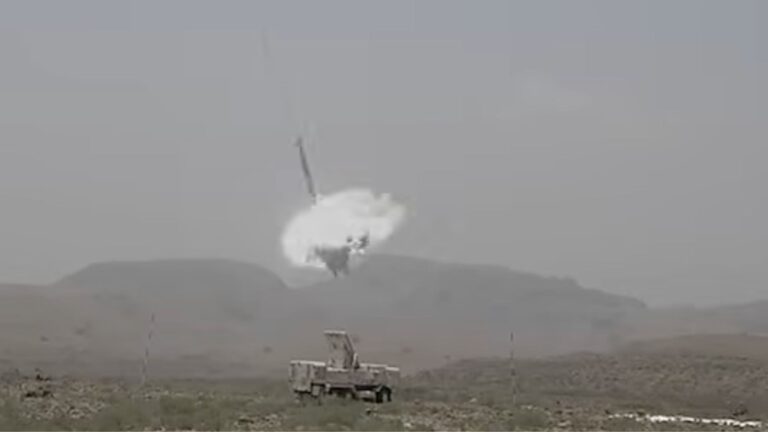
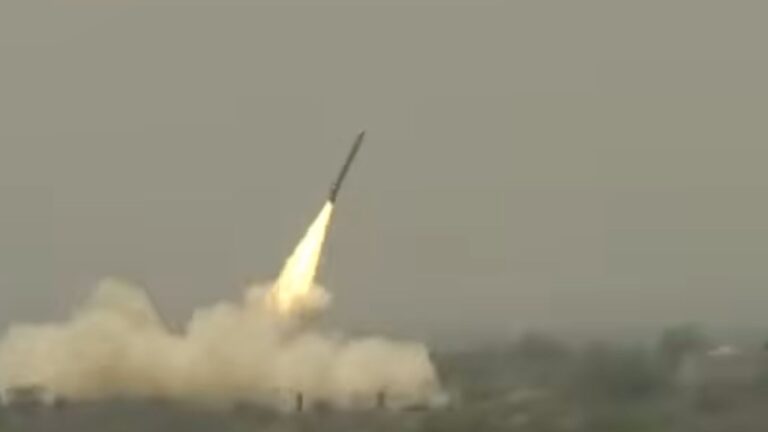
The missile, revealed through still images in the ISPR presentation, appears to be an air-breathing, ramjet-powered supersonic cruising missile. Many observers have drawn a direct line to the Chinese HD-1, an export-oriented supersonic missile developed by Guangdong Hongda Blasting Engineering Group — a mining company, not a traditional defence contractor.
But Arslan Khan urged caution. “I wouldn’t be surprised if this is just a stock video that they’ve found on file somewhere and used it as a substitute, because it’s not the first time they would do this,” he said, citing a separate instance in the same ISPR video where footage labelled as the Shahpar-3 drone was actually recycled Shahpar-2 footage from an older electro-optical sensor.
Bilal Khan offered a more structural interpretation. “The HD-1 doesn’t come from the traditional line of Chinese munitions development,” he explained. “It was designed and developed by a mining company. They obviously don’t have supersonic wind tunnel facilities or ramjet development bureaus. What happened was this company went through the Chinese commercial market, found enough suppliers to develop a supersonic cruising missile.”
The implication, he argued, is that Pakistan’s National Engineering and Scientific Commission (NESCOM) may not be importing the HD-1 wholesale, but rather leveraging the same Chinese commercial defence supply chain — sourcing newer subsystems, potentially including active electronically scanned array (AESA) seekers — to produce a more capable indigenous derivative.
“We’ve not really seen any indication of any tests being carried out,” Arslan Khan added, noting the absence of NOTAMs or satellite imagery of test infrastructure. “I think this is more indication of where they want to take the Fatah programme, as opposed to what the actual system is.”
Related reading
Pakistan’s Shahed-Style Drone Production Strategy: Loitering Munitions at Scale
If the Fatah-3 represents the headline, the panellists argued that Pakistan’s investment in mass-producible one-way attack drones and loitering munitions represents the more consequential long-term development.
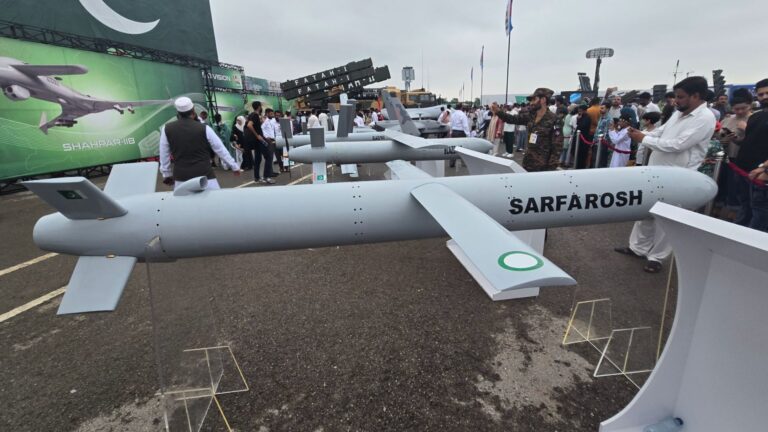
Several jet-powered one-way attack drones have emerged from Pakistani entities in the past year — the NESCOM Sartoforosh with a reported 1,000 km range, the Woot-Tech HiMark-25 TJ turbojet loitering munition, and the Delta Buzz. But the Defence Uncut panel was sharply critical of the design philosophy behind jet-powered systems when the real requirement is mass production.
“The Turks are aiming for very high-end, swarming, AI-enabled, intelligent-type drones,” said Arslan Khan, critiquing Baykar and the broader Turkish drone industry. “But they’re completely overlooking the fundamentals. Forget all this AI, forget all this smart stuff — just get back to the basics. We need to drop a warhead on this target a thousand miles away. How do we do it in the simplest, easiest way?”
The real play, the panellists argued, is the simpler Shahed-style piston-powered drone — and the evidence suggests Pakistan is pursuing this track through large-scale production facilities modelled on Iran’s distributed manufacturing approach.
“A Shahed-type drone is fibreglass,” said Aseem. “You need maybe three or four moulds. Two for the fuselage and wing, two for the vertical tails. You design it for hand layup — you don’t need an autoclave or anything fancy. You just need a barra denter in his workshop to put some fibreglass, pour some epoxy, and he has a Shahed now.”
Bilal Khan connected this to Pakistan’s broader economic geography and population density. “You distribute the parts throughout the country in small, hidden workshops. You take a page out of the Iranians. We might not have underground cities, but we have tons of rural areas, hugely dense cities — Karachi alone. You can hide production facilities everywhere.”
The operational concept involves mixed salvos mirroring doctrines observed in the Russia-Ukraine war and Iran’s combined use of Shahed-136 drones with ballistic missiles: cheap loitering munitions launched first to saturate and deplete Indian short-range air defence systems like the Akash and MRSAM, followed by higher-value Fatah-series missile strikes against pre-mapped military targets — airbases, radar sites, command nodes, and logistics depots.
Pakistan Air Force Fleet Expansion: J-10CE and JF-17 Before J-35 Fifth-Generation Fighter
The panellists reserved their warmest praise for what the Pakistan Air Force did not announce.
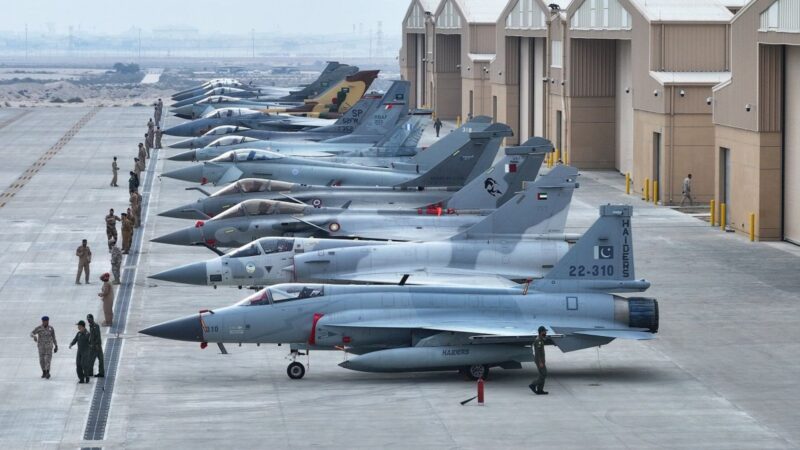
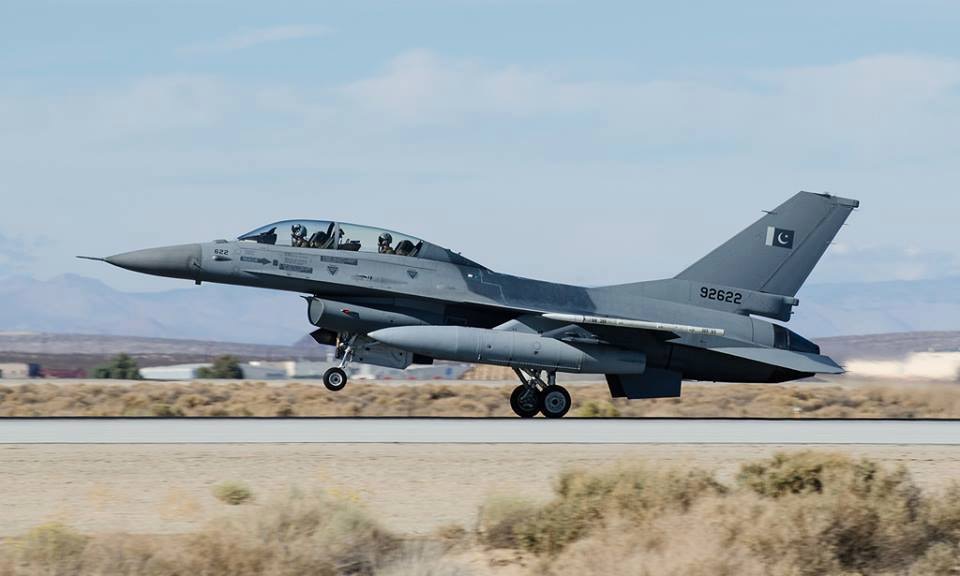
In a defence environment saturated with speculation about the Shenyang J-35AE stealth fighter, the PAF’s press conference on May 7 confirmed that J-10CE and JF-17 Thunder fleet expansion is the near-term procurement priority — with fifth-generation fighter aircraft remaining under evaluation for the early 2030s.
“That press conference felt like a breath of fresh air,” said Aseem. “Someone intelligent, smart, who knew what they were talking about. Not like a fanboy. He said, ‘We’re doubling down on J-10s and JF-17s.’ And then: ‘We’re looking at fifth-generation options, but we’ll procure them when there’s a need.’ Clearly, they realized there’s no immediate need for a fifth-gen fighter.”
The force-employment logic, as Bilal Khan described it, divides the PAF fleet into complementary tactical roles. “The J-10s provide top cover and the JF-17s become basically your munitions deployment donkeys — they deploy the AZBs, the cruise missiles, the CM-400 AKGs,” he said. “They take the brunt of that abuse because they’re low-cost. You can replace them, relatively speaking. From there, you add your J-35 or your Khan, and then you have the entire system.”
This assessment aligns with Quwa’s earlier analysis that the PAF would need quantitative mass through 4+/4.5-generation fighters before a stealth-led air combat doctrine becomes viable — an argument the outlet has maintained since well before Operation Bunyan-un-Marsoos.
Pakistan’s Military Satellite Constellation: ISTAR, Kill Chain Closure, and PRSC-EO3
Pakistan’s space-based intelligence, surveillance, and reconnaissance constellation has expanded faster than any other element of its post-conflict military modernization. SUPARCO has placed six satellites in orbit since May 2024, including three PRSC electro-optical satellites (EO-1, EO-2, EO-3), a synthetic aperture radar (SAR) satellite capable of imaging through cloud cover and at night, and a hyperspectral imaging satellite for detecting camouflaged equipment and disturbed terrain. A $406 million deal with China’s PIESAT will add a 20-satellite interferometric SAR constellation for persistent change detection along the India-Pakistan border.
The panellists framed the satellite constellation as the binding thread that connects every other procurement — the architecture that turns missiles, drones, and fighter jets into a functioning strike system.
“I’m sure they’re doing trade studies — do we blindly fire 15 Fatah-2s, or do we fire two Fatah-2s with satellite coverage to ensure we’re targeting correctly?” said Aseem. “Maybe they’ve realized it’s much harder to scale munitions production than to launch a couple of satellites.”
As Quwa’s analysis has argued, the satellite constellation provides the architectural basis for a persistent strike-BDA-restrike cycle — the capacity to confirm whether a target has been neutralized through battle damage assessment and, if not, to cue a follow-up strike without depending on manned overflight of contested airspace. For the first time in Pakistan’s history, the entire kill chain — find, fix, track, target, engage, assess — can be closed independently of allied or commercial satellite imagery.
Decision-Making Speed: The Gap That No Weapon System Can Fill
For all the optimism about the procurement trajectory — from the Fatah missile family to the PAF’s J-10CE and JF-17 expansion to the satellite constellation — the Defence Uncut panel returned repeatedly to a concern that no amount of hardware, software, or industrial capacity can resolve: operational decision-making speed at the highest levels of Pakistan’s military command.
“The challenge is decision-making,” said Bilal Khan. “How quickly can your decision-makers move from point A to point B? Will you have someone on the night of May 7th, next year, decide — while the PAF is walling off the IAF — that you go and do something across the LOC? Do you have someone who can do that?”
“And I think that is the kind of operator I’m not sure we have yet at the top.”
It is a question that echoes beyond the podcast. Al Jazeera’s own anniversary reporting noted that despite Pakistan’s post-conflict procurement surge, the structural conditions that led to last year’s India-Pakistan war — mutual distrust, absent communication channels, the Indus Waters Treaty suspension, and India’s evolving doctrine treating major militant attacks as acts of war — remain fundamentally unresolved. Christopher Clary of the University at Albany cautioned against assuming the upgrades represent a clear shift in the balance: “We don’t know whether this will be just a ‘Red Queen’s race,’ where both sides race as fast as possible just to stay in the same relative position.”
Pakistan can build the rockets. It can launch the satellites. It can fill workshops across Sindh, Punjab, and Khyber Pakhtunkhwa with fibreglass moulds and epoxy.
But the test will come not in a press conference in Rawalpindi, but on a night when someone at GHQ has to decide, in minutes rather than hours, whether to use them.
Quwa Plus · In-Depth Pakistan Coverage
Understand Pakistan’s Defence and National Security in Unmatched Depth
Understand what Pakistan is acquiring, how its armed forces are evolving, and where national security policy is heading through dedicated defence news, force analysis, procurement tracking, Pulse Check briefings, and more than a decade of documented reporting.
Featured & Trusted By