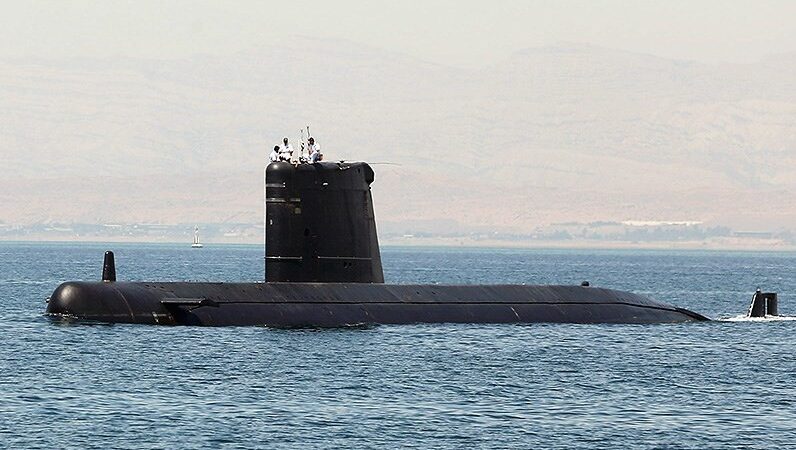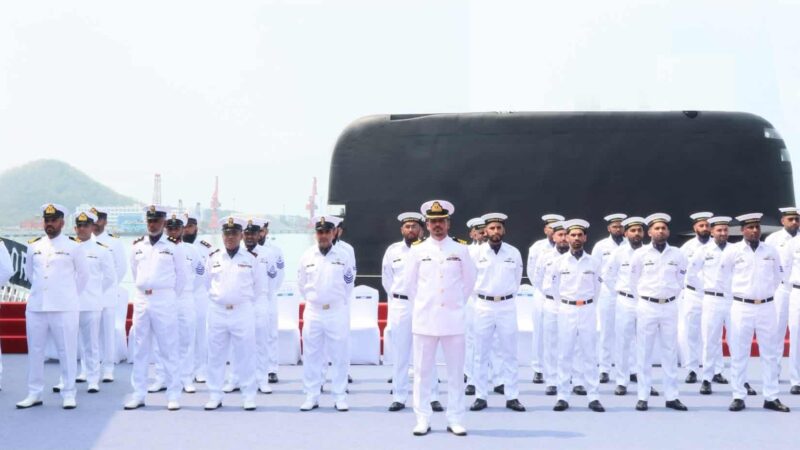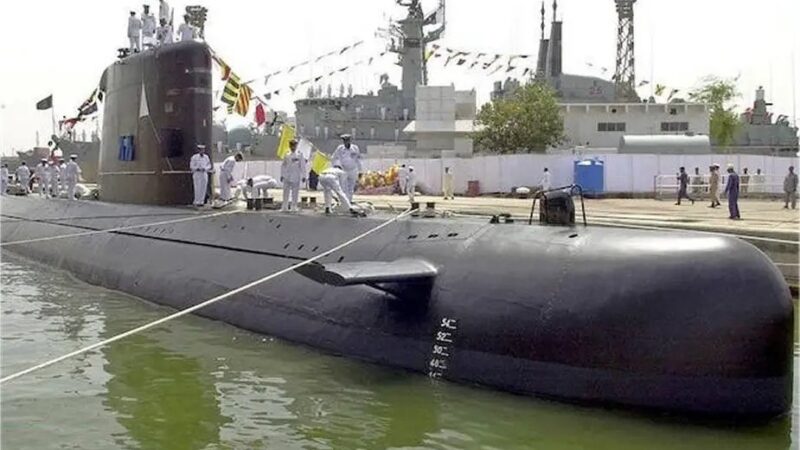
The Pakistan Navy (PN) does not currently operate a nuclear-powered submarine. Its fleet is entirely conventionally powered — comprising the Khalid-class (Agosta 90B) and the incoming Hangor-class (S26) air-independent propulsion (AIP) boats. However, the PN has been actively pursuing a smaller, littoral-focused submarine class to complement the blue-water Hangor fleet.
This requirement — the shallow water attack submarine (SWATS) — has appeared in Pakistan’s Ministry of Defence Production (MoDP) yearbooks, in public statements by retired PN flag officers, and in the product portfolios of the PN’s closest foreign partner in submarine work: Türkiye’s Savunma Teknolojileri Mühendislik A.Ş. (STM). It is the most likely next submarine program the PN will contract.
More significantly, the SWATS program represents a potential inflection point in the PN’s industrial trajectory. As Quwa assessed in January 2023, the PN will likely follow the same pattern it used for surface combatants: start with a ‘safe’ foreign design (the Hangor, mirroring the Tughril-class frigate), then move to a more ambitious original design (the SWATS and its successors, mirroring the Jinnah-class frigate). If that analogy holds, the SWATS is not an end in itself — it is the intermediary step toward an indigenous submarine design that could one day succeed the Agosta 90Bs.
The SWATS program is part of the Pakistan Navy’s broader submarine fleet.
The Requirement
The operational logic for SWATS is straightforward. The Hangor-class displaces 2,800 tons and was derived from the PLAN’s Yuan-class — a platform designed for long-range, long-endurance operations in open waters. As Quwa’s analysis of how the Hangor-class reshapes Pakistan’s maritime A2/AD posture detailed, the Hangor is a blue-water asset. It is not optimized for shallow-water operations in the Makran coast littoral, the approaches to Karachi and Gwadar, or the constrained waters of the northern Arabian Sea.
Those missions — coastal surveillance, mine countermeasures support, special operations force (SOF) insertion, and anti-ship warfare in shallow, high-clutter environments — require a smaller, more manoeuvrable boat. The PN has historically addressed this with Cosmos MG110 (SX756/W) mini-submarines, acquired from Italy in the late 1980s and early 1990s. The MG110s displace only 119 tons and are operated by the PN’s Special Service Group (Navy). As the Diplomat noted, the MG110s have been in service since the early 1990s and are nearing the end of their operational lives.
The SWATS requirement is more ambitious than a simple MG110 replacement. Where the MG110s are restricted to SOF and mine-laying roles with no meaningful anti-ship capability, the SWATS would be a combat submarine — armed with heavyweight torpedoes and potentially anti-ship cruise missiles (ASCM), capable of conducting AShW and anti-submarine warfare (ASW) in littoral waters. As Quwa reported in 2017, STM’s initial proposal to the PN was for a joint development of a mini-submarine, but STM itself noted that the program could “expand into a ‘different and strategic’ initiative.” The program has since evolved from a mini-submarine replacement to a full shallow-water attack submarine requirement.
The MoDP’s 2015–2016 yearbook listed the development and construction of a miniature submarine as a target for 2016–2017, assigning the task to KSEW — a detail Quwa first reported by cross-referencing the MoDP listing with STM’s parallel overtures. By 2022, the requirement had crystallized as a SWATS/SWAS (shallow water attack/assault submarine) program.
STM500: The Frontrunner
STM’s STM500 is the most publicly associated contender for the SWATS requirement. The design’s lineage runs directly from the mini-submarine discussions STM initiated with the PN in 2016 — the same year STM won the $350 million Agosta 90B mid-life upgrade contract.
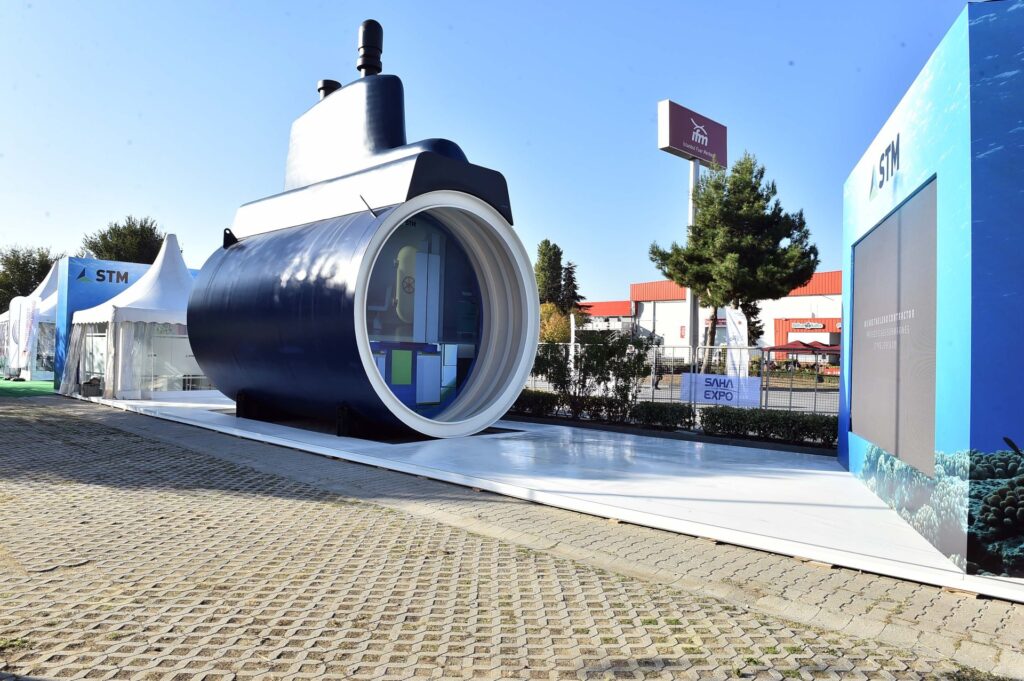
STM unveiled the STM500 concept at the 10th Naval Systems Seminar in August 2021 and began pressure hull test production in June 2022. Pressure hull testing was completed in 2024, with the hull showcased at SAHA EXPO 2024 in Istanbul — making STM the first privately-owned Turkish company to manufacture military submarine pressure hull sections domestically.
The STM500’s published specifications, per Naval Technology and STM’s product page, paint a compact but capable boat. The submarine measures 49 m in length with a submerged displacement of 700 tons — updated from the original 42 m / 540-ton concept. It dives to more than 200 m, achieves a top speed exceeding 18 knots, and can sustain 30-day deployments with a crew of 22 plus eight SOF personnel.
The armament is noteworthy for a submarine of this size. The STM500 carries four torpedo tubes capable of launching eight heavyweight torpedoes and guided missiles. Roketsan is providing the AKYA new-generation heavyweight torpedo — a fibre-optic wire-guided weapon with a range exceeding 50 km and a speed of 45 knots — as well as a submarine-launched variant of the ATMACA anti-ship missile. (Naval Technology)
Propulsion is diesel-electric with lithium-ion batteries. AIP is listed as optional, per Defense Mirror — a detail with implications for the PN, which could specify Stirling AIP to maintain commonality with the Hangor fleet’s propulsion philosophy.
The STM500 exhibited at IDEAS 2022 in Pakistan, with Turkish defence media reporting that the PN had selected the submarine for its SWAS program. This has not been officially confirmed by the PN. However, as Quwa noted in its December 2025 analysis of the PN’s fleet trajectory, the SWATS partner selection is one of the PN’s most consequential near-term procurement decisions.
STM’s existing relationship with the PN — spanning the Agosta 90B MLU, the Babur-class (MILGEM) corvettes, the PN Fleet Tanker (PNS Moawin), and the Jinnah-class frigate — makes it the most deeply embedded foreign defence partner in Pakistan’s naval program outside of China. As Quwa’s analysis of Turkey booking $3 billion in Pakistani defence deals documented, this relationship has expanded steadily since the Agosta 90B MLU was the entry point.
Alternative Contenders
STM is not the only option. China’s CSOC has offered the MS200 — a 200-ton mini-submarine design with two torpedo tubes — which Quwa noted as a plausible alternative when it was revealed at a Chinese defence exhibition. CSOC’s existing relationship with the PN through the Hangor program and the broader CSIC submarine export portfolio makes it a viable competitor.
Italy — through Fincantieri or its subsidiary — is another theoretical contender, given Italy’s legacy in Pakistan’s mini-submarine domain (the Cosmos MG110s were Italian-built). However, Quwa’s analysis of the sea-based nuclear deterrent question noted that European suppliers may face political constraints on submarine exports to Pakistan, similar to the dynamics that ended the Type 214 deal with Germany.
South Korea’s Daewoo Shipbuilding & Marine Engineering (DSME, now Hanwha Ocean) is a global leader in conventional submarine exports, but has no existing defence relationship with Pakistan.
The practical shortlist, given the PN’s established supplier relationships and political alignment, likely narrows to STM and CSOC. STM has the advantage of an existing submarine partnership, a design already in production (the STM500), and a subsystem ecosystem (Aselsan, Havelsan, Roketsan) that the PN already operates. CSOC has the advantage of scale, price competitiveness, and the ability to bundle the SWATS with broader Hangor-class support.
From SWATS to an Agosta 90B Successor: The Industrial Logic
The most strategically significant dimension of the SWATS program is not the boats themselves. It is what the program enables next.
Quwa has assessed since January 2023 that the PN intends to follow a stepwise path toward an indigenous submarine design. The Hangor-class is the ‘safe’ option — a near-stock Chinese design that the PN accepted with minimal customization to control cost and schedule risk, as Quwa’s analysis explained. The SWATS, by contrast, would involve the PN (and KSEW) in the design process from the ground up — either as a joint development with STM or through a co-production arrangement that transfers design engineering, not just assembly work.
This distinction is critical. The Agosta 90B ToT gave KSEW the ability to build a submarine designed by someone else. The Hangor ToT is doing the same at a larger scale. But neither program has given KSEW — or the PN’s design establishment — the ability to design a submarine. The SWATS program, if structured as a joint development, would close that gap.
A former Chief of Naval Staff, Admiral Zafar Mahmood Abbasi, publicly stated that the PN aims to become a “submarine-building navy.” As Quwa noted in its Silent Service assessment, this language signals an ambition beyond assembly — it implies domestic design capability.
The SWATS-to-successor pathway would likely follow this sequence, based on Quwa’s analysis of the PN’s acquisition patterns:
First, SWATS — a 500–700 ton shallow-water boat, co-developed with a foreign partner (likely STM), built at KSEW. The primary industrial objective is design participation: KSEW and the Maritime Technologies Complex (MTC) gain experience in submarine hull design, hydrodynamic optimization, and system integration from a clean-sheet starting point.
Second, a larger conventionally powered submarine — potentially in the 1,500–2,000 ton class — designed to succeed the Khalid-class (Agosta 90B) as the PN’s medium-displacement workhorse. As Quwa’s Silent Service analysis argued, the Agosta 90Bs will begin showing their age by the mid-2030s. With no lifecycle support from France — Naval Group lost the Agosta 90B MLU bid to STM in 2016, and has had no involvement in the PN’s submarine programs since — the PN will need a replacement platform by the 2040s at the latest.
This successor submarine would be a substantially more ambitious undertaking than the SWATS. It would require AIP integration (likely Stirling, for commonality with the Hangor), a combat management system capable of supporting ASCM and torpedo operations, and a hull designed for multi-week patrols. STM’s xTS1700 — the 1,740-ton, 60.14 m AIP submarine design STM unveiled at IDEF 2017 as its proposal for Turkey’s MILDEN (National Submarine) program — is a relevant reference point. The xTS1700 features eight torpedo tubes, accommodates 25 crew plus six SOF operators, and was designed by STM’s own engineering team. If the PN and STM co-develop the SWATS successfully, the xTS1700 or its successor could serve as a starting point for a larger Pakistan-Turkey joint submarine.
Third — and this is the most speculative step — one can see the design knowledge from SWATS and its successor feeding into a conventionally powered submarine with a dedicated strategic weapons capacity. As Quwa explored in its analysis of the PN’s nuclear asset requirements, two retired PN flag officers — Vice Admiral Ahmed Saeed and Rear Admiral Saleem Akhtar — publicly discussed the need for a “dedicated nuclear asset” on Pakistan state television. Admiral Saeed argued that the Hangor-class would serve as a “hybrid” deterrent (conventional submarine carrying nuclear-capable SLCMs), but that the PN should gradually build toward an “assured” second-strike capability.
However, Quwa’s assessment is that the PN is more likely to pursue this through a large, conventionally powered submarine with a vertical launch system (VLS) for Babur-series SLCMs — potentially SLBMs — rather than a nuclear-powered boat. The technical and fiscal barriers to a nuclear submarine are substantial: Pakistan has no naval nuclear propulsion program, and developing a compact submarine reactor would require multi-decade investment. South Korea’s KSS-III, which fires ballistic missiles from a conventional submarine via VLS, provides a precedent for this approach.
The SWATS program is the first link in this industrial chain. Without the design experience that SWATS would build at KSEW and MTC, none of the subsequent steps — from Agosta 90B successor to a potential strategic submarine — are plausible. As Quwa’s Silent Service analysis concluded, the PN’s future submarine ambitions rest on whether Naval Headquarters (NHQ) can structure the SWATS program not just as a procurement — three boats to patrol the Makran coast — but as an industrial capability development initiative.
Design Priorities for SWATS
Quwa’s Silent Service analysis outlined the design philosophy the PN would likely adopt for SWATS and subsequent original submarines. The emphasis would fall on:
Acoustic signature reduction — the primary survivability metric for a submarine operating in the shallow, warm waters of the northern Arabian Sea, where ambient noise conditions and thermal layering create a complex detection environment.
Endurance — the ability to loiter on station for weeks without resupply, requiring either AIP or advanced lithium-ion battery technology (or both).
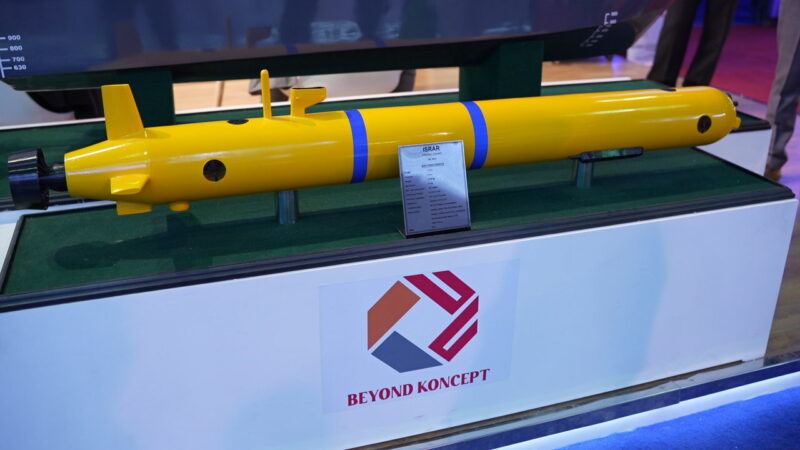
Manned-unmanned teaming — the capacity to deploy autonomous underwater vehicles (AUVs) from the submarine for ISR, mine countermeasures, and acoustic decoy operations.
Conservative armament — heavyweight torpedoes and ASCMs through torpedo tubes. No VLS. The PN’s focus at the SWATS level would be AShW and ASW, not strategic strike. As Quwa assessed, one should expect a conservative design that prioritizes stealth and endurance over payload volume.
These priorities align with the STM500’s design philosophy, which is itself oriented toward littoral operations with a small crew, high automation, and a torpedo-tube-based weapons fit. The alignment suggests the STM500 is a natural fit for the PN’s stated requirements — assuming the political and commercial terms can be agreed.
What to Watch
The SWATS program is the PN’s most consequential near-term submarine procurement decision after the Hangor-class. Three indicators will signal progress:
A contract announcement — likely with STM, possibly with CSOC. Turkish defence media have reported a selection, but neither the PN nor STM has officially confirmed a contract signing as of May 2026.
KSEW capacity allocation — the KSEW Hangor batch is expected to run into the early 2030s. If the SWATS contract is signed before the Hangor batch completes, KSEW would need to either expand its submarine construction infrastructure (potentially leveraging the SLTS system already installed) or subcontract hull fabrication to another Pakistani shipyard.
Design scope — whether the SWATS contract is structured as a build-to-print procurement (KSEW builds an STM500 or CSOC design as-is) or a co-development (KSEW and MTC participate in the design process). The latter would be the stronger signal of the PN’s intention to build toward an indigenous submarine capability.
Learn More
The “Silent Service” is Still the Future of Pakistan’s Navy — Quwa’s foundational analysis of the SWATS program, original submarine design ambitions, and the industrial path from Hangor to a successor class.
Pakistan Proceeds With New Miniature Submarine Program — Quwa’s first reporting on the MoDP yearbook listing and STM’s mini-submarine proposal.
Pakistan Navy Hints Need for Dedicated Nuclear Asset — Retired PN flag officers’ discussion of the Hangor as a ‘hybrid’ deterrent and the case for a dedicated nuclear attack platform.
Pakistan’s Pursuit of a Sea-Based Nuclear Deterrent — Why the PN may firewall conventional and nuclear submarine programs.
Turkish Defence Vendor STM Showcases MILDEN Submarine Proposal — STM’s xTS1700 design and the mini-submarine proposal for Pakistan.
Pakistan’s Anti-Access/Area-Denial Options (Part 2): Submarines — How SWATS fits into the PN’s distributed lethality-based A2/AD architecture.
Extending Deterrence: How the Hangor-Class Reshapes Pakistan’s Maritime A2/AD Posture — The fleet architecture that SWATS would complement.
Note: Quwa will update this page as the SWATS program progresses.