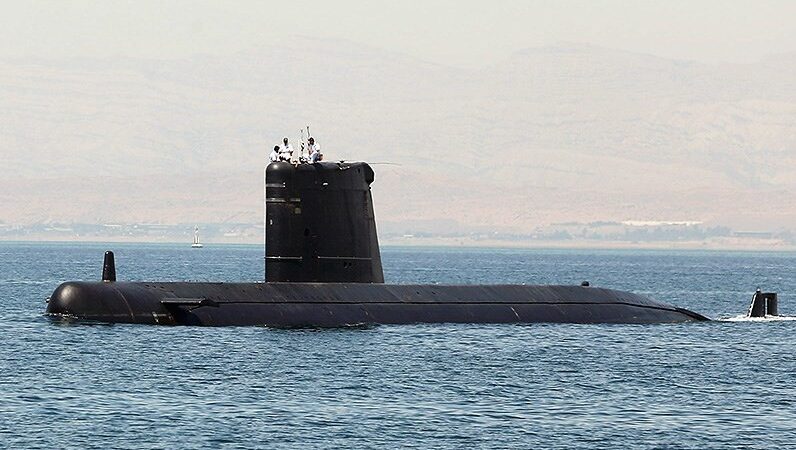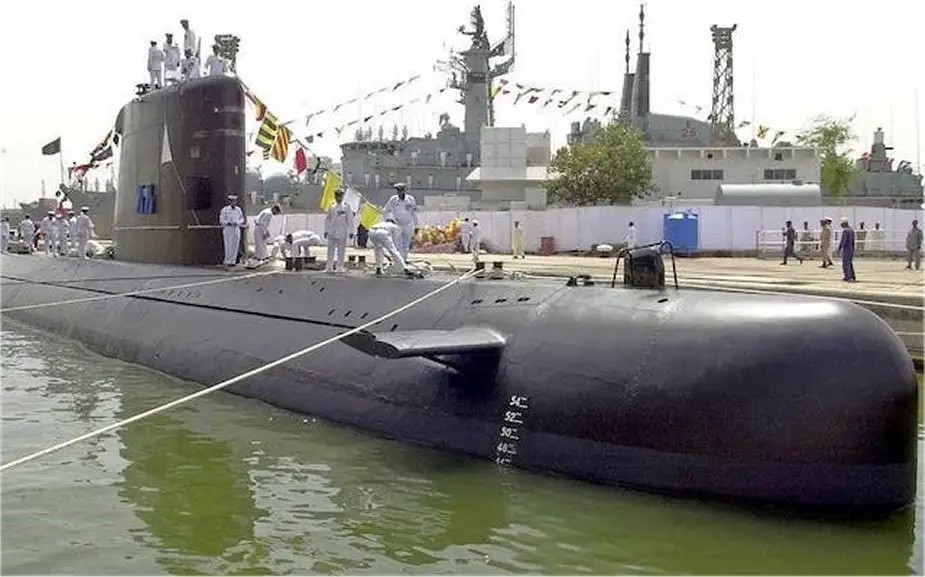
The Pakistan Navy (PN) operates three Khalid-class submarines — PNS/M Khalid (S137), PNS/M Saad (S138), and PNS/M Hamza (S139) — based on the French Agosta 90B design. Built under a contract signed in September 1994 between the Ministry of Defence Production (MoDP) and DCN International (now Naval Group), the program was valued at approximately $950 million and included a phased transfer of technology (ToT) to Pakistan’s Karachi Shipyard & Engineering Works (KSEW). The contract was signed during Benazir Bhutto’s second government, which chose the French Agosta 90B over competing bids from Germany (Type 209), Sweden, and Russia — a decision shaped in part by the inclusion of the ToT provision and KSEW’s capacity to absorb submarine construction work. (Corruption Tracker — Karachi Affair)
The Khalid-class has been the PN’s frontline submarine since 1999. PNS/M Hamza — the third boat, assembled at KSEW — was the first Agosta 90B globally to be built with the French MESMA (Module d’Énergie Sous-Marine Autonome) air-independent propulsion (AIP) system from the outset, making it the first AIP-equipped submarine constructed in South Asia. (NTI — Pakistan Submarine Capabilities) The class is undergoing a comprehensive mid-life upgrade (MLU) led by Türkiye’s STM, and is widely assessed to have been the platform used for Pakistan’s Babur 3 submarine-launched cruise missile (SLCM) tests. The Khalid-class is one of several submarine types operated by the Pakistan Navy.
Origins and Procurement
The Agosta 90B program originated in the early 1990s, when the PN identified the need for modern diesel-electric submarines to replace the ageing Daphné-class boats that had served since the late 1960s. In September 1994, the MoDP signed a contract with DCN for three Agosta 90B submarines — an improved version of the Agosta 70 design already operated by the PN — with the deal structured to build progressively more of each boat in Pakistan. (Global Security — Khalid-class)
As Naval Technology reported, PNS/M Khalid was built entirely at DCN’s Cherbourg yard in Normandy and commissioned in 1999. PNS/M Saad was assembled at KSEW with French technical assistance and commissioned in December 2003. PNS/M Hamza was constructed and assembled at KSEW with the highest share of domestic content — including pressure hull fabrication at the PN Dockyard — and was commissioned in September 2008.
The program was disrupted by the May 2002 Karachi bombing, in which 14 people — including 11 French DCN engineers and technicians providing technical assistance at the dockyard — were killed when their bus was struck by a car-borne explosive device. As Naval Technology noted, work on PNS/M Hamza was halted for a period following the attack. The bombing was later linked to a broader French corruption investigation — the so-called ‘Karachi affair’ — involving alleged kickbacks and retrocommissions tied to the submarine contract. French courts ultimately tried several former government officials in connection with the affair.
The ToT component of the Agosta 90B contract is significant not for the submarines themselves — which are now over two decades old — but for what it enabled. KSEW’s experience fabricating pressure hulls, integrating subsystems, and conducting harbour and sea trials on PNS/M Hamza directly created the industrial foundation that the PN leveraged when negotiating the Hangor-class (S26) transfer-of-technology arrangement with China in 2015. Quwa’s analysis of Pakistan’s pivot from kit assembly to defence design traced this industrial lineage in detail — from Agosta 90B assembly through Hangor ToT to an eventual indigenous design capability.
Specifications
The Khalid-class retains the basic double-hull design of the original Agosta 70 but introduces improved acoustic discretion, diving capability, and a modernized combat system. Wikipedia, citing Pakistani and French naval sources, and Naval Technology list the following specifications:
The class displaces 1,570 tons surfaced and approximately 2,050–2,083 tons submerged. Length is 76 m (249.4 ft), beam 6.8 m, and draught 8.2 m. Surfaced speed is 12 knots; submerged speed reaches 20.5 knots — substantially faster than the Hangor-class’s estimated 17-knot maximum. Range is approximately 10,000 nautical miles at 9 knots, and endurance exceeds 60 days according to PN statements — rising to 150 days for PNS/M Hamza with its MESMA AIP module. The class is powered by two SEMT Pielstick 16 PA4 V 185 VG diesel engines and two Jeumont-Schneider alternators producing 4,600 hp (3,400 kW).
The Khalid-class is armed with four 533 mm torpedo tubes — two fewer than the Hangor-class’s six. The original French weapons fit included the MBDA (formerly Aérospatiale) SM.39 Exocet anti-ship missile, launched from torpedo tubes — a sea-skimming ASCM with a range of 50 km and a 165 kg warhead. As Naval Technology detailed, the Exocet receives target range and bearing data before launch and approaches the target using inertial navigation followed by active radar homing.
For the heavyweight torpedo role, the PN operates the Atlas Elektronik DM2A4 SeaHake mod 4 — a fibre-optic wire-guided torpedo with a range exceeding 50 km and a speed above 50 knots. Atlas Elektronik confirmed in 2012 that the DM2A4 is in service with the German, Turkish, Pakistani, and Spanish navies. The DM2A4 is a dual-purpose anti-submarine and anti-surface weapon, and its fibre-optic guidance makes it largely countermeasure-resistant. As Quwa’s detailed breakdown of the Agosta 90B upgrade program noted, the PN’s choice of the Atlas Elektronik ISUS-100 sonar suite for the MLU was logically consistent with the existing DM2A4 torpedo — Atlas Elektronik is the only company offering a complete sensor-to-shooter chain for conventional submarines.
MESMA Air-Independent Propulsion
The MESMA system is a closed-cycle steam turbine that burns ethanol and liquid oxygen to generate steam, which drives a turbine to produce electricity. The process is self-contained — it does not draw atmospheric air — enabling the submarine to operate submerged without snorkelling for extended periods. According to Naval Technology, MESMA allows the Agosta 90B to remain submerged approximately three times longer than a conventional diesel-electric submarine.
PNS/M Hamza was built with the MESMA module integrated from the outset. The liquid oxygen (LOX) tank was installed in a hull subsection during April 2000, with the AIP ‘plug’ comprising two modules — one for the LOX tank and one for the steam generator. As Naval Technology reported, the MESMA AIP successfully completed PN acceptance trials. In March 2007, the PN placed an order with DCNS (now Naval Group) for the retrofit of MESMA to the first two boats — PNS/M Khalid and PNS/M Saad — which was completed by December 2011. The NTI’s assessment confirmed this timeline: “In 2011, Pakistan retrofitted the two earlier Agosta-90B vessels with MESMA during overhauls.”
The PN thus became one of the few navies globally to operate an entirely AIP-equipped submarine fleet — every Khalid-class boat now has MESMA. This distinction held until the Hangor-class commissioning in 2026, which added a second AIP type (Stirling-cycle) to the fleet. As Quwa explored in its Defence Uncut podcast on Pakistan’s submarine fleet, operating two different AIP systems — MESMA on the Khalid-class and Stirling on the Hangor — creates a maintenance and training complexity, but also provides operational flexibility. If one system encounters a class-wide issue, the other remains available.
STM Mid-Life Upgrade (MLU)
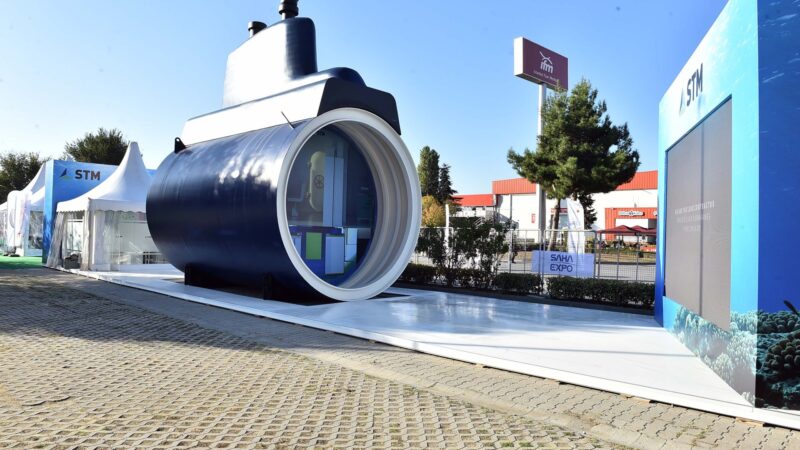
In June 2016, the PN signed a $350 million contract with Türkiye’s Savunma Teknolojileri Mühendislik A.Ş. (STM) to upgrade the Khalid-class’s electronic subsystems. STM announced the contract as its first major submarine program, noting its bid was “technically and commercially superior” to Naval Group’s competing offer — a significant detail, given that Naval Group designed the Agosta 90B. The PN chose a third-party integrator over the original equipment manufacturer (OEM).
The MLU is comprehensive. As Quwa documented in detail through 24 sourced references, the upgrade involves replacing the submarine’s entire sensor and electronics suite while retaining the hull and propulsion system:
Hensoldt Optronics South Africa is supplying the OMS-200 optronic mast and SERO 250 periscope — replacing the original French optics with high-definition television, laser rangefinder, and shortwave infrared (SWIR) camera systems. STM awarded the contract to Hensoldt in October 2016, and both systems integrate directly into the new combat management system. (Jane’s Navy International, October 2016)
Kelvin Hughes of the UK is providing its SharpEye I-band pulse-Doppler radar, capable of detecting targets as small as 0.5 m² at several nautical miles. The radar uses gallium nitride (GaN) power transistor technology — a solid-state design offering improved reliability over legacy magnetron-based radars. Kelvin Hughes announced the first contract in February 2017 and a follow-on for PNS/M Saad in November 2017.
Aselsan of Türkiye is supplying the ARES-2SC/NS electronic support measures (ESM) suite — a passive system designed to identify and locate radar emissions, including low-probability-of-intercept (LPI) radars, with 360° azimuth coverage. The system was originally designed for the Turkish Navy’s Type 214 submarines. (Jane’s 360, November 2016)
Atlas Elektronik of Germany is providing the ISUS-100 Integrated Sensor Underwater System — a new-generation sonar suite designed for complex littoral waters. It includes an expanded flank array sonar (EFAS), extended towed array sonar (ETAS), enhanced cylindrical array sonar (ECAS), and multi-purpose active sonar (FLAS). The ISUS-100 replaces the original Thales TSM 223 sonar. (Atlas Elektronik product documentation)
Havelsan of Türkiye is supplying the Sonar Integrated Submarine Command and Control System (SEDA) — the central combat management system that integrates all of the above sensor feeds into a unified operational picture. (MSI Turkish Defence Review, December 2017)
In March 2019, Pakistan signed an additional contract with STM to add torpedo countermeasures and acoustic measurement sensors to the program — expanding the MLU beyond the original sensor-replacement scope. Anadolu Agency reported the contract signing in March 2019.
In December 2019, STM’s General Manager Murat İkinci told Defence Turkey that the company planned to initiate sea trials for PNS/M Hamza in early 2020 and deliver the first upgraded boat by the end of that year. PNS/M Khalid was scheduled to follow in 2021. However, as Quwa reported, the COVID-19 pandemic disrupted this timeline. The current completion status of the MLU has not been publicly confirmed, though STM’s presence at position 2 on Google’s SERP for “agosta 90b” — ahead of most editorial content — indicates the company continues to market the program actively.
Babur 3 SLCM Integration
The Khalid-class is widely assessed to have been the platform used for Pakistan’s Babur 3 submarine-launched cruise missile tests.
On 9 January 2017, the Inter-Services Public Relations (ISPR) directorate announced the successful test of the Babur 3 from “an underwater, mobile platform” in the Indian Ocean, describing it as a weapon that would provide Pakistan a “credible second strike capability, augmenting deterrence.” ISPR stated the missile has a range of 450 km and is the sea-launched variant of the ground-launched Babur 2. (Quwa’s original reporting; CSIS Missile Threat)
A second test followed in March 2018, with the Diplomat noting that ISPR released footage confirming the missile ejects horizontally through torpedo tubes — not from a vertical launch system.
ISPR did not name the launch platform. However, as of January 2017, the Khalid-class was the only operational submarine type in the PN fleet — the Agosta 70 boats did not carry SLCMs, and the Hangor-class had not yet been launched. Defense News assessed the Khalid-class as the test platform, as did the NTI.
However, as Quwa’s analysis of Pakistan’s pursuit of a sea-based nuclear deterrent explored, the PN may now be moving away from the ‘hybrid model’ — where conventional submarines carry nuclear-armed SLCMs — in favour of a clear firewall between conventional and nuclear platforms. Under this approach, the Khalid-class would continue to operate in the conventional AShW and ASW roles, with the nuclear deterrent pursued through a dedicated future platform. This firewall preserves the PN’s ability to work with Western and allied suppliers (STM, Aselsan, Atlas Elektronik, Hensoldt) who would be unlikely to participate in programs linked to nuclear weapons delivery.
Operational Context and Future Role
The Khalid-class has been the PN’s primary submarine capability for over 25 years — the longest-serving frontline submarine type in the fleet since the Daphné-class boats retired.
The class bridges two eras of the PN’s subsurface force. PNS/M Hamza’s assembly at KSEW in the 2000s established the industrial baseline that made the Hangor-class ToT arrangement possible. The STM MLU introduced the PN to Turkish defence suppliers — Aselsan, Havelsan — that now feature across the PN’s surface fleet as well (notably the Babur-class (MILGEM) corvettes and the Jinnah-class frigate). As Quwa’s analysis of Turkey booking $3 billion in Pakistani defence deals detailed, the Agosta 90B MLU was the entry point for a supplier relationship that now spans surface combatants, corvettes, fleet tankers, and potentially future submarine programs.
Once the Hangor fleet reaches full operational capability, the Khalid-class will transition to a complementary role. The class’s smaller displacement (2,083 tons vs the Hangor’s 2,800 tons) and higher submerged speed (20.5 knots vs the Hangor’s estimated 17 knots) suit it for littoral operations — the nearshore defence of Pakistan’s EEZ, Karachi port approaches, and Gwadar — while the Hangor takes the blue-water, long-endurance patrols. As Quwa’s analysis of the Hangor-class and Pakistan’s A2/AD posture laid out, this division creates a layered fleet architecture: Khalid for the littoral, Hangor for the open ocean, and eventually SWATS for shallow-water coastal defence.
The MLU is designed to extend the Khalid-class’s service life into the mid-2030s. Whether the boats remain operationally relevant beyond that depends on hull fatigue and the pace of the Hangor-class KSEW batch delivery, but the Khalid-class’s role as a training platform and littoral deterrent ensures it will not be retired prematurely. The PN invested $350 million in the MLU precisely to avoid a capability gap during the Hangor’s protracted induction schedule.
Boat Names and Status
PNS/M Khalid (S137) — built at DCN Cherbourg, France. Commissioned 1999. First Agosta 90B delivered to Pakistan. MESMA AIP retrofitted by December 2011. Undergoing STM MLU.
PNS/M Saad (S138) — assembled at KSEW with French technical assistance. Laid down June 1998, launched August 2002, commissioned December 2003. MESMA AIP retrofitted by December 2011. STM MLU contract for this boat signed February 2018.
PNS/M Hamza (S139) — constructed and assembled at KSEW. Laid down March 1997, launched August 2006, commissioned September 2008. First Agosta 90B built with MESMA AIP from the outset. First boat scheduled for STM MLU completion. Construction was disrupted by the May 2002 Karachi bombing that killed 11 French engineers.
Learn More
Details of the Pakistan Navy’s Agosta 90B Submarine Upgrade Program — Quwa’s comprehensive breakdown of every MLU subsystem, with 24 sourced references.
Pakistan Adds to Agosta 90B Submarine Upgrade Program — The March 2019 torpedo countermeasures and acoustic measurement sensor contract.
Tests Scheduled for Pakistan’s First Upgraded Agosta 90B in 2020 — STM’s delivery timeline and Defence Turkey interview.
Inside Pakistan’s Pivot From Kit Assembly to Defence Design — The industrial lineage from Agosta 90B assembly through Hangor ToT.
The Pakistan Navy is a Silent Success Story With Big Ambitions — Defence Uncut — Podcast analysis covering the Khalid-class’s role in the PN’s broader fleet evolution.
Turkey Books $3 Billion in Pakistani Defence Deals — How the Agosta 90B MLU became the entry point for Turkey-Pakistan naval cooperation.
Note: Quwa will update this page as the MLU program progresses.