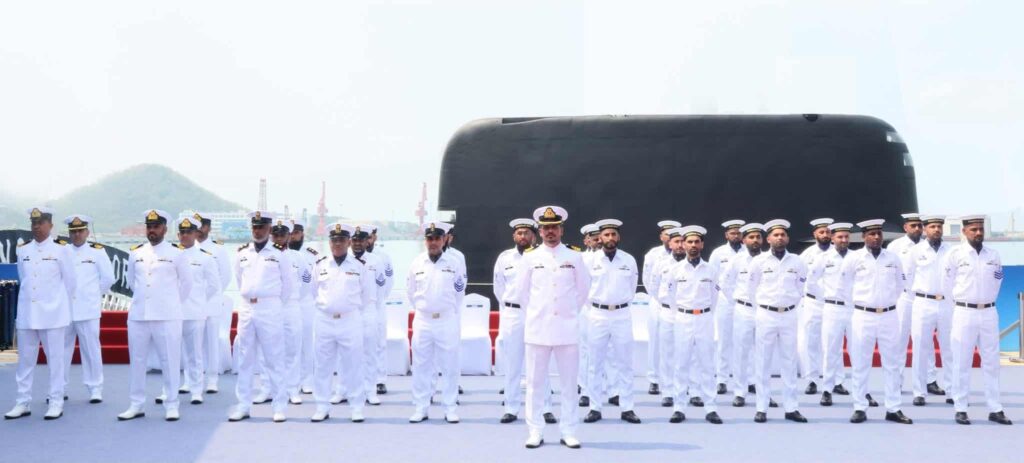
Updated 29 September 2026: This page now reflects PNS/M Hangor’s arrival at Karachi in June 2026 and its test-firing of a CM-708UNB anti-ship cruise missile on 27 September 2026, which confirms the Hangor-class’s anti-ship missile armament.
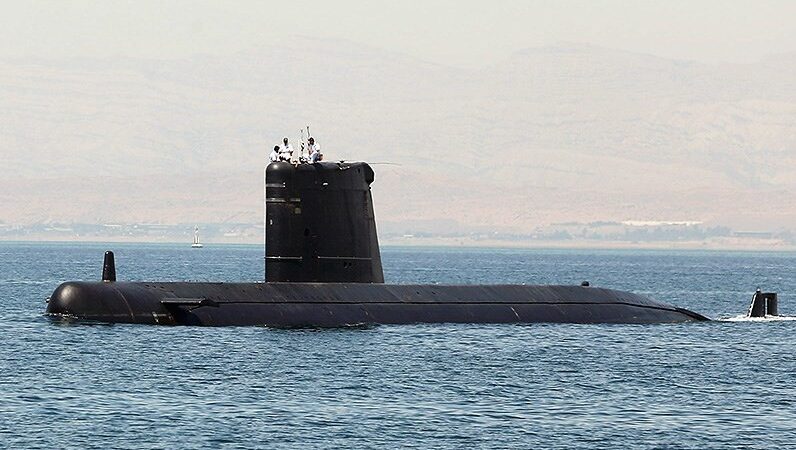
The Hangor-class is a conventionally powered, air-independent propulsion (AIP)-equipped submarine built for the Pakistan Navy (PN) by China. It is based on the China Shipbuilding & Offshore International Co. Ltd (CSOC) S26 export design – itself derived from the People’s Liberation Army Navy’s (PLAN) Type 039A/B Yuan-class – and displaces 2,800 tons at 76 m in length, making it the largest submarine the PN has operated. These specifications were disclosed by Karachi Shipyard & Engineering Works (KSEW) at the 2018 International Defence Exhibition and Seminar (IDEAS) in Karachi, where KSEW displayed a scale mock-up alongside a specifications sheet.
The PN ordered eight Hangor-class boats in 2015 under a deal reported by the Financial Times at $4–5 billion. Four are being built at Wuchang Shipbuilding’s Shuangliu Base in Wuhan, and four at KSEW under a transfer-of-technology (ToT) arrangement. The lead boat, PNS/M Hangor, was commissioned at a ceremony in Sanya, China, in May 2026, with President Asif Ali Zardari in attendance alongside Chief of the Naval Staff (CNS) Admiral Naveed Ashraf – an event covered in detail by Quwa.
The Hangor-class is not a nuclear-powered submarine. It uses a Stirling-cycle AIP system for extended submerged operations. The PN has indicated that its conventional submarine fleet will be reserved for anti-ship warfare (AShW) and anti-submarine warfare (ASW), with any future sea-based nuclear deterrent pursued through a dedicated platform – a distinction Quwa explored in its analysis of Pakistan’s pursuit of a sea-based nuclear deterrent. The Hangor-class is one of several submarine types operated by the Pakistan Navy.
Program Origins
The Hangor-class program traces its roots to the collapse of a separate deal. In the late 2000s, the PN had been negotiating with Germany’s Howaldtswerke-Deutsche Werft (HDW) for three Type 214 submarines equipped with fuel-cell AIP. That program, valued at approximately 1.2 to 1.3 billion euros, fell apart between 2009 and 2011. As Quwa’s reporting on how the West handed Pakistan’s air power bid to China documented, the failure owed to a convergence of Pakistan’s post-2008 fiscal crisis and Germany’s reluctance to extend financing – a pattern that repeated across multiple Pakistani defence procurements from Western suppliers during this period.
The PN subsequently opened talks with CSOC for a new fleet of AIP-equipped boats. In April 2015, the Pakistani government approved the purchase of eight submarines – two more than the six originally discussed. The Ministry of Defence Production (MoDP) initially designated the program as the ‘S20,’ though the boats would later be identified as derivatives of CSOC’s S26 export design. In August 2016, the Chief Project Director of the PN’s new submarine program disclosed to the National Assembly’s Standing Committee on Defence that the first four boats were due in 2022–2023 and the remaining four by 2028 – a timeline that would later slip.
In January 2017, the then-CNS, Admiral Muhammad Zakaullah, announced that the new submarines would be christened the Hangor-class. The name honours the original Daphné-class boat PNS Hangor, which in 1971 sank INS Khukri – the first submarine kill of a warship since the Second World War.
The program hit a major disruption when Germany refused to issue export licences for the MTU 12V 396 marine diesel engines originally specified for the submarines. According to Republic World and Defense News, the ban followed a 2021 discovery that MTU engines had been supplied for use on Chinese warships in violation of the EU arms embargo – a restriction that applied to China as the manufacturing and delivery partner, not to Pakistan directly. The decision forced CSOC to substitute Chinese-made CHD620 diesel engines – a licensed derivative of the MTU 396 design. Thailand’s parallel S26T program faced the same engine substitution, and its navy initially declined to approve the CHD620 until China completed over 6,000 hours of bench testing. Pakistan did not conduct or publish an equivalent independent evaluation, a point Quwa explored in its analysis of how the Hangor program has been shaped by setbacks. The COVID-19 pandemic compounded those delays further.
Specifications
The Hangor’s known specifications come from two primary sources: KSEW’s display at IDEAS 2018 in Karachi, and CSOC’s published S26 export marketing data – the latter disclosed at defence exhibitions including IDEX 2017 in Abu Dhabi, which Quwa covered at the time.
At 2,800 tons displacement and 76 m in length, the Hangor is heavier than the S26 baseline (2,550 tons, 77.7 m) but slightly shorter. KSEW’s IDEAS 2018 specifications sheet listed a draught of 6.2 m and a surfaced speed of 10 knots. It did not disclose maximum submerged speed or range. The S26 baseline, as marketed by CSOC, has a maximum diving depth of 300 m, a maximum submerged speed of 17 knots, and an endurance of up to 65 days at sea when alternating between diesel-electric and AIP propulsion – figures confirmed by Asian Military Review’s reporting on the S26T variant built for Thailand.
The reasons for the Hangor’s heavier displacement have not been officially explained. Given that the hull is shorter than the S26 reference design but 250 tons heavier, the additional mass likely reflects hull-form modifications, subsystem changes, or reinforced structures to accommodate the PN’s specific operational and weapon-integration requirements.
The Hangor features six torpedo tubes – likely 533 mm in diameter – configured to deploy heavyweight torpedoes, anti-ship cruise missiles (ASCM), and submarine-launched cruise missiles (SLCM). The torpedo tube count matches the S26 baseline and is consistent with the Yuan-class family. Army Recognition, citing open-source analysis of the Hangor’s design, estimated a crew of approximately 38 with berths for up to eight additional special forces personnel – consistent with the S26T’s published crew figures.
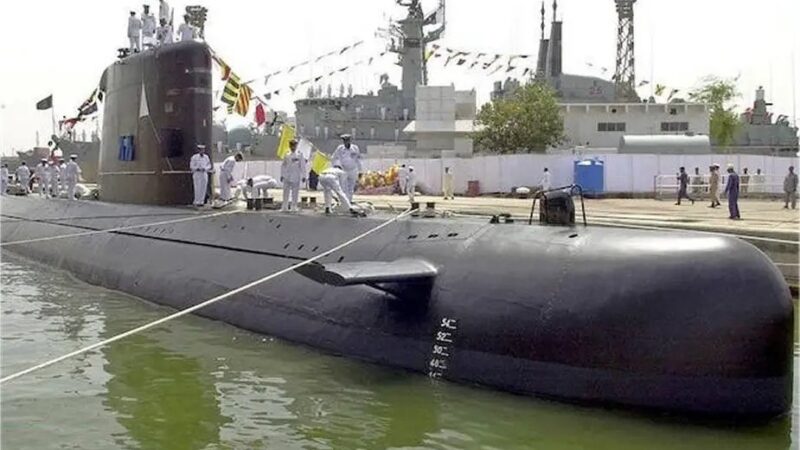
In comparison, the PN’s existing Khalid-class (Agosta 90B) submarines displace 2,083 tons submerged and measure 76.2 m in length. The Hangor is roughly 700 tons heavier – a weight class that reflects a submarine designed for longer-endurance, open-ocean patrols rather than primarily littoral operations. As Quwa’s analysis of Pakistan’s submarine fleet modernization has noted, this size distinction signals the PN’s intent to shift from a nearshore defensive posture to a blue-water A2/AD capability.
Air-Independent Propulsion
The Hangor uses a Stirling-cycle AIP system. The Stirling engine burns a carbon fuel source in the presence of stored liquid oxygen to generate electricity and power the boat’s motors without consuming atmospheric air. This enables the submarine to operate submerged without snorkelling for potentially several weeks – a figure consistent with the S26T’s published 20-day AIP-only endurance at low speed, per Asian Military Review.
This is a critical capability. A conventional diesel-electric submarine must periodically rise to snorkelling depth to run its diesel engines and recharge its batteries. During those windows, the boat is exposed to detection by maritime patrol aircraft (MPA), surface ships, and satellite-based sensors. AIP removes much of that exposure.
The PN is not new to AIP. Its three Khalid-class boats use the French MESMA (Module d’Énergie Sous-Marine Autonome) system, which operates on a similar closed-cycle principle but uses ethanol and oxygen combustion rather than a Stirling engine. PNS/M Hamza – the third Khalid-class boat, assembled at KSEW – was the first Agosta 90B globally to be built with MESMA from the outset.
The two AIP approaches carry different trade-offs. Stirling engines introduce more dynamic moving parts than the MESMA closed-cycle steam turbine, creating a potential acoustic signature – a relevant variable in the warm, shallow waters of the Arabian Sea where ambient noise conditions differ from the colder, deeper waters where many European AIP submarines were designed to operate. However, as the hosts of Quwa’s Defence Uncut podcast discussed in their May 2026 analysis of the Hangor’s design, the submarine’s double-hull construction appears to compensate for this through improved acoustic insulation – a design feature inherited from the Yuan-class family.
In comparison, the fuel-cell AIP that would have accompanied the abandoned Type 214 deal generates electricity with virtually no moving parts, offering the quietest signature of the three systems. That option was no longer available to the PN after Germany’s withdrawal.
The AIP system’s value lies in giving the PN a submarine that can hold a patrol station for weeks at a time in the deep waters of the Arabian Sea – far from the littoral zone where the PN’s smaller, older boats operate. The distinction between a diesel-electric submarine that must snorkel every few days and an AIP boat that can remain submerged for weeks is qualitative, not quantitative. It changes the character of the threat that adversary ASW forces must plan against.
Armament and Weapon Systems
The Hangor’s six torpedo tubes are its primary weapon interface. They are configured to fire heavyweight torpedoes, anti-ship cruise missiles, and submarine-launched cruise missiles. The PN has not officially confirmed the torpedo or SLCM types, though a September 2026 test-fire established the ASCM.
For the SLCM role, the Babur 3 is the expected weapon. On 9 January 2017, the Inter-Services Public Relations (ISPR) directorate announced the successful test of the Babur 3 from “an underwater, mobile platform.” ISPR described the weapon as having a range of 450 km and stated it would provide Pakistan a “credible second strike capability, augmenting deterrence.” As Defense News reported at the time, the test marked the first occasion on which an official Pakistani institution linked a sea-launched weapon to the concept of nuclear second strike. A second test followed in March 2018, with the Diplomat noting that ISPR released footage confirming the missile ejects horizontally through submarine torpedo tubes. The Khalid-class is widely assessed to have been the launch platform, given it was the only operational submarine type in the PN fleet at the time.
However, Quwa’s reporting on Pakistan’s pursuit of a sea-based nuclear deterrent – drawing on a May 2026 investigation by Drop Site News and on-the-record remarks by retired PN officials – indicates that the PN may have walked back the ‘hybrid model’ (where conventional submarines would carry nuclear-armed SLCMs) in favour of a clear firewall between conventional and nuclear platforms. Under this approach, the Hangor-class would be reserved exclusively for the AShW and ASW roles.
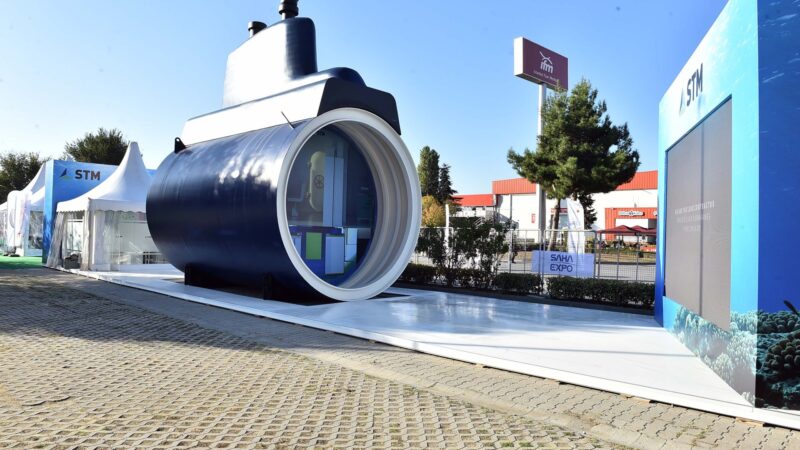
This firewall has industrial implications that Quwa examined in detail. The PN’s conventional submarine program involves partnerships with Western and allied suppliers – including Türkiye’s STM for the Khalid-class mid-life upgrade and potentially for the SWATS program. These partners are unlikely to participate in a program that could implicate them in nuclear weapons delivery. By clearly designating the Hangor as a conventional platform, the PN preserves access to the broader supplier base it needs for future classes.
For the ASCM role, the Hangor carries the CM-708UNB – an export variant of China’s YJ-82 family. On 27 September 2026, PNS/M Hangor test-fired a CM-708UNB in the North Arabian Sea, with the PN’s Directorate General of Public Relations (DGPR) footage identifying the missile and confirming the PN procured the munition alongside the submarines. The China Aerospace Science and Industry Corporation (CASIC) designed the CM-708UNB to launch from submarine torpedo tubes while submerged, with a stated range of 290 km.
The PN’s purchase mirrors Thailand’s S26T contract, which included the CM-708 anti-ship/ground-to-ground missile as a free-of-charge inclusion, per Thai defence media reporting on the contract structure. Quwa had assessed in 2016 that the CM-708UNB would likely accompany the PN’s new submarines.
For heavyweight torpedoes, the Yu-6 or an export derivative is the probable choice, consistent with the PLAN’s Yuan-class torpedo loadout. The PN has not officially confirmed the torpedo type.
Pakistan is also localizing submarine subsystems. According to Global Industrial and Defence Solutions’ (GIDS) product roadmap – referenced in Quwa’s Hangor program analysis – Pakistan is developing an automated deployment and retrieval system (ADRS) and electronic support measures (ESM) system for submarines. One can see these systems being configured for the Hangor fleet.
Program Status
PNS/M Hangor – the lead boat – was commissioned at a ceremony in Sanya, China, in May 2026. President Zardari attended as chief guest alongside CNS Admiral Naveed Ashraf. The commissioning caps a program that survived a decade of setbacks – supplier disruptions, pandemic-driven delays, and a forced engine switch.
The boat arrived at Karachi on 11 June 2026, where Commander Pakistan Fleet, Vice Admiral Abdul Munib, received it at the PN Dockyard. On 27 September 2026, PNS/M Hangor test-fired a CM-708UNB anti-ship cruise missile in the North Arabian Sea – the first publicly announced weapons firing by the class.
Production at Wuchang Shipbuilding’s Shuangliu Base moved forward at a steady clip from 2024 onward. The lead boat was launched for sea trials in April 2024. The second boat, PNS/M Shushuk, launched in March 2025. The third, PNS/M Mangro, launched in August 2025. The fourth, PNS/M Ghazi, launched in December 2025. According to the PN’s Director General of Public Relations (DGPR), all four Chinese-built boats had entered the “final stages of being handed over to Pakistan” by late 2025.
The four KSEW-built units are tracking behind the original schedule. The steel cutting ceremony for the fifth boat (first KSEW-built) took place in December 2021. The keel laying for the sixth was held in February 2025. The accumulated delays push a realistic timeline for the KSEW batch into the early 2030s.
To support submarine construction, KSEW installed a Ship Lift & Transfer System (SLTS) with two parking stations specifically allocated for submarine work, according to the MoDP’s 2022–2024 Yearbook – an investment noted in Quwa’s commissioning analysis.
The pace of fleet expansion is without precedent in the PN’s modern history. If all four Chinese-built boats are commissioned within 2026, the PN’s AIP-equipped submarine fleet would more than double in a single year – from three Khalid-class boats to seven. Managing this intake – in terms of crew training, maintenance infrastructure, and base capacity – represents a substantial institutional challenge. To prepare, Pakistan announced in 2020 that China would send a Yuan-class submarine on lease for training purposes.
Cost and Procurement
Reports pegged the deal at $4–5 billion, with the Financial Times first reporting the figure in 2015. It was unclear whether that sum covered only the eight submarines or also the four Type 054A/P frigates the PN subsequently ordered from China in late 2017 and early 2018 – a point Quwa noted in its original reporting on the frigate contracts.
Thailand’s order for its S26T submarine provides a per-unit reference. Bangkok signed a contract worth $393 million (13.5 billion Thai baht) for a single S26T in May 2017 – later expanded to a planned three-boat acquisition valued at approximately $1.04 billion. These figures, reported by Asian Military Review, suggest a per-unit cost of approximately $347 million for the base S26 design. The Hangor’s modifications – heavier displacement, different subsystem fits, and the four-boat ToT component at KSEW – likely raise the per-unit cost further.
The ToT arrangement is a significant element of the program’s value beyond the submarines themselves. KSEW’s experience assembling four Hangor-class boats builds submarine construction capacity that could serve future classes – including the planned shallow-water attack submarines (SWATS). This industrial lineage runs from the Agosta 90B (PNS/M Hamza assembled at KSEW in the 2000s) through the Hangor ToT batch, creating a stepwise capability build that the PN intends to leverage for indigenous submarine design.
Strategic Significance: Extending Pakistan’s A2/AD Lines
The Hangor-class is the centrepiece of the PN’s subsurface modernization. Once all eight boats are inducted, the PN will operate a combined fleet of at least 11 AIP-equipped submarines. As Quwa’s detailed analysis of how the Hangor-class reshapes Pakistan’s maritime A2/AD posture explained, the Hangor’s Yuan-class lineage – a platform designed for long-range, long-endurance operations in open waters – positions the PN to push its anti-access/area-denial lines deeper into the Indian Ocean. The contested maritime space shifts farther from the Pakistani coastline.
This represents a layered approach to subsurface warfare. The PN’s existing Khalid-class boats and the older Agosta 70 submarines would operate closer to Pakistani waters, defending the littoral zone and exclusive economic zone (EEZ). The Hangor fleet would take open-ocean, long-endurance patrols.
The planned SWATS program would add a third layer. If the SWATS boats materialize as small AIP-equipped submarines – a design in the 500 to 700-ton range, with Italy’s Fincantieri and Türkiye’s STM competing for the contract, as Quwa reported in its sea-based deterrent analysis – they would free the Hangor fleet from littoral duties entirely.
A fleet of 11 AIP-equipped submarines solves a basic arithmetic problem that Quwa’s Defence Uncut podcast discussed in its August 2025 analysis: the PN’s current fleet of five submarines cannot sustain a meaningful number of boats on patrol while cycling others through maintenance and crew rest. Eleven boats would allow the PN to maintain three to four on patrol at any given time.
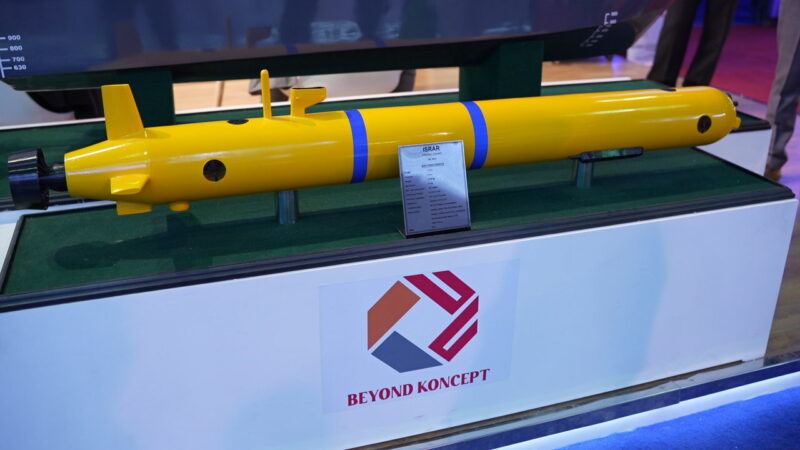
Future manned-unmanned teaming could pair Hangor-class boats with autonomous underwater vehicles (AUVs) for intelligence, surveillance, and reconnaissance (ISR) and mine countermeasures – extending the submarine’s sensor reach without exposing the manned platform.
The Hangor commissioning also brings into focus a longstanding question in Pakistani defence planning: budget allocation. As Quwa’s retrospective of PN surface combatants (2007–2026) demonstrated, the PN has simultaneously pursued multiple surface fleet programs alongside the submarine arm. However, as the retrospective argued, submarines are the PN’s primary AShW and ASW platforms – the assets most capable of threatening adversary combatants in a contested environment where surface ships are increasingly vulnerable. In this vein, one can see the PN treating the Hangor-class as its highest-priority conventional capability investment.
Hangor-Class vs Scorpène-Class (Kalvari)
The Hangor-class and the Indian Navy’s Kalvari-class (Scorpène) are the two newest conventional submarine types in South Asian waters. A factual comparison illustrates how both navies are structuring their sub-surface forces.
The Hangor is substantially larger. At 2,800 tons and 76 m, it outweighs the Kalvari – which displaces 1,775 tons and measures 67.5 m – by a significant margin. The Kalvari’s specifications, per its Wikipedia entry sourced from Indian Navy data, include a test depth of 350 m, six 533 mm torpedo tubes, and capacity for SM.39 Exocet ASCMs or 30 mines.
Both classes use AIP, but different systems. The Hangor uses Stirling-cycle; the Kalvari uses MESMA – the same system fitted to the PN’s Khalid-class. MESMA’s closed-cycle steam turbine has fewer dynamic moving parts than a Stirling engine, though the Hangor’s double-hull construction provides acoustic insulation that a single-hull design does not.
The armament picture diverges in one critical respect. The Kalvari can deploy the SM.39 Exocet ASCM and heavyweight torpedoes, and India has discussed integrating the BrahMos-NG supersonic ASCM in future variants. However, the Kalvari does not currently carry a land-attack cruise missile. The Hangor, by contrast, is expected to deploy the Babur 3 SLCM – giving the PN a submarine-launched land-attack capability that the Indian Navy’s conventional boats do not yet possess.
India ordered six Scorpène-class boats from Naval Group (formerly DCNS), all now commissioned. Pakistan ordered eight Hangor-class boats – meaning the PN will operate a numerically larger AIP submarine fleet than the Indian Navy’s Scorpène fleet.
However, the comparison must be placed in the context of each navy’s broader submarine force. India’s submarine arm also includes the Arihant-class SSBN, nuclear-powered attack submarines leased from Russia, and the older Sindhughosh-class (Kilo) and Shishumar-class (Type 209) boats. The Hangor does not compete in the nuclear submarine domain. India’s multi-tier fleet architecture (SSBN + SSN + SSK/SSP) differs from Pakistan’s currently single-tier structure (SSK/SSP), though the SWATS program could add a second tier.
The more relevant comparison may be at the fleet level. India has multiple submarine types to draw on. The PN will depend on the Hangor as its primary blue-water deterrent for the foreseeable future – making the Hangor’s value to the PN proportionally greater than any single Scorpène’s value to the Indian Navy.
Boat Names and Status
The PN has named all four Chinese-built boats, continuing its tradition of reusing historic submarine names from the Daphné-class era.
PNS/M Hangor – lead boat, commissioned May 2026 at Sanya, China; arrived at Karachi June 2026 and test-fired a CM-708UNB in September 2026. Named after the Daphné-class PNS Hangor (1967–2006), famous for sinking INS Khukri in 1971.
PNS/M Shushuk – second boat, launched for sea trials March 2025. Named after the Daphné-class PNS Shushuk (1970–2006).
PNS/M Mangro – third boat, launched August 2025. Named after the Daphné-class PNS Mangro (1970–2006).
PNS/M Ghazi – fourth boat, launched for sea trials December 2025. Named after PNS Ghazi, Pakistan’s first submarine – a Tench-class boat (ex-USS Diablo) acquired from the United States in 1964, lost during the 1971 war.
The four KSEW-built boats (fifth through eighth) have not yet been publicly named.
Recent Developments
September 2026 – PNS/M Hangor test-fires a CM-708UNB anti-ship cruise missile in the North Arabian Sea on 27 September, per PN DGPR.
June 2026 – PNS/M Hangor arrives at Karachi on 11 June and is received at the PN Dockyard by Commander Pakistan Fleet, Vice Admiral Abdul Munib.
May 2026 – Lead boat PNS/M Hangor commissioned at Sanya, China. President Zardari attended as chief guest alongside CNS Admiral Naveed Ashraf.
December 2025 – Fourth boat PNS/M Ghazi launched for sea trials at Wuchang Shipbuilding. PN DGPR stated all four Chinese-built boats are in the final stages of handover.
August 2025 – Third boat PNS/M Mangro launched at Wuchang Shipbuilding.
March 2025 – Second boat PNS/M Shushuk launched for sea trials at Wuchang Shipbuilding.
February 2025 – Keel laying ceremony for the sixth submarine (second KSEW-built) at Karachi.
April 2024 – Lead boat PNS/M Hangor launched for sea trials from Wuchang Shipbuilding’s Shuangliu Base in Wuhan.
December 2021 – Steel cutting ceremony for the fifth submarine (first KSEW-built) at KSEW.
April 2015 – Pakistani government approves purchase of eight AIP submarines from China.
Learn More
Pakistan Navy PNS/M Hangor Submarine Tests CM-708UNB Anti-Ship Missile – Quwa’s report on the Hangor-class’s first announced missile test and what the CM-708UNB adds to the PN’s submarine fleet.
Inside Pakistan’s New Hangor-Class Submarines – Quwa’s detailed analysis of the commissioning, design, capabilities, and strategic logic.
Extending Deterrence: How the Hangor-Class Reshapes Pakistan’s Maritime A2/AD Posture – Analysis of the fleet architecture shift from littoral defence to blue-water A2/AD.
Pakistan’s Pursuit of a Sea-Based Nuclear Deterrent – Why the PN is firewalling conventional and nuclear submarine programs.
How Pakistan’s New Shark (Hangor) Aims to Push India Away from the Arabian Sea – Defence Uncut podcast episode on the Hangor’s strategic implications.
Retrospective: Pakistan Navy Surface Combatants (2007–2026) – Context for the PN’s submarine vs surface fleet budget debate.
Multi-Billion Dollar Missteps: How the West Handed Pakistan’s Air Power Bid to China – The pattern of Western supplier withdrawals that drove the PN toward China.
Note: Quwa will update this page as the PN and KSEW disclose additional details.