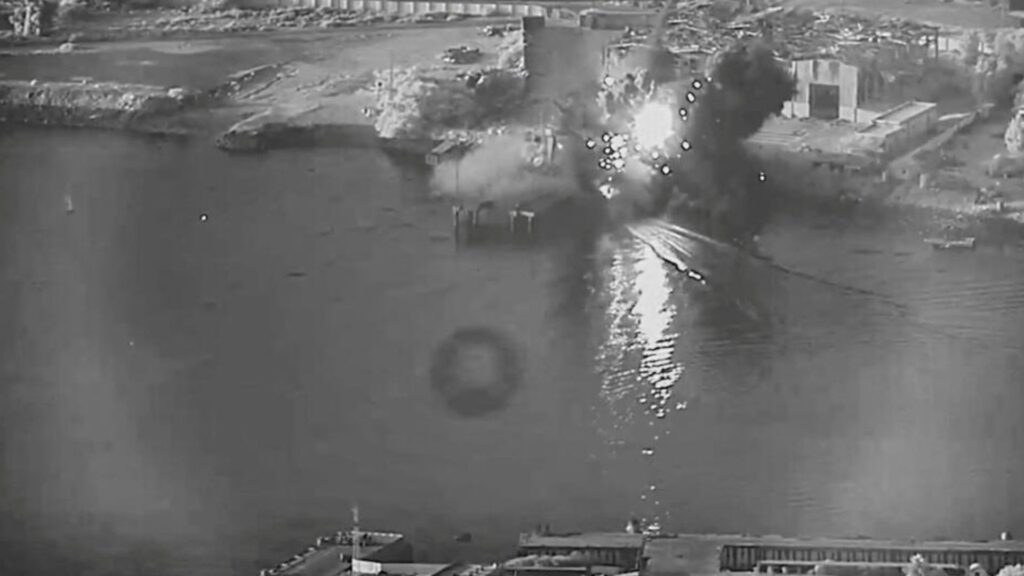
On 13 July 2026, the U.S. Central Command (CENTCOM) announced that three Saronic Corsair unmanned surface vessels (USVs) had struck submarine and ship-maintenance facilities at Iran’s Bandar Abbas Naval Base. It was the first acknowledged American combat use of a one-way attack (OWA) sea drone. The attack formed part of a wider wave involving combat aircraft, surface ships, and aerial OWA drones against Iranian air-defence, radar, missile, drone, and naval assets.
The Saronic Corsair is a 24-foot USV with a payload capacity of 1,000 lb, a range exceeding 1,000 nautical miles, and a top speed of over 35 knots. Saronic markets it as an attritable, networked, and configurable platform suited to intelligence, surveillance, and reconnaissance (ISR), maritime security, logistics, electronic warfare (EW), and strike work.
In December 2025, Saronic secured a $392 million U.S. Navy production contract, and the U.S. military subsequently deployed the Corsair to the Middle East for surveillance and security missions. In June, a Corsair also took part in the rescue of two U.S. Army aviators from a downed AH-64 Apache. Thus, the platform matured in the mundane roles well before it was used kinetically.
Overall, the Bandar Abbas attack demonstrates that a small, inexpensive boat can cross past a defended target’s protective envelope without exposing its crew or risking a major surface warship in the operation.
For the Pakistan Navy (PN), this is a working example of how USVs factor into littoral and anti-access and area-denial (A2/AD) warfare. Pakistan is already developing USVs and autonomous underwater vehicles (AUVs). However, the harder questions – i.e., the operational roles, production quantities, and the coastal defences needed to stop the same weapon when it is pointed the other way – remain unanswered.
Quwa Plus
Go Beyond the Headlines on Pakistan’s Defence and Security.
Quwa Plus gives you deeper reporting, briefings, and analysis on Pakistan’s defence programs, foreign policy, national security, and regional strategy. Follow the developments that matter to professionals, analysts, and serious readers tracking Pakistan’s security landscape.
Join ($29.99/Year) Already a subscriber?Sign in