
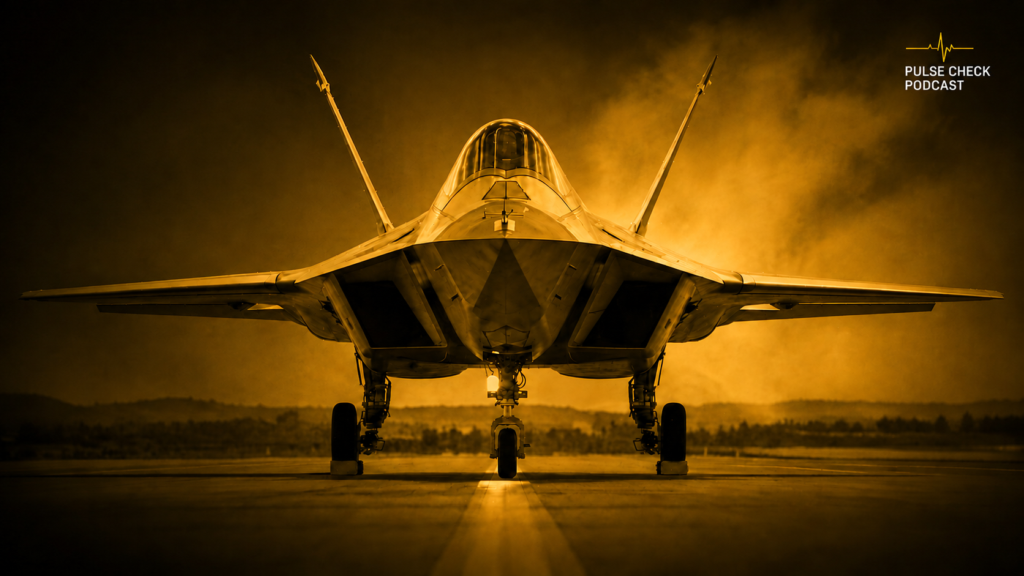
Turkish Aerospace Industries (TUSAŞ) has run the first taxi test of P1, the second KAAN prototype and the first airframe assembled as a fully integrated test article.
TUSAŞ is targeting first deliveries to the Turkish Air Force by the end of the decade, with Block 30 aircraft flying on the indigenous TEI TF35000 turbofan from around 2033.
That timeline places KAAN directly inside the Pakistan Air Force’s (PAF) requirement to replace its oldest F-16A/B Block-15 airframes by 2040 – a competition it now shares with China’s Shenyang J-35AE.
The latest episode of Pulse Check takes up the question that has trailed the program since 2016. What did Pakistan give up by pursuing Project AZM in parallel rather than joining what was then TF-X?
Bilal Khan is joined by Aseem, who has worked closely with both the Turkish and Pakistani aerospace sectors. His answer, argued over the length of the episode rather than asserted at the top, is that Pakistan should have joined.
Pulse Check is exclusive to Quwa Plus and Quwa Pro subscribers.
Subscribing gives you the full episode, the complete Pulse Check and Defence Uncut archives, and Quwa’s ongoing analysis of Pakistani, Turkish and Gulf procurement – including the forthcoming assessment of what the Makkah Joint Defence Agreement means for Pakistan’s access to Turkish industry.
What Türkiye Actually Built
Aseem’s central claim is that Türkiye succeeded because it gave TF-X the same standing that Pakistan once gave its nuclear program – national priority, sustained funding, and engineers rather than administrators in charge.
He does not offer that comparison loosely. He made the same argument in his own writing on AZM years ago, and the episode works through why it holds.
The evidence sits in how TUSAŞ organized itself.
Its unmanned aerial vehicle, aircraft, helicopter and space divisions each carry multiple programs, while TF-X was given a dedicated division of its own.
Around it, Türkiye built new factories and wind tunnels and put sustained money into human resource development.
In this vein, the upstream work mattered as much as the airframe – alloys, gas turbines, composites, and at one point a TUSAŞ general manager remarking that the company might have to build its own ejection seat.
Türkiye also recognized the limits of its own base and contracted BAE Systems to lend it a workforce to learn from.
Its NATO membership did the rest, opening access to technologies and supplier relationships Pakistan has never had.
Get the Full Picture on Pakistan’s Defence and National Security
Get dedicated Pakistani defence news, force analysis, procurement tracking, and national security policy insight, backed by more than a decade of documented reporting and depth general news coverage cannot match.
The Pakistani Engineers at TUSAŞ, Explained Properly
The several hundred Pakistani engineers working at TUSAŞ have been persistently misread as evidence of official PAF or Pakistan Aeronautical Complex (PAC) participation in the program.
They are not.
Most arrived through BAE Systems, which asked its own workforce who wanted to go to Türkiye and found a large number of Pakistani-origin engineers – many of them British citizens, some second or third generation, several who had never lived in Pakistan.
TUSAŞ hired directly and globally, drawing from Pakistan, the United States and the United Kingdom, and maintains a subsidiary office in Pakistan for extended support work.
A separate and much smaller cohort did come through an arrangement with Pakistani state-owned enterprises. Aseem declines to put a figure on it, but is clear it was well short of the numbers circulated publicly.
What made any of this possible was a security decision. TUSAŞ partitioned the aircraft, opening roughly 80 per cent of its parts to engineers from anywhere while restricting radars and electronic systems to Turkish nationals working through ASELSAN and TÜBİTAK.
That is a different posture from the F-35, where citizenship and clearance gate the entire program – and it is precisely what let Türkiye recruit at scale.
Why 2016 Was the Window
Türkiye began inviting Pakistan into the program from at least 2016, and Quwa has recommended taking that offer since the same year.
The argument was never hindsight. It rested on a simple observation – there was no reason to run an identical program in parallel when a partner was willing to carry the industrial burden.
Had Pakistan joined in 2016 or 2017, when program risk was highest and the price of entry lowest, the co-production, offset and technology-sharing terms available would have been considerably better than anything on offer today.
One can see how that would have compounded.
Bilal argues TUSAŞ’s second-largest unit might sit in Pakistan by now, absorbing the engineering and scientific graduates the country currently exports.
NESCOM could have taken the unmanned combat aerial vehicle (UCAV) role in the loyal wingman effort, a capability Pakistan is only now building toward.
Two things got in the way, in his reading.
Pakistani decision-makers misjudged Türkiye’s capacity, framing TUSAŞ as an assembly operation no better than PAC – an impression that collapsed for anyone who actually visited Ankara.
And the decision itself was taken without transparency, or any outside expertise weighing in. Quwa has covered why Project AZM failed before, but this episode approaches it from the Turkish side of the table.
Related reading
The Constraint PAC Cannot Engineer Around
Aseem’s account of those visits runs the other way as well.
TUSAŞ delegations toured PAC and its Aircraft Manufacturing Factory (AMF), saw the computer numerical control (CNC) machines cutting JF-17 Thunder parts, and concluded Pakistan could manufacture components for KAAN.
What they were not shown was the constraint beneath the machines.
Pakistan does not produce the raw materials those parts are made from – they arrive from China – and prohibited import lists would block Pakistan from sourcing them elsewhere even with the money to do so.
Aseem’s characterization is that AMF functions as a Chinese factory inside Pakistan rather than a Pakistani factory building Pakistani aircraft.
Bilal’s response is where the episode turns from diagnosis to argument.
The nuclear program faced exactly this problem, and Pakistan answered it by treating the Pakistan Atomic Energy Commission (PAEC) as a national champion and forcing indigenous development of the alloys and forging capability it could not import.
Khan Research Laboratories began on the metallurgical side of that effort. Descon and other private firms cut their teeth on the same work, through what amounted to an early public-private partnership.
Thus the constraint was never that export controls made an aerospace base impossible. Türkiye hit the same wall, because nobody sells stealth-grade alloys to anyone.
The constraint was that Pakistan stopped.
Once the nuclear program cleared its security threshold, the horizontal economic work that should have followed into gas turbines, alloys and composites never received the same attention.
What This Means for 2030 and 2040
None of this is settled history, because a version of the same decision is in front of the PAF again.
Its next procurement cycle opens around 2030, and the F-16A/B replacement question will be answered inside it.
KAAN and the J-35AE are both live options, and the terms Pakistan can secure on either will depend on how early it commits and what it brings to the table.
That is where the Makkah Joint Defence Agreement becomes relevant.
The trilateral arrangement between Pakistan, Saudi Arabia and Türkiye offers a capacity-building path that could give Islamabad a route into Turkish programs it declined a decade ago – this time with Gulf capital attached.
One could see that shifting the terms available on KAAN considerably.
Whether Pakistan moves on it is a separate question, and the record since 2016 is not encouraging.
Listen to the Full Episode
The full conversation runs well past this summary. Aseem walks through what TUSAŞ delegations were actually shown at PAC and what they missed, the security partitioning that opened KAAN to foreign engineers, and the five-engineer test he argues would have settled Pakistan’s AZM-or-TF-X question in a single week.
Quwa Plus · In-Depth Pakistan Coverage
Understand Pakistan’s Defence and National Security in Unmatched Depth
Understand what Pakistan is acquiring, how its armed forces are evolving, and where national security policy is heading through dedicated defence news, force analysis, procurement tracking, Pulse Check briefings, and more than a decade of documented reporting.
Featured & Trusted By