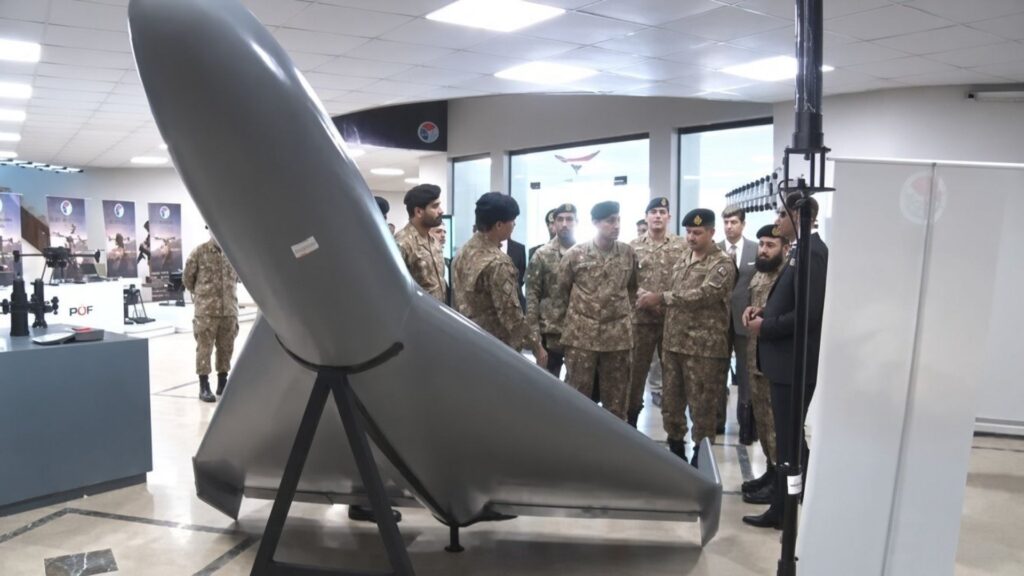
On 29 August, the Pakistan Army Chief of Army Staff (COAS) and Chief of Defence Forces (CDF), Field Marshal Asim Munir, visited Pakistan Ordnance Factories (POF).
While reviewing POF’s projects – e.g., from a new gas-operated assault rifle to new quadcopter-compatible drop munitions – the CDF was also briefed on a tailless delta loitering munition similar in concept to Iran’s Shahed-136. This would be at least the second munition of this type under development in Pakistan, with the other being the Heavy Industries Taxila (HIT) D-248, which has a stated range of 2,200-3,000 km.
The actual ranges of these new munitions are yet to be validated or verified, but the information provided (if only for marketing purposes) and other news (i.e., Ukraine’s Fire Point promoting the FP-1) showcase how the Pakistan Army is looking to shape its long-range strike capability.
Basically, the Army’s desired ‘reach capacity’ likely calls for munitions with ranges of 2,000-3,000 km, with low-cost, piston-powered one-way-attack (OWA) drones being a key component. Thus, both state-owned enterprises (SOEs) – e.g., HIT and POF – and private sector-led partnerships (e.g., Fire Point) are actively competing for an apparent bid. If the goal is to emulate Russia, Ukraine, and Iran in their scale-heavy and mass-salvo strategies, then one can expect the Army seeking large numbers of these long-range OWAs to build a large stockpile and wartime production capacity for replenishment.
So, in this context, domestic production via technology transfers and indigenization is expected. However, it will be worth seeing which entities take on the production work, specifically whether they are new private sector entrants or established SOEs. On paper at least, the recently formed Defence Industrial Production and Regulatory Authority (DIPRA) promises pathways for the private sector to pursue this opportunity (i.e., a requirement that could span tens of thousands of units, if not more). So, the private Pakistani company speaking to Fire Point is looking to co-market and manufacture the FP-1 for this requirement.
Quwa Plus
Go Beyond the Headlines on Pakistan’s Defence and Security.
Quwa Plus gives you deeper reporting, briefings, and analysis on Pakistan’s defence programs, foreign policy, national security, and regional strategy. Follow the developments that matter to professionals, analysts, and serious readers tracking Pakistan’s security landscape.
Join ($29.99/Year) Already a subscriber?Sign in