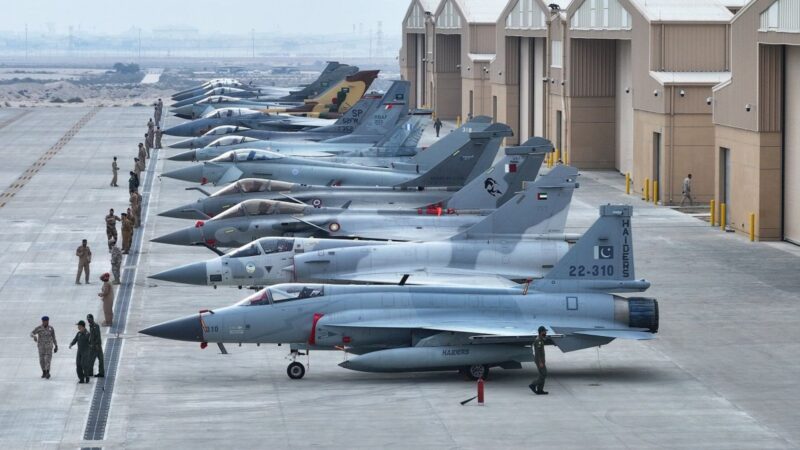

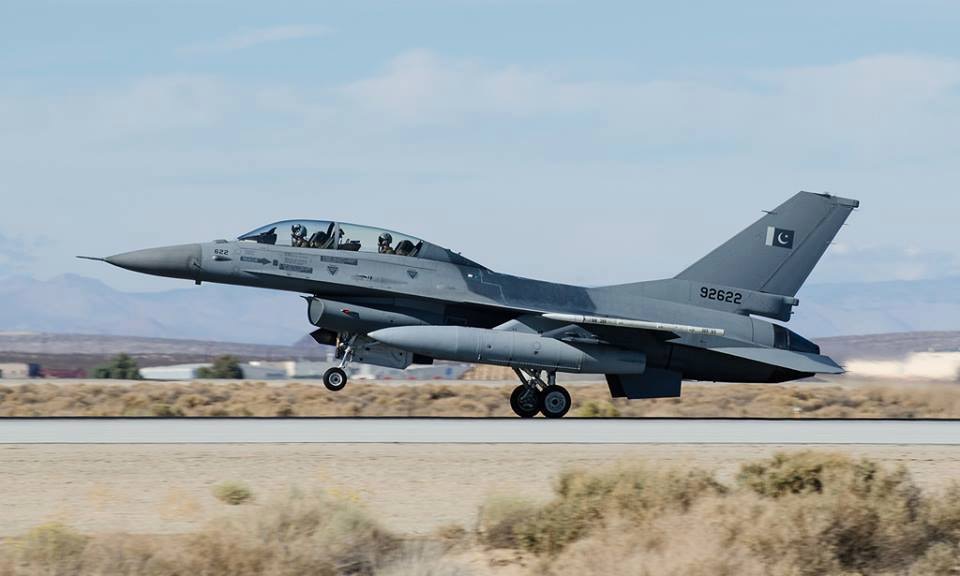
Pakistan’s three F-16A/B Block-15 squadrons are scheduled to retire by 2040, with no service life extension left to keep them flying past that point. That timeline sets up the Pakistan Air Force’s (PAF) largest fighter decision in a generation.
The retirement date is effectively confirmed by the $686 million support and upgrade deal Pakistan signed with the United States in December 2025, aimed largely at keeping the F-16 fleet viable through the 2030s.
The latest episode of Defence Uncut – Quwa’s Pakistani defence news and commentary podcast, hosted by Bilal Khan and Arslan Khan – works through the question that follows. The common assumption is that the Shenyang J-35 stealth fighter simply steps in, but the hosts explain why the real answer is more complicated.


A Mainstay With Big Shoes to Fill
The F-16 is the PAF’s mainstay multi-role fighter, valued less for any single capability than for its reliability and consistently high availability. It is the aircraft air headquarters can count on for any mission, and it integrates alongside JF-17 Thunder and J-10C formations.
Given that role, the replacement question is not simply about which fighter looks best on paper. As the episode frames it, the PAF must find an aircraft capable of performing the specific jobs the F-16A/Bs perform across three squadrons and roughly 50 to 55 airframes.
The F-16 also brings interoperability with NATO and with regional partners such as Saudi Arabia and Türkiye. That bridge to Western systems is a factor the PAF will weigh, even as it moves further towards Chinese platforms.
The J-35 vs. Western Options
The Shenyang J-35AE, offered through the Aviation Industry Corporation of China (AVIC), is the leading candidate – largely because it is the only fifth-generation aircraft currently on offer to the PAF.
Even so, the hosts caution that a stealth fighter does not automatically inherit the F-16’s workhorse role, since low-observable designs tend to carry smaller payloads and require more maintenance between sorties.
This is why the episode argues against writing off the Eurofighter Typhoon. Drawing on cost-per-flight-hour comparisons, the hosts contend that the Typhoon is not as prohibitively expensive as is often assumed, especially when a single Typhoon’s ability to carry heavy payloads over long ranges is weighed against several lighter aircraft.
The political objections are valid, however. Germany’s restrictions on integrating Pakistani munitions are a genuine obstacle, though the hosts note that interface solutions and Türkiye’s own new-build Typhoon order could be factors as well.
There is also a strong case for new-build F-16 Block 72s. The PAF already operates the Block 52, so inducting the closely related Block 72 would carry little transition difficulty, and the F-16 line is expected to support airframes into the 2070s.
Interestingly, the hosts suggest the PAF might prefer a Chinese heavyweight such as the J-16 if it were on offer, given that aircraft’s role as the People’s Liberation Army Air Force’s mainstay. That option is not on the table, and older strike platforms such as the JH-7B are treated as effectively dead ends.
Azerbaijan’s JF-17 Block III
The episode opens on a separate development: Azerbaijan showing off its newly inducted JF-17 Block III fleet. The nine aircraft were produced in 2024 and wear the same livery as the PAF’s own jets, appearing externally identical in configuration.
The hosts unpack the twin-seat JF-17B question, since those airframes were delivered in a Block II configuration despite being designed for Block III compatibility. They also weigh the prospect of Turkish weapons integration, carried out through Pakistan Aeronautical Complex (PAC).
For the PAF, an Azerbaijani-funded customization path could open new options for its own JF-17 fleet, and potentially for export. That is a thread worth watching as the Block III matures in a second operator’s service.
Watch the Full Episode
The full Defence Uncut episode goes deeper into the F-16 replacement debate, the cost realities of a Typhoon acquisition, and a wider discussion of Pakistan’s command structure and force disaggregation.
Given that the PAF’s next procurement cycle is set to open in the late 2020s and materialize through the 2030s, what replaces the F-16 could define the force for decades.
Listen to the full episode:
For the written market-intelligence version of this analysis, see Quwa’s coverage of the PAF’s next procurement cycle, available with Quwa Pro.