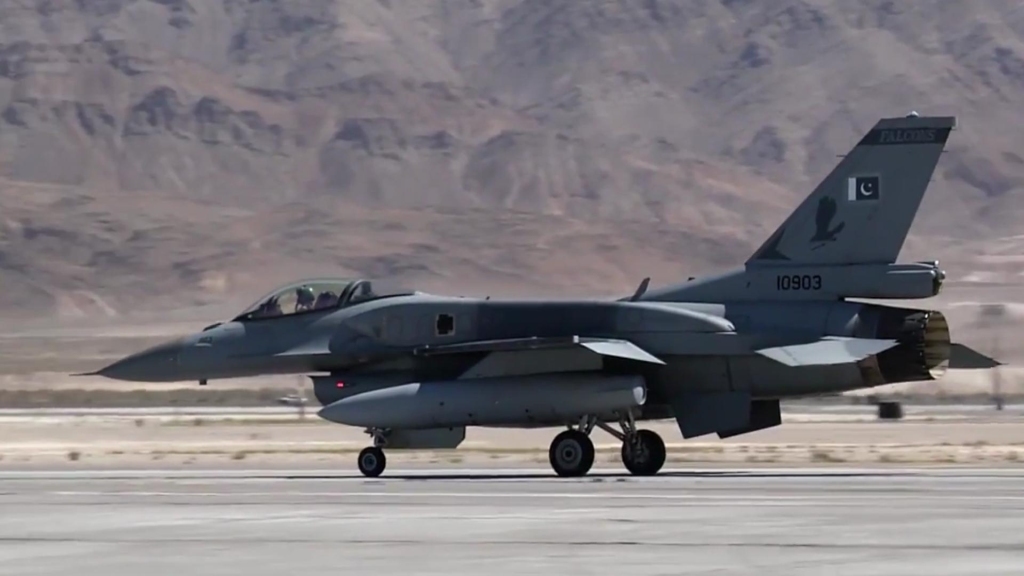
On 08 December, the U.S. Department of State cleared and submitted a proposal to Congress for the supply of defence articles valued at USD $686 million for the Pakistan Air Force’s (PAF) F-16 fleet.
The proposed package consists of 92 Link-16 tactical data-link (TDL) systems, six inert Mk82 general purpose bomb (GPB) bodies (used for training purposes), AN/APX-126 Advanced Identification Friend or Foe (AIFF) systems, KY-58M and KIV-78 cryptographic appliques, AN/APQ -10C Simple Key Loaders, ADU-891 missile adaptor units, and various other “weapons integration, test, and support equipment.”
Of the total $686 million, about $37 million will go toward the purchase of Major Defence Equipment (MDE), while the remainder, $649 million, will cover non-MDE items such as support and training.
According to the State Department’s submission to Congress, the deal will “extend the aircraft life [of the PAF’s F-16 fleet] through 2040 while addressing critical flight safety concerns.” The proposal also highlights that the update will continue enabling the PAF’s F-16s to interoperate with U.S. Air Force and other coalition fighters in combat operations, exercises, and training.
Related Reads
- Pakistan Air Force’s Shift to Satellites, Jamming, and Standoff Weapons
- How a US Mistake Handed Pakistan’s Arms Market to China.
- The Blueprint for Pakistan’s Future-Proof Air Defence System.
The proposal represents the first – albeit modest – genuine capability upgrade for the Pakistani F-16 fleet since the completion of the Peace Drive program, which saw the PAF induct 18 new-build Block-52 aircraft and upgrade its approximately 45 F-16A/B Block-15s.
The most notable element is the inclusion of 92 Link-16 TDL terminals, but with the AN/APX-126 AIFF system as well as KY-58M and KIV-78 cryptographic modules. This update likely aims to make the PAF F-16 fleet Mode 5 IFF (identification of friend-or-foe) interoperable and, as a result, bring the PAF F-16 fleet into compliance with NATO’s post-2020 IFF standards. In effect, this is the main component allowing the PAF’s F-16s to interoperate with U.S. and allied/coalition aircraft (such as the aircraft used in the Gulf or Turkey) for joint exercises or operations. At this point, the PAF’s F-16s can only operate from Mode 4 through their existing AN/APX-113s.
Quwa Plus
Go Beyond the Headlines on Pakistan’s Defence and Security.
Quwa Plus gives you deeper reporting, briefings, and analysis on Pakistan’s defence programs, foreign policy, national security, and regional strategy. Follow the developments that matter to professionals, analysts, and serious readers tracking Pakistan’s security landscape.